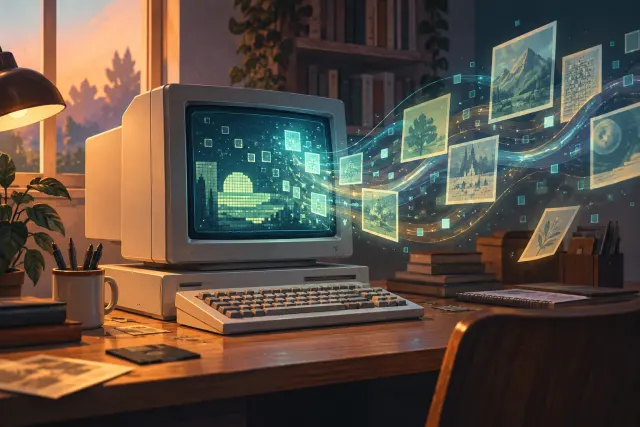
The home computer as a living document
Museums and archives are redefining the conservation of home technology by prioritizing digital functionality and usage context over the mere physical integrity of the hardware.
Open storyKeyboards, tapes and manuals opened up new ways to learn and create at home. This collection explores home computers as both machines and everyday objects, looking at how they were connected, expanded and used.
Readings to help you find your bearings.
Connections, storage and documentation help explain how a home computer was used, beyond what its technical specifications alone can tell us.
The focus here is hardware and its peripherals. Programs have their own place in Software, while connected services are covered in Internet.
Three perspectives on the archive.
Learning about home computers and finding your way through their documentation.
The home computer as a living document The 1980s Computer: More Than an Object, an Archive in ItselfWays to expand a computer and store information.
The Floppy Disk as Document: Beyond the Physical Medium The Apple IIc and the Disk Drive Built into the ComputerIdentifying machines and understanding their technical context.
From Spacewar! to Networked Worlds: How Each Setting Reshaped Video Games The open architecture of the IBM PC 5150 and the origin of the de facto standardThe 1990s transformed video games without replacing one platform with another overnight. 3D graphics, CD-ROMs, personal computers, and early networked communities broadened the medium, while arcades retained experiences that were difficult to reproduce at home.
Read articleThe National Archaeological Museum’s archive preserves written testimony of the museum’s institutional life from its founding in 1867.
Read articleMachines developed between 1942 and 1946 at the University of Pennsylvania used punched paper tape to input programs and data into memory, employing a teletype for outputting results.
Read articleIBM announced the development of the IBM 650 in 1953, a magnetic-drum computer aimed at businesses and universities.
Read articleThe MUNCYT website dates the beginning of the museum’s history—or, more precisely, the project to create it—to 1962.
Read articleSteve Russell and other MIT members developed Spacewar! for the PDP-1 computer, a two-player space combat game using vector graphics.
Read articleThe 1990s transformed video games without replacing one platform with another overnight. 3D graphics, CD-ROMs, personal computers, and early networked communities broadened the medium, while arcades retained experiences that were difficult to reproduce at home.
Announced in 1953, the IBM 650 made magnetic-drum memory the basis of an expandable commercial system. Its story links IBM’s organizational changes to new business uses and the growth of university computing education.
On August 12, 1981, IBM presented its personal computer in Manhattan. This article analyzes how an internal decision within the General Products Division led to a de facto standard that transformed the technology industry.
The Macintosh 128K brought a graphical interface to the home and office desk with an integrated screen, a mouse and programs such as MacPaint and MacWrite. Its compact design also imposed limits: little memory, one floppy drive and workflows shaped by disk swaps and peripherals.
Introduced in 1981, the IBM PC did not invent personal computing, but it helped win corporate acceptance and established a reference other manufacturers could reproduce. Its expandable architecture fostered a compatible-computer ecosystem and reshaped the everyday relationship between computers, peripherals, and users.
In 1962, Steve Russell and others in the MIT community created Spacewar! for the PDP-1. Its duel between two ships made the university computer more than a calculating tool: it also became a gathering place for competition and experimentation with digital play.
The IBM PC did not invent the personal computer, but IBM’s name helped establish it as a credible business tool. Its rapid development around third-party components and software made compatibility the foundation of a platform the company would no longer control on its own.
Video game history is more than a succession of increasingly powerful machines. Shared computers, arcades, home systems, and networks encouraged different rhythms and rules, from text-based exploration to repeatable action and persistent multiplayer worlds.
The 1981 launch of the Model 5150 did not just introduce Intel 8088-based hardware, but established the foundations of the compatible platform by opening its design to third parties.
Museums and archives are redefining the conservation of home technology by prioritizing digital functionality and usage context over the mere physical integrity of the hardware.
The shift to accessible graphical interfaces transformed the computer from an expert tool to a daily object. This analysis examines the cultural and technical impact of Windows 95 on the maturity of home software.
Analysis of how hardware limitations and the shift to graphical interfaces defined the learning curve of Autodesk 3ds Max in its DOS release.
Editorial review ·