From arcades to multiple places to play
In the 1990s, playing games became less tied to one machine or setting. Arcades still brought people together for short, competitive sessions, with cabinets and controls designed around individual titles. Consoles brought experiences once associated with arcades to the living-room television, while personal computers supported different genres, rhythms, and forms of distribution. This was not a tidy handover but an uneven coexistence of platforms.
Arcades offered an early showcase for real-time polygonal graphics. Sega’s Virtua Racing (1992) and Virtua Fighter (1993) showed that 3D could change not only how a game looked, but how players understood space and movement in a race or a fight. Later, PlayStation, Sega Saturn, and Nintendo 64 brought different approaches to 3D into homes. Their capabilities and libraries varied, and 3D did not immediately erase earlier techniques.
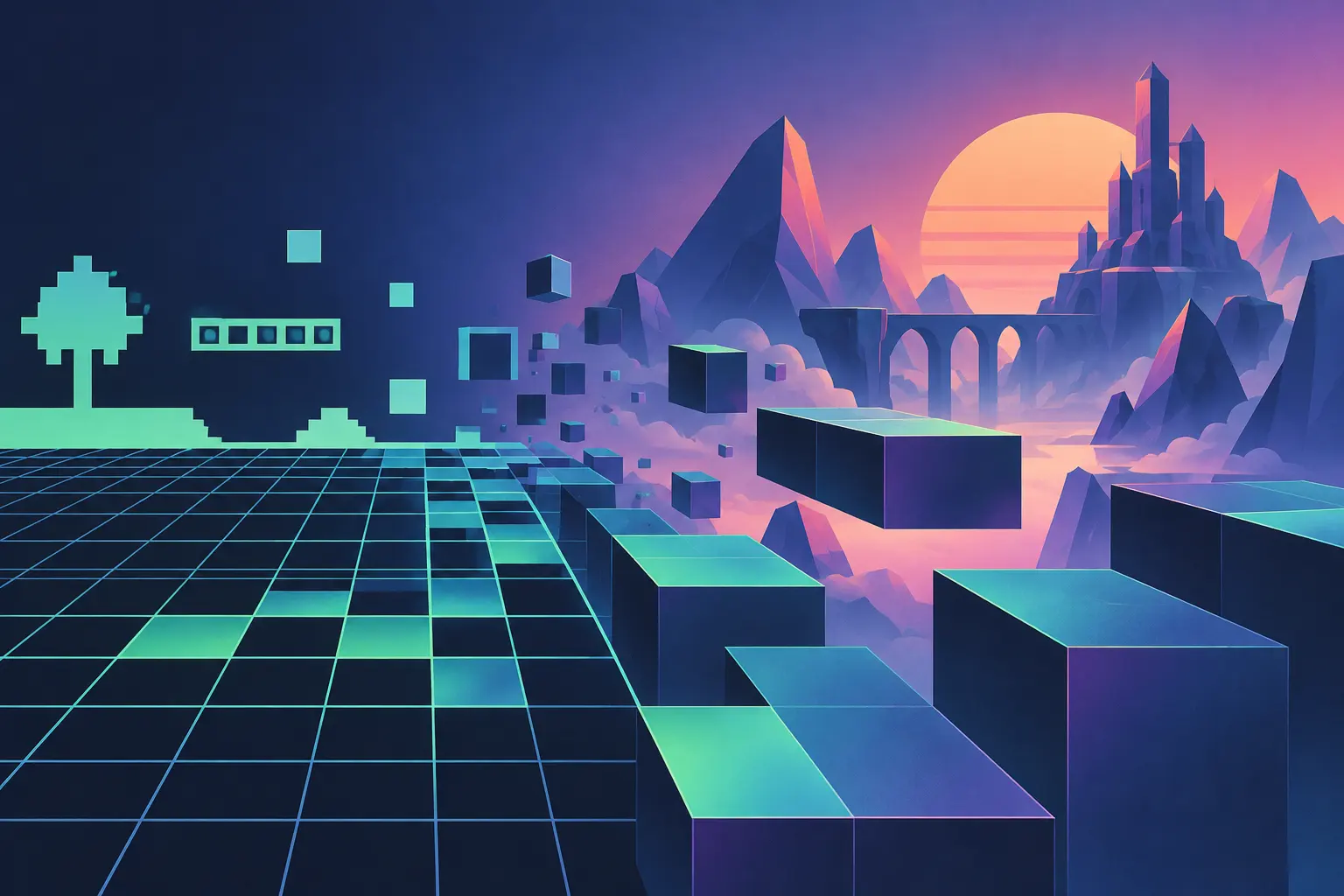
Before home consoles could readily render polygonal worlds, many games created depth through layered backgrounds, scaled sprites, or techniques such as the Super Nintendo’s Mode 7. For years, two-dimensional imagery and three-dimensional spaces existed side by side. Perspective was a design choice, shaped by what a game wanted players to see and do.
Computers and a wider range of genres
On personal computers, id Software’s Wolfenstein 3D (1992) and Doom (1993) consolidated a form of first-person action built around fast movement and responsive environments. Their settings had technical limits and were not unrestricted 3D spaces, but they established recognizable conventions for the genre. Doom’s shareware circulation—offering part of the game to try before buying the full version—also demonstrated a distribution route distinct from traditional retail.
The computer was not just a home for action games. Myst (1993) built exploration and puzzles around pre-rendered scenes; CD-ROM capacity made it possible to include imagery and audiovisual sequences that were difficult to fit on lower-capacity formats. In a different direction, Civilization and SimCity placed planning, management, and experimentation at the center of play. The decade expanded the medium’s repertoire not through one formula, but through experiences that asked for different skills and kinds of attention.
CD-ROM expands production possibilities
Compared with cartridges, CD-ROM offered more room for music, video, and extended narrative sequences. It also brought choices about cost, manufacturing, and access to content. PlayStation made optical media central to its proposition, while Nintendo retained cartridges for the Nintendo 64. The contrast shows that a format was more than a container: it shaped how games were produced and what players expected from their presentation and scale.
Released for PlayStation, Final Fantasy VII (1997) combined pre-rendered sequences with three-dimensional characters and settings. Its significance illustrates how a medium could support narrative ambition and platform strategy at the same time. Cinematic-looking sequences did not replace play; they formed part of a presentation that moved between story, exploration, and combat.
Arcades did not disappear
The spread of home consoles and more capable computers reduced the centrality of many arcades, but did not end arcade play. Where the cabinet and specialized controls were integral to the experience, arcade machines retained an advantage: driving cabinets, light guns, and music games offered interactions that were difficult to reproduce at home. Some venues broadened their entertainment offerings; traditional arcades, meanwhile, came to depend more on enthusiasts and specialist spaces.
The social dimension diversified as well. MUDs and other connected games let people in different places share sessions and worlds, first through text and later with increasingly elaborate visuals. Ultima Online (1997) brought massively multiplayer role-playing to notable commercial scale, but it did not create networked play from nothing: it extended ideas and practices cultivated in earlier systems and communities. Connectivity added another option to an already varied landscape: competing with someone in the same room, exploring alone, or taking part in a shared world.
A decade of parallel paths
The history of the 1990s is not a straight line from the arcade to online play, or from flat graphics to 3D. Consoles brought certain experiences to more homes; computers favored strategy, adventure, and routes such as shareware; arcades sustained forms of play tied to physical presence and specialized controls. The decisive change was the expansion of video games’ language and of the contexts in which people played. New technologies opened possibilities, but no single platform or technique displaced all the others.
- Decade
- 1990s
- Region
- Global
- Level
- Enthusiast
- Entities
- Salón recreativo, PlayStation, Nintendo 64, Sega, Nintendo, Doom, Virtua Fighter, Ordenadores personales
Sources and references
- Historia de los videojuegostranslate.google.com · 2026-11-09
- Historia de los videojuegos - Wikipedia, la enciclopedia librees.wikipedia.org · 2026-11-09
- 10.2: La evolución de los juegos electrónicosespanol.libretexts.org · 2026-11-09
- Videojuego de aventuraes.wikipedia.org · 2026-11-09
- Género de videojuegoses.wikipedia.org · 2026-11-09