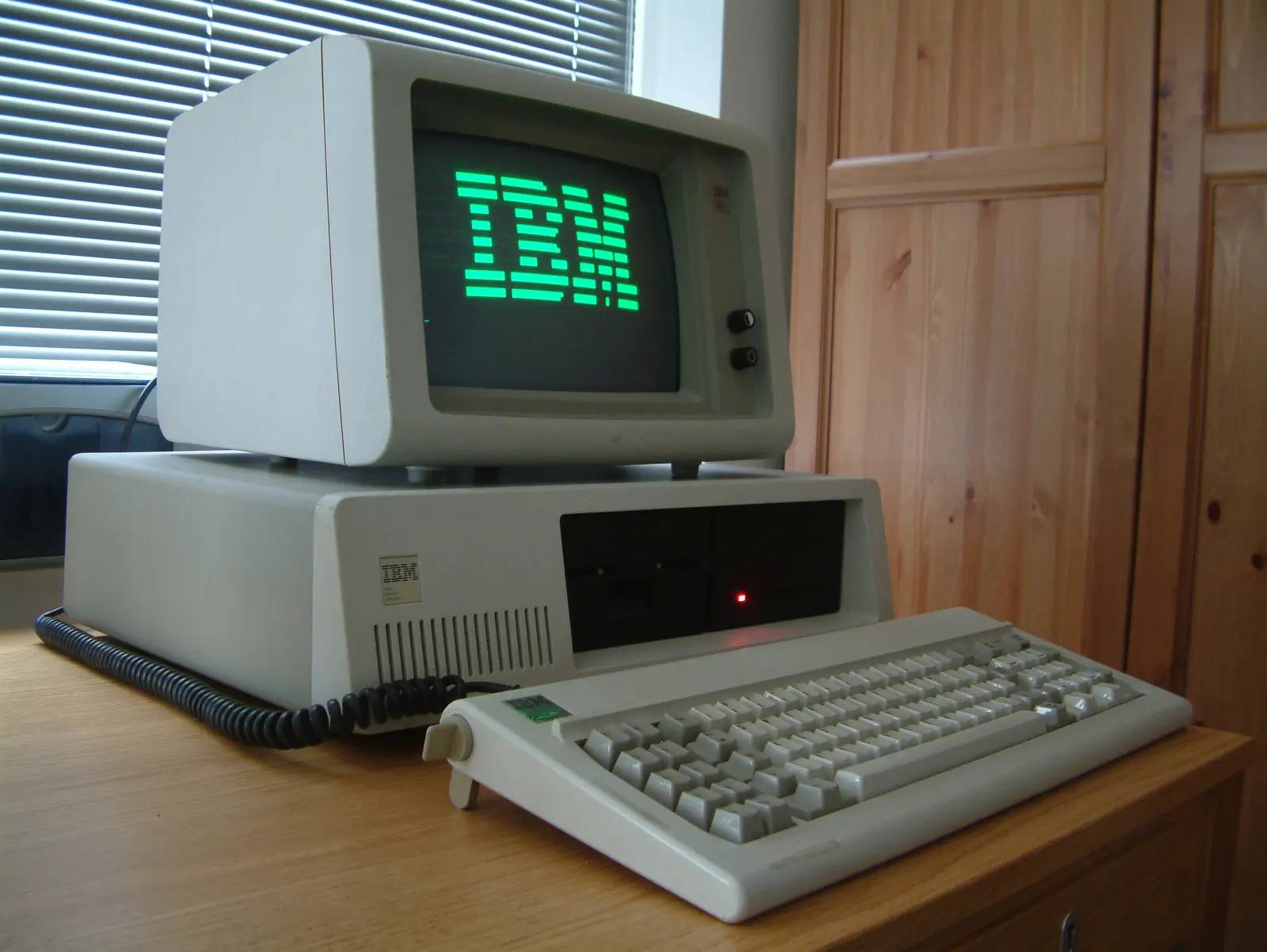
On August 12, 1981, IBM introduced the Personal Computer, model 5150, a device that became the direct predecessor of modern personal computers. This launch was not merely the introduction of a new product, but the starting point for the compatible platform that would dominate the industry throughout the 1980s. Unlike other equipment of the time, such as the Apple II+, which limited memory to 48 KB, the IBM PC 5150 incorporated the Intel 8088 processor and ran PC-DOS, an operating system virtually identical to MS-DOS. This technical and strategic combination allowed the machine to rapidly become widespread in professional and home environments, redefining the interaction between businesses and technology.
Launch context and positioning
In 1981, the personal computing market was in a transitional phase. While Apple offered the Apple II+, IBM decided to create its own personal computer instead of using existing hardware. The decision to base the design on standard components was crucial. The IBM PC 5150 was positioned as an accessible tool, not only due to its cost but also because of its ability to integrate into corporate workflows. Historical evidence indicates that this launch consolidated the concept of the 'PC' as a global market category, establishing a de facto standard that transcended immediate technical specifications.
Architecture based on the Intel 8088
The heart of the IBM PC 5150 was the Intel 8088 processor. This technical choice differentiated the machine from other contemporary platforms. The use of a 16-bit microprocessor, although operating on an 8-bit bus, allowed for scalability that other systems did not offer to the same extent. The 5150 architecture was designed to be robust and, above all, open. IBM did not attempt to create a closed ecosystem but opted for a structure that allowed for expansion and modification by third parties. This technical decision laid the groundwork for what was to come: the proliferation of compatible hardware.
The role of PC-DOS and the software ecosystem
The operating system of the IBM PC 5150 was PC-DOS, a version of MS-DOS developed by Microsoft. The relationship between IBM and Microsoft was fundamental to the machine's success. PC-DOS provided a command-line interface that, although basic, was sufficient for the business applications of the time. The software ecosystem began to expand rapidly thanks to the accessibility of the hardware. Unlike proprietary systems, the open nature of the IBM PC allowed developers from around the world to create applications for the platform, generating a feedback loop that drove the massive adoption of the machine.
Opening the design and the rise of clones
IBM's most impactful decision was to open the IBM PC 5150 architecture to third parties. By basing the design on standard components and not restricting the architecture through patents, IBM allowed other companies to manufacture compatible machines. This phenomenon gave rise to clones, a market that would transform the personal computing business. Clones offered the same performance and software compatibility at lower prices, accelerating the adoption of the standard. The compatible platform became an ecosystem in itself, where brand loyalty was less important than technical compatibility.
Impact on the massification of computing
The IBM PC 5150 put a computer on every desk, massifying personal computing worldwide. Its impact was cultural and economic. Businesses adopted the PC as a standard tool, and home users began to see technology as something accessible. Massification was not just a sales phenomenon but a change in the perception of technology. The IBM PC 5150 demonstrated that computing did not have to be exclusive to large corporations or academic institutions but could be an everyday tool. This paradigm shift was possible thanks to the combination of accessible hardware and an expanding software ecosystem.
Legacy and limits of historical verification
The legacy of the IBM PC 5150 is undeniable. It is considered the progenitor of the compatible platform and the starting point of the standard that dominated the 1980s. However, it is important to recognize the limits of what can be verified. Historical sources provide a general view of the launch and its impact, but do not detail all of IBM's internal decisions or the specific negotiations with Microsoft. The available evidence confirms the launch date, the processor architecture, and the role of PC-DOS, but does not offer an exhaustive analysis of marketing strategies or immediate reactions from competitors. Despite these limitations, the historical consensus is clear: the IBM PC 5150 redefined the personal computing industry.
Conclusion
The launch of the IBM PC 5150 in 1981 was not an isolated event but the beginning of an era. The combination of Intel 8088-based hardware, the PC-DOS operating system, and the opening of the architecture to third parties created the conditions for the massification of personal computing. The de facto standard established by IBM remains the foundation of the compatible platform, a testament to the importance of openness and collaboration in the history of technology. The IBM PC 5150 was not just a machine but a catalyst that transformed the way the world interacts with technology.
- Decade
- 1980s
- Region
- North America
- Level
- Introduction
- Entities
- IBM PC 5150, Intel, Computadora, IBM PC
Sources and references
- La historia del microprocesador y la computadora personalwww.academia.edu · 2026-10-19
- 🖥️ El 12 de agosto de 1981 cambió la historia de la informática ...www.instagram.com · 2026-10-19
- IBM PC - Wikipedia, la enciclopedia librees.wikipedia.org · 2026-10-19
- "💻 El día que nació la computadora ...www.instagram.com · 2026-10-19
- Un viaje al pasado: desde los inicios del ordenador ...www.balanicomputer.com · 2026-10-19
- ¿Por qué IBM creó su propio ordenador personal (PC) en ...translate.google.com · 2026-10-19
- MS-DOSdbpedia.org · 2026-10-19