The appeal—and cost—of milestones
A history of computing told as a row of inventions is easy to follow: every object seems to occupy its place and propel the next one forward. But the order is also an editorial choice. A RetroPause article about milestones in home computing points out that popular technology histories are often organized as a succession of recognizable inventions and products, and that a list of milestones is not enough to tell the past. That observation is a starting point, not permission to replace one closed list with another.
The problem is not that milestones exist. It is that, without an explanation of why they were selected, they can make a complex history look inevitable—as if every innovation followed a single route and the best-remembered devices alone made up the whole story.
What a specific example can tell us
A document from the Universitat Politècnica de València places the first industrial applications of robots on car-manufacturing lines in Europe in 1970 and 1971. This is a bounded claim: it concerns industrial applications in that context and those years. It does not, by itself, establish the beginning of robotics or support generalizations about every industry, country or use of computing.
Being precise about that limit strengthens the account. Rather than calling those years “the beginning” of an entire technology, we can describe what the source allows us to say and leave open the questions it does not answer: which machines were installed, what tasks they performed and how those production lines changed. The evidence supplied does not resolve those details, so they should not be filled in with conjecture.
From an isolated object to a collection
A preserved item can show one part of history, but a collection also offers a comparative frame. According to Madrid es Ciencia’s entry on the UPM Historical Computing Museum, the museum preserves close to 500 objects that show the evolution of computing and communications. The figure and description allow us to discuss a collection devoted to those fields; they do not, in the material available here, detail its inventory, selection criteria or the provenance of each object.
That distinction matters. An object’s presence in a collection shows that it is now part of a heritage narrative, but the available entry is not enough to reconstruct how it was used, who used it or what it meant in different settings. That would require records, attributable testimony or further documentation. A collection opens questions; it does not answer them automatically.
Institutions have histories too
The history of computing is not limited to devices: it also includes the institutions that decide to preserve and explain them. The MUNCYT page says that the history of the museum—or, more precisely, of the project to create it—begins in 1962. That wording invites us to distinguish the idea of creating a museum from its subsequent institutional history. With the information available, we should not conflate the two or add opening dates absent from the supplied evidence.
Looking at this institutional layer helps explain why certain objects become visible as heritage: spaces and projects bring them together, classify them and present them. This is a general interpretation of what preserving a collection entails, not a claim about specific curatorial decisions at these institutions.
The value of histories of documentation
An academic article in Documentación de las Ciencias de la Información addresses the historical evolution of information and documentation technologies. Its available abstract says that different stages in electronic technology marked important milestones in the history of documentation. It does not, however, provide a breakdown of those stages or enough examples to reconstruct them here.
That reference allows us to widen the frame: technology can be studied through its effects on practices and fields of work, not only through the arrival of products. But attributing a specific sequence to it would go beyond what the extract provides. A responsible history distinguishes between the subject a source announces and what the consulted material actually demonstrates.
A timeline that shows its seams
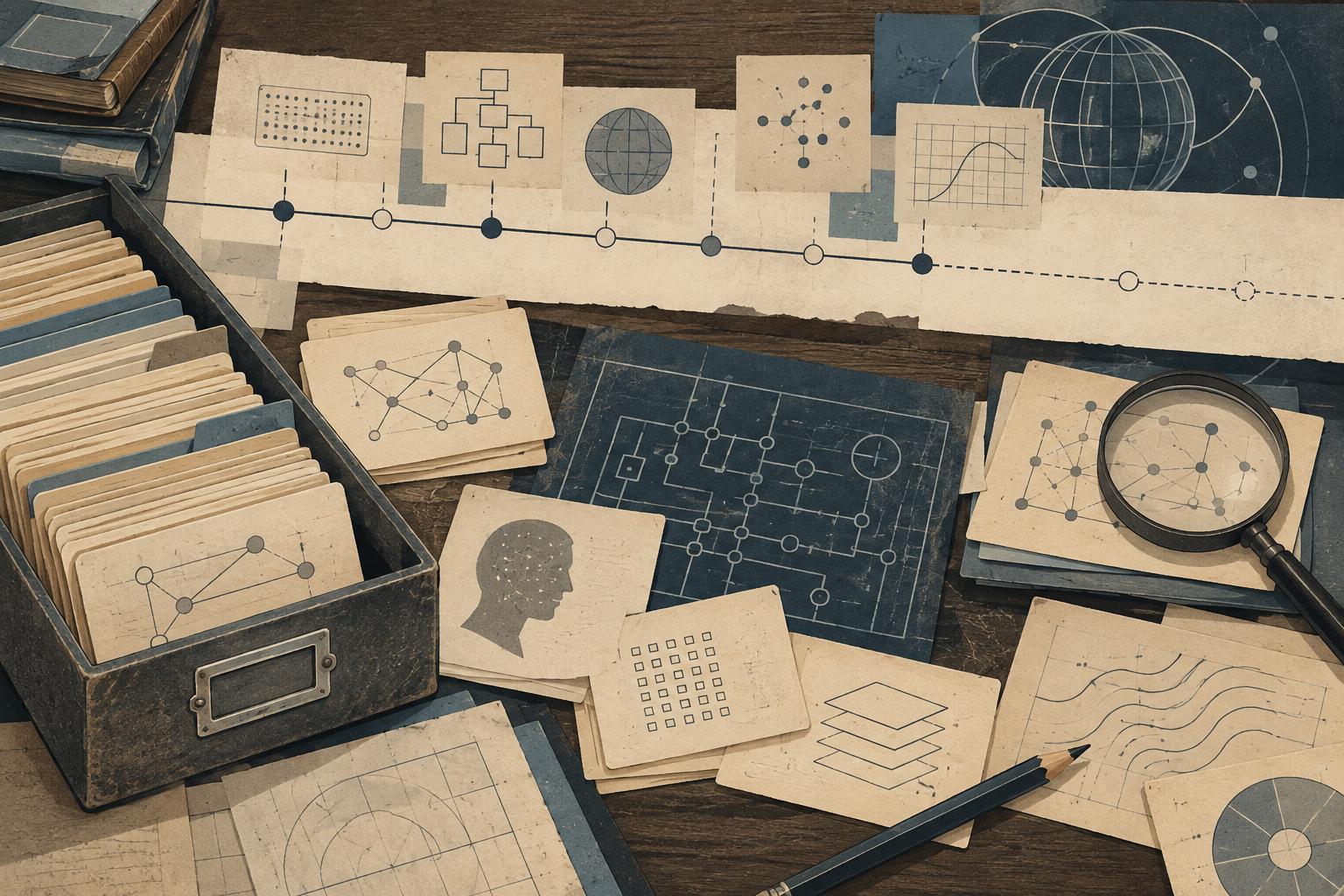
To tell the evolution of computing without turning it into a parade of novelties, every milestone should come with an explanation: what it represents, which documents support it and what it leaves out. Timelines can be useful maps, provided they are not mistaken for the territory. Museums and collections offer another kind of evidence, while studies of documentation make it possible to ask questions about uses and impacts; each source has a different scope.
The available material supports a modest conclusion: technology narratives become more rigorous when they make their criteria and limits explicit. We can cite industrial applications of robots in Europe in 1970 and 1971, recognize a university collection of close to 500 objects and attend to the history of heritage institutions. We cannot turn those scattered references into a comprehensive history of computing. Making that boundary visible does not impoverish the story; it clearly shows what is known and what research would be needed to go further.
- Decade
- 1970s
- Region
- Spain
- Level
- Introduction
- Entities
- Museum
Sources and references
- UN VIAJE A LA HISTORIA DE LA INFORMÁTICAmuseo.inf.upv.es · 2026-09-30
- De VisiCalc al USB: cómo se cuentan los hitos ... - RetroPausewww.retropause.com · 2026-09-30
- (Nuestra) Historiamuncyt.es · 2026-09-30
- Evolución histórica de las Tecnologías de la Información y ...revistas.ucm.es · 2026-09-30
- Museo Histórico de la Informática UPM | madrimasdwww.madrimasd.org · 2026-09-30