In the era of home computing, the floppy disk was not simply a storage medium; it was a document in itself. Its small magnetic surface contained not only data but also the footprint of a cultural practice of organization and memory. This article explores how the floppy disk became an object of documentation, beyond its technical function, and how cataloging and preservation practices have attempted to capture that documentary dimension.
The Floppy Disk as an Archival Object
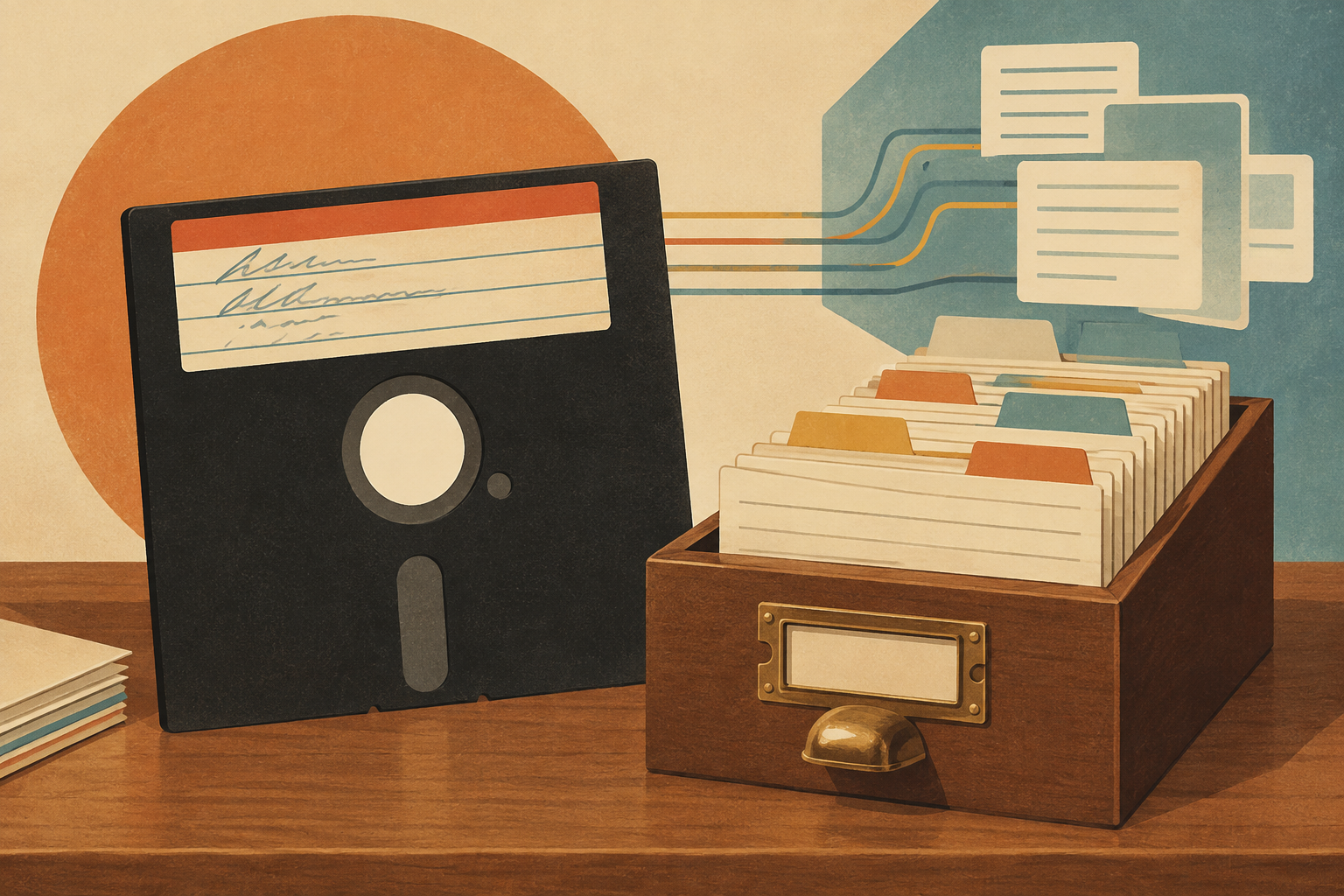
The floppy disk, with its physical format of 5.25 or 3.5 inches, became a standard for information exchange in the 80s and 90s. However, its value did not lie only in storage capacity, but in the way users used it to document their digital life. Handwritten labels, cardboard folders, and personal filing systems were an integral part of the floppy disk experience. These practices reflected a need for order and control in an emerging digital world, where information was volatile and difficult to recover.
Cataloging and Description Practices
Archival description standards, such as the Catalan Archival Description Standard (NODAC), recognize the importance of registering the physical unit where electronic documents are stored. This includes not only the content of the floppy disk, but also its context: who created it, when, and for what purpose. Cataloging a floppy disk therefore requires a dual gaze: one towards the digital content and another towards the physical object. This duality is crucial to understanding the floppy disk as a document, as the physical medium and digital content are inseparable in their documentary value.
Documentation in the Domestic Context
In the domestic sphere, the floppy disk was used for a variety of purposes: from saving schoolwork to storing personal software. Documentation of these uses was often informal, but no less significant. Users created their own filing systems, which reflected their needs and priorities. These systems, although not always standardized, were a form of documentation that captured the digital life of an era. The transition from informal to formal, from handwritten label to structured metadata, marks an evolution in how we understand and preserve digital information.
Challenges of Preservation
The preservation of floppy disks presents unique challenges. Magnetic degradation, the obsolescence of reader units, and the lack of preservation standards make these objects fragile and difficult to maintain. However, preservation is not limited to the technical integrity of the floppy disk; it also includes the preservation of its documentary context. This means that when preserving a floppy disk, one does not only preserve the digital content, but also the history of its use and its cultural significance. Collaboration between archivists, librarians, and technology enthusiasts is essential to address these challenges and ensure that the floppy disk as a document is not lost in time.
The Floppy Disk in Collective Memory
Beyond its practical function, the floppy disk has left a mark on collective memory. It is a symbol of an era when technology was in constant evolution and when users had to adapt to new ways of interacting with information. Nostalgia for the floppy disk is not only for the object itself, but for the experience of using it: the wait for reading, the concern for the correct label, the satisfaction of finding a lost file. This collective memory is part of the documentary value of the floppy disk, as it captures not only information, but also the emotions and cultural practices associated with its use.
Towards a New Understanding of the Digital Document
Reflection on the floppy disk as a document invites us to rethink our understanding of what a document is in the digital age. It is no longer just about content, but about context, practice, and culture. The floppy disk, as an object of documentation, reminds us that technology is not neutral; it is imbued with the intentions, limitations, and aspirations of those who use it. By studying the floppy disk, we do not only study a storage medium, but a form of digital life that deserves to be documented, preserved, and understood in all its complexity.
- Decade
- 1980s
- Region
- Global
- Level
- Enthusiast
- Entities
- Disquete
Sources and references
- LAS BASES DE DATOS HISTÓRICASagora.edu.es · 2026-10-13
- Los archivos, entre la memoria histórica y la sociedad del ...openaccess.uoc.edu · 2026-10-13
- Ordenadores y el descubrimiento de la informática domésticawww.retropause.com · 2026-10-13
- Norma de Descripción Archivística de Cataluña (NODAC) ...cultura.gencat.cat · 2026-10-13
- Concepto de documento, registro y archivo. ...www.academiaauma.es · 2026-10-13
- Boletín de Información Bibliográficawww.cultura.gob.es · 2026-10-13
- El Apple IIc y el lugar del disquete en el propio ordenadorwww.retropause.com · 2026-10-13
- Reglas de Catalogaciónwww.bne.es · 2026-10-13