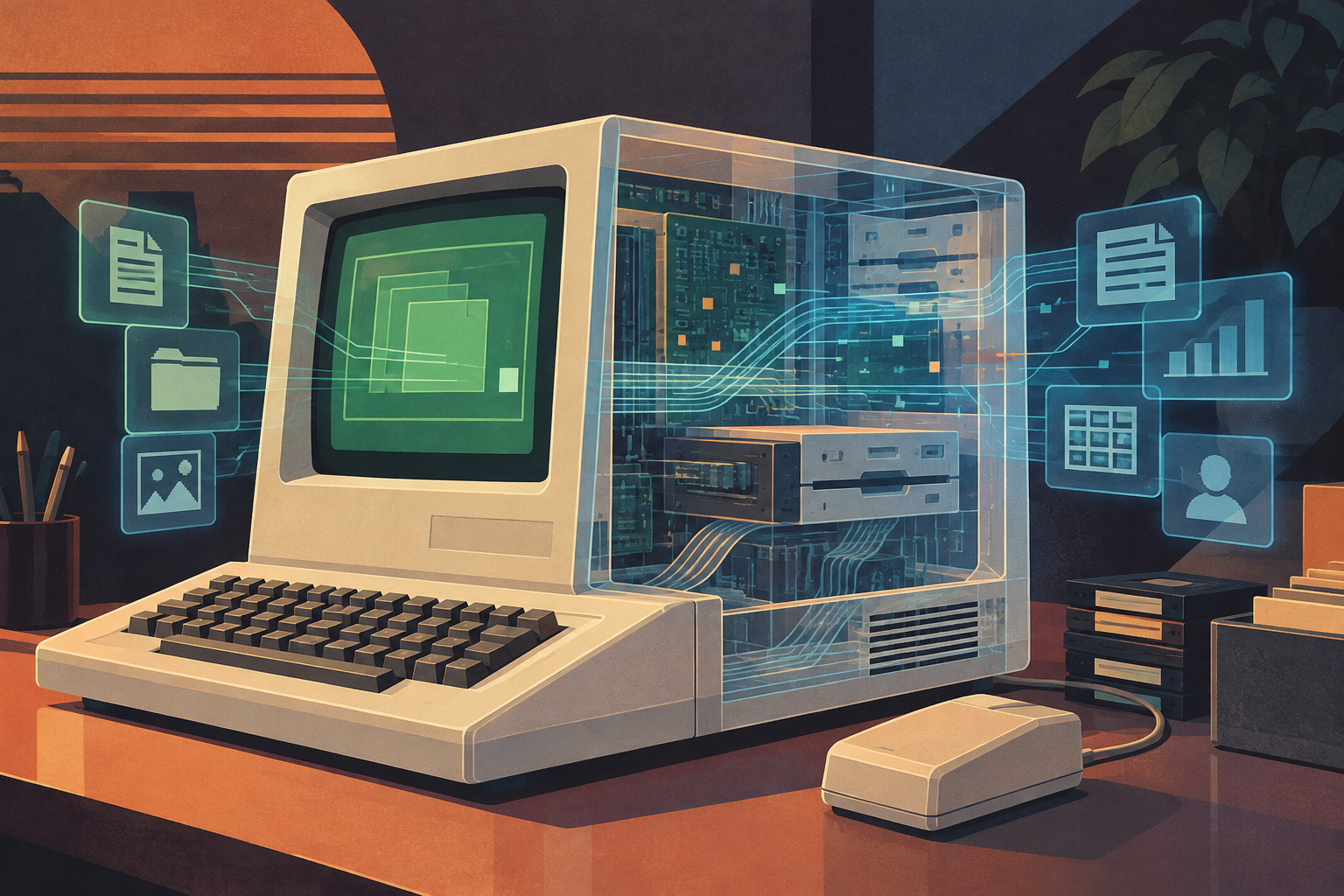
When a 1980s home computer enters a museum or private collection, the first reaction is often technical: checking the motherboard's condition, cleaning the connectors, or verifying the chassis integrity. However, this view reduces the device to a simple piece of hardware, ignoring the complexity of its cultural function. Digital preservation, understood as the set of methods to ensure that stored information remains readable and functional despite technological changes, introduces a crucial nuance. The value of these machines does not lie solely in their materiality, but in their ability to store and process data. Therefore, conserving the machine without documenting its usage context is equivalent to storing a book without reading it or recording its provenance.
The Definition of Conservation Documentation
Conservation documentation is defined as the set of textual and visual records collected during the care and treatment of an object. In the field of arts and furniture, this concept has been widely studied, but its application to computing is more recent and challenging. It is not just about photographing the equipment, but capturing the information surrounding it. This includes software configurations, peripherals that were usually connected, and usage practices that defined its role in the home. Without these records, the computer becomes a static object, stripped of the dynamics that gave it meaning for decades.
The Challenge of Technological Obsolescence
Digital preservation aims to ensure that stored digital information, regardless of the format or system used for its creation, can continue to be used in the future. This goal is particularly difficult in the case of 1980s computers, as the operating systems and programming languages of that era have almost completely disappeared. Rapid technological changes can alter the information contained in these devices, making original data unreadable or non-functional. Therefore, conservation cannot be limited to keeping the hardware operational, but must include strategies to emulate or migrate the associated software and data.
The Cultural Context of the Home Computer
1980s computers were not just calculation tools; they were objects of popular culture that integrated into daily life. Documenting their usage context involves understanding how families interacted with them, what games they played, and what programs they used for education or leisure. This context is as important as the technical specification of the processor or memory. Collaboration between conservators, historians, and technicians is key to addressing this complexity. Conservators bring the care methodology, historians the social context, and technicians the viability of emulation. Together, they can ensure that the legacy of early personal computers is preserved integrally.
Beyond Technical Specifications
Researchers and collectors often focus on the technical specifications of computers, such as clock speed or RAM amount. However, these figures do not tell the whole story. The evolution of human-machine interaction is a fundamental aspect that is lost if only the hardware is looked at. How users learned to program, how they solved software problems, or how they shared information through BBS is part of the cultural memory that must be preserved. Conservation documentation allows access to these aspects, offering a richer and more nuanced view of the incipient digital era.
Interdisciplinary Collaboration as Key
The complexity of conserving a home computer requires interdisciplinary collaboration that is not always easy to achieve. Museums and archives face the challenge of integrating knowledge from different fields. Preventive conservation, defined as a cultural heritage conservation strategy that proposes a systematic work method, is fundamental in this process. It is not just about reacting to a failure, but preventing the loss of information. This involves establishing clear protocols for documentation, emulation, and data migration. Collaboration between experts from different disciplines is the only way to address this task effectively.
Current Limitations and Challenges
Despite advances in digital preservation, significant limitations exist. Not all 1980s systems are emulable with precision, and some data may be irreversibly lost if not documented in time. Furthermore, the lack of standardization in conservation documentation for computing means that each institution has to develop its own methods. This makes comparison and information exchange between museums and archives difficult. It is necessary to develop common standards that allow for more coherent and accessible preservation. The digital preservation community must work together to overcome these challenges and ensure that the memory of the incipient digital era is not lost.
Conclusion: An Integral Legacy
Conserving a 1980s computer is conserving the memory of an era when technology integrated into daily life. It is not just about maintaining a physical object, but preserving the information and context surrounding it. Conservation documentation, digital preservation, and interdisciplinary collaboration are the tools needed to achieve this. By adopting this approach, museums and collectors can offer a more complete and meaningful view of the legacy of early personal computers. This legacy is not just technical, but cultural, and deserves to be preserved with the same rigor as any other historical document.
- Decade
- 1980s
- Region
- Global
- Level
- Enthusiast
- Entities
- Museum
Sources and references
- Georas Museo Internet ESPANOLlaw.yale.edu · 2026-10-18
- Guía de Buenas Prácticas de Conservación en Museos ...www.academia.edu · 2026-10-18
- Documentación de la conservación y las implicaciones de ...translate.google.com · 2026-10-18
- PLAN CONSERVACIÓN PREVENTIVA MUSEO SEFARDÍwww.cultura.gob.es · 2026-10-18
- Preservación digitales.wikipedia.org · 2026-10-18


