Introduced in January 1984, the Macintosh offered a different way to interact with a personal computer. Rather than relying mainly on typed commands, users could point to items on screen and choose actions with a mouse. The graphical interface was its most visible feature, but the experience also depended on a compact machine with a built-in display, one floppy drive and very limited memory. Its contribution was not to eliminate the practical tasks of computing, but to reorganise them around visual interaction.
A desktop contained in one case
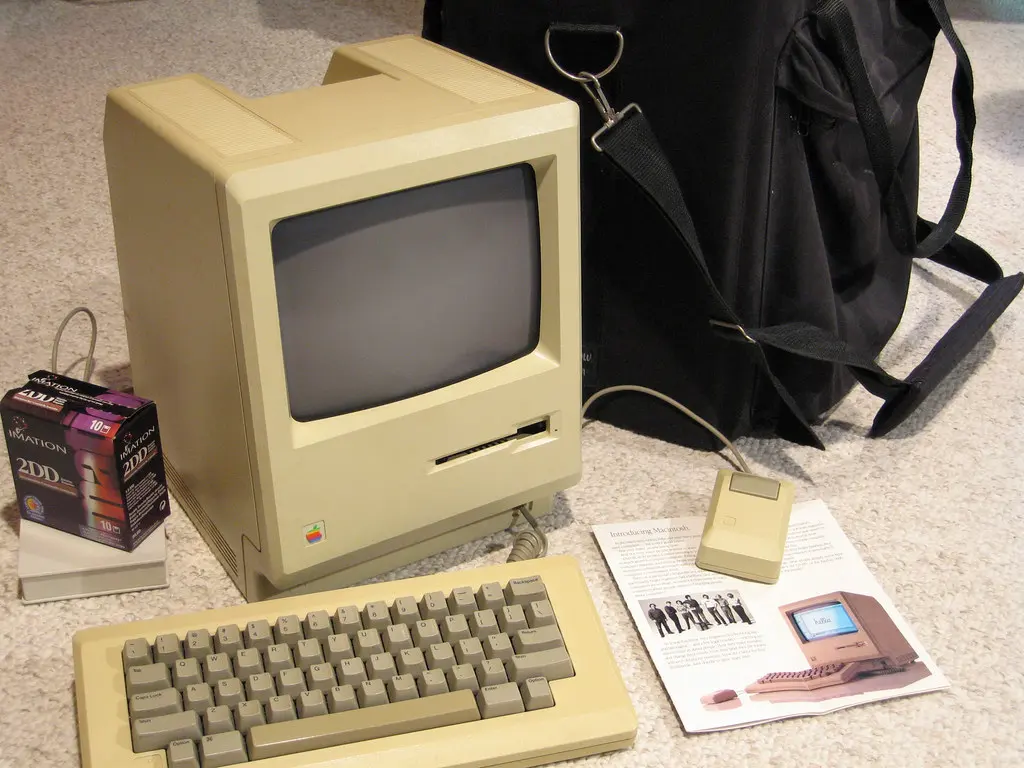
The original Macintosh brought a nine-inch monochrome CRT display, with a resolution of 512 × 342 pixels, and a 3.5-inch, 400 KB floppy drive together in a beige case. The keyboard and mouse connected separately. This integration reduced the number of separate devices on a desk compared with many contemporary setups, though printers, modems and external drives could still extend the system.
The interface was not simply decoration. The pointer, windows and selectable items offered a way of interacting that differed from the command line. The bundled MacPaint and MacWrite made the idea tangible: one was suited to drawing, the other to writing and editing documents on screen. A printed manual and an interactive tour on floppy disk, accompanied by an audio cassette, also helped users learn this new way of working.
One floppy drive, frequent disk swaps
The model had no room for an internal hard drive or a second floppy drive. The operating system, applications and documents were stored on floppy disks. For light use, a startup disk could hold the system, programs and files; when users needed more space or had to move between applications and data, they had to swap disks during a session.
Apple offered an external drive that let users keep a startup disk and a data disk available at the same time. Historical documentation says the company estimated that between 50 and 60 percent of Macintosh owners had bought an external drive by late 1984. The figure points to a gap between the idea of an integrated computer and the reality of using one: the machine took up little space, but working with several programs and files could require additional storage.
A graphical interface on a tight memory budget
The Macintosh 128K had 128 KB of RAM, shared by the processor and video system. The operating system and graphical interface used some of that memory; technical documentation estimates that about 88 KB remained for applications and data. Some programs also limited document size. Memory therefore shaped both what could run and how work was organised: opening programs, saving files and managing disks were visible parts of the experience.
The interface could feel more approachable to people who found commands intimidating, but it did not make the Macintosh frictionless. Contemporary reviews praised the sharp display and quiet operation while also noting the limited memory, lack of colour and inconvenience of a single floppy drive. The design made some actions easier while bringing other constraints into sharper focus.
Peripherals and a closed configuration
The back panel had two serial ports labelled “Printer” and “Modem”, as well as a proprietary connector for the external floppy drive. Apple sold modems and the ImageWriter dot-matrix printer, which could print graphics. These accessories extended the system into communications and printing, but required compatible devices and more desk space.
The lack of internal expansion slots reflected a design choice: keep the configuration closed and rely on software and external accessories to add capabilities. This made the computer compact, but set it apart from machines that let users install cards inside the case. Soldered memory and limited upgrade options made some changes difficult; in 1984 Apple introduced the Macintosh 512K, a separate model with more memory.
The Macintosh 128K captures a defining tension in 1980s home computing. Its built-in screen and mouse-based interaction brought the computer closer to a visual desktop experience. Yet everyday use still depended on floppy disks, peripherals and scarce resources. Its legacy lies in proposing a new organisation of computer work—more visual and concentrated in one machine, but still shaped by very real limits on storage and memory.
- Decade
- 1980s
- Region
- North America
- Level
- Introduction
- Entities
- Sobre la mesa, Disquete, Macintosh 128K, Macintosh
Sources and references
- Macintosh 128Ktranslate.google.com · 2026-11-01
- Timeline: Origen de la Informática.www.timetoast.com · 2026-11-01
- El CASE DE LA COMPUTADORAnoesilvazel.blogspot.com · 2026-11-01
- Home Computerretroinvaders.com · 2026-11-01
- Hardware básico de una computadora personalwww.calameo.com · 2026-11-01