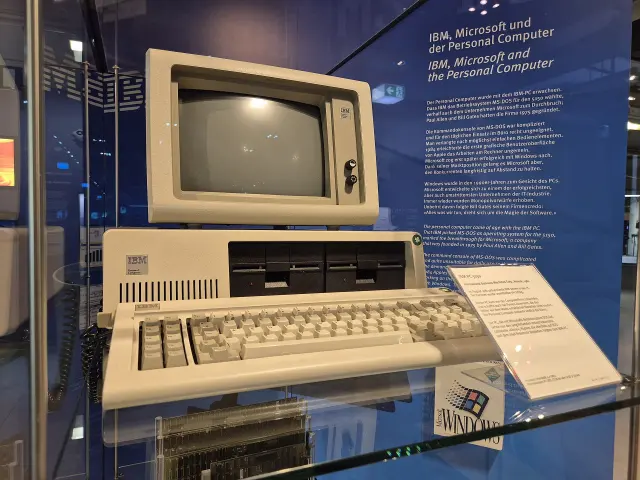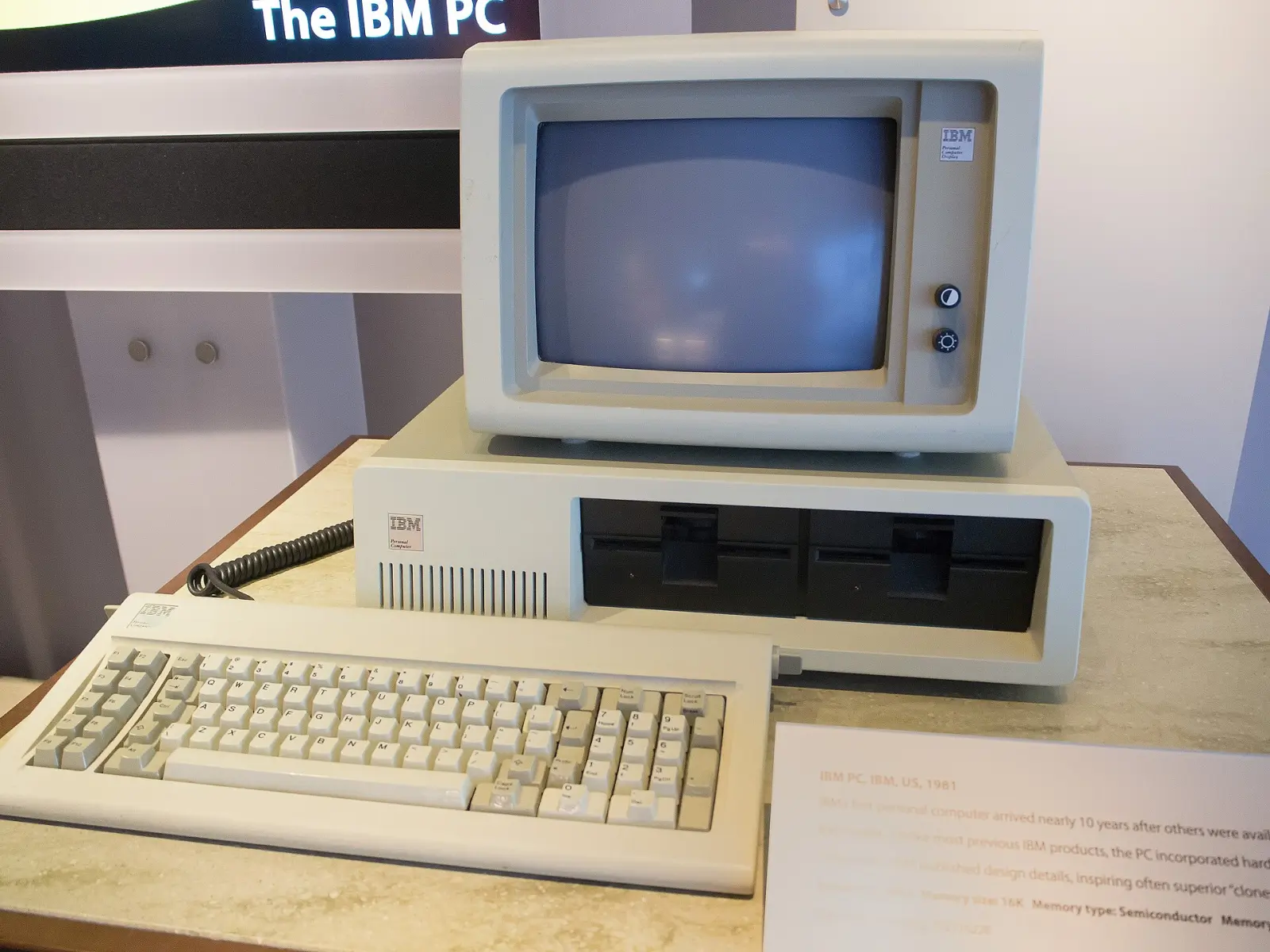
Introduced on 12 August 1981, the IBM Personal Computer was neither the first personal computer nor the beginning of home computing. Apple, Commodore, and Tandy were already selling machines aimed at consumers. IBM’s contribution was different: its name helped many businesses regard the personal computer as a serious tool, while its design offered a technical reference other manufacturers could follow.
A machine designed to reach the market quickly
IBM developed the PC in Boca Raton, Florida, outside much of the company’s usual process. The project needed to move quickly, so its team used components and software from outside suppliers rather than making every part in-house. Among its central choices were an Intel processor and Microsoft as the supplier of the operating system.
That approach allowed IBM to assemble a machine in a short time, but it also distributed control of key elements among several companies. Microsoft retained the rights to the operating system it supplied, and both Microsoft and Intel could sell their products to other manufacturers. The strategy addressed an immediate development challenge; its implications for competition became clear later.
The PC did not enter an empty market. Earlier personal computers had already extended computing beyond technically skilled hobbyists, but many businesses still had questions about usefulness, security, and maintenance. IBM’s presence gave the new category a commercial legitimacy that did not rest on the machine’s features alone.
Compatibility as promise and business opportunity
The IBM PC could be expanded with cards and accessories. More consequentially, its use of available components and the publication of technical information made it easier for other companies to build compatible machines. Compatibility was not just a feature intended to let owners upgrade their computers; it became a business opportunity for manufacturers able to sell machines that ran software written for the PC.
As compatible systems multiplied, the market became less dependent on a single machine or manufacturer. IBM’s architecture became a de facto standard: users could choose among different computers and, in many cases, continue using the same software. That continuity appealed both to businesses seeking to protect their investment in programs and to buyers looking for more choice.
Openness came at a cost for IBM. The company had helped establish the technical rules, but it did not control every component on which the ecosystem depended. Compatible manufacturers could compete at lower prices and quickly adopt products from Intel and Microsoft. The architecture that made the PC a recognizable platform also limited IBM’s ability to keep it exclusively its own.
The computer as a collection of parts
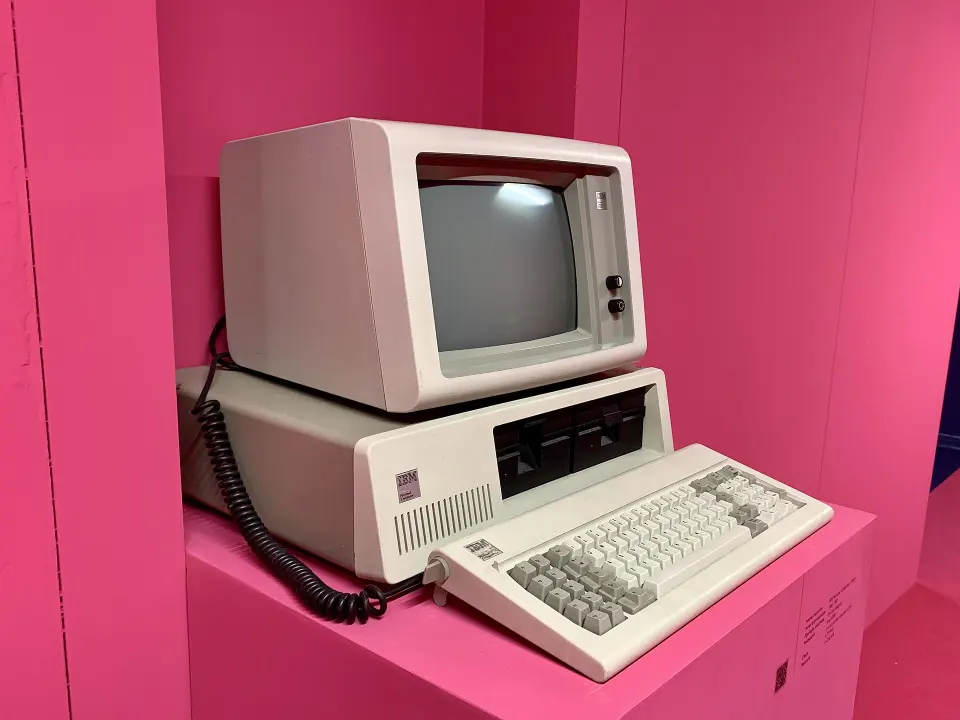
At home, a PC was more than the processor inside a case. The keyboard and screen shaped interaction; floppy drives loaded programs, saved work, and exchanged information. Expansion cards and accessories could add functions, although the options depended on the configuration and the products available.
This physical arrangement shaped the experience. Using a computer meant relying on physical media to store and move data, while software determined which tasks it could perform. The catalogue grew to include business and consumer programs from different suppliers. Home computing thus took shape around an expandable machine, its connected devices, and a collection of programs—not a single isolated appliance.
The PC also reached buyers through specialist computer stores. This distribution brought the machine to people who were not necessarily purchasing it as part of a company’s infrastructure. The combination of brand credibility, varied software, and scope for expansion helped the computer serve different purposes, from office work to activities at home.
A standard IBM no longer controlled
Competition showed that establishing a standard is not the same as controlling it indefinitely. As compatibles gained ground, IBM had to respond to a market moving faster than the company could set the pace. Later decisions—including products intended to distinguish IBM’s designs from the shared architecture—did not erase the value customers and manufacturers had come to place on compatibility.
The loss of control was not predetermined in 1981. IBM continued to make computers and remained a significant presence, but rivals used the standard to offer alternatives, and the company did not retain exclusive control of the elements underpinning the ecosystem. The IBM PC’s history illustrates a lasting tension in technology: openness can widen adoption and encourage innovation, while also distributing power among participants.
Seen from the home, the IBM PC’s legacy is not simply that a business brand entered the living room. It helped establish the personal computer as a composable system: a central machine that could grow through software, storage, cards, and peripherals within an architecture shared by different manufacturers. That structure explains both the PC’s flexibility and the competition that eventually escaped IBM’s control.
Documentary gallery
- Decade
- 1980s
- Region
- North America
- Level
- Introduction
- Entities
- Intel, Disquete, IBM PC
Sources and references
- Cómo el IBM PC ganó y luego perdió el mercado de las ...translate.google.com · 2026-10-27
- Una nueva era de la PC - News Center Latinoaméricanews.microsoft.com · 2026-10-27
- Sonyes.wikipedia.org · 2026-10-27
- Macintoshes.wikipedia.org · 2026-10-27
- Acer Inc.es.wikipedia.org · 2026-10-27