The Apple IIc raises a specific question about the home computer: what changes when storage is not presented as a separate external unit but is part of the machine itself? The available description identifies a 5¼-inch disk drive built into the computer and integrated peripheral ports. It also says the model had no internal expansion slots. This is a useful basis for discussing design and documentation, but it does not establish how every household used the machine.
A configuration brought together in one case
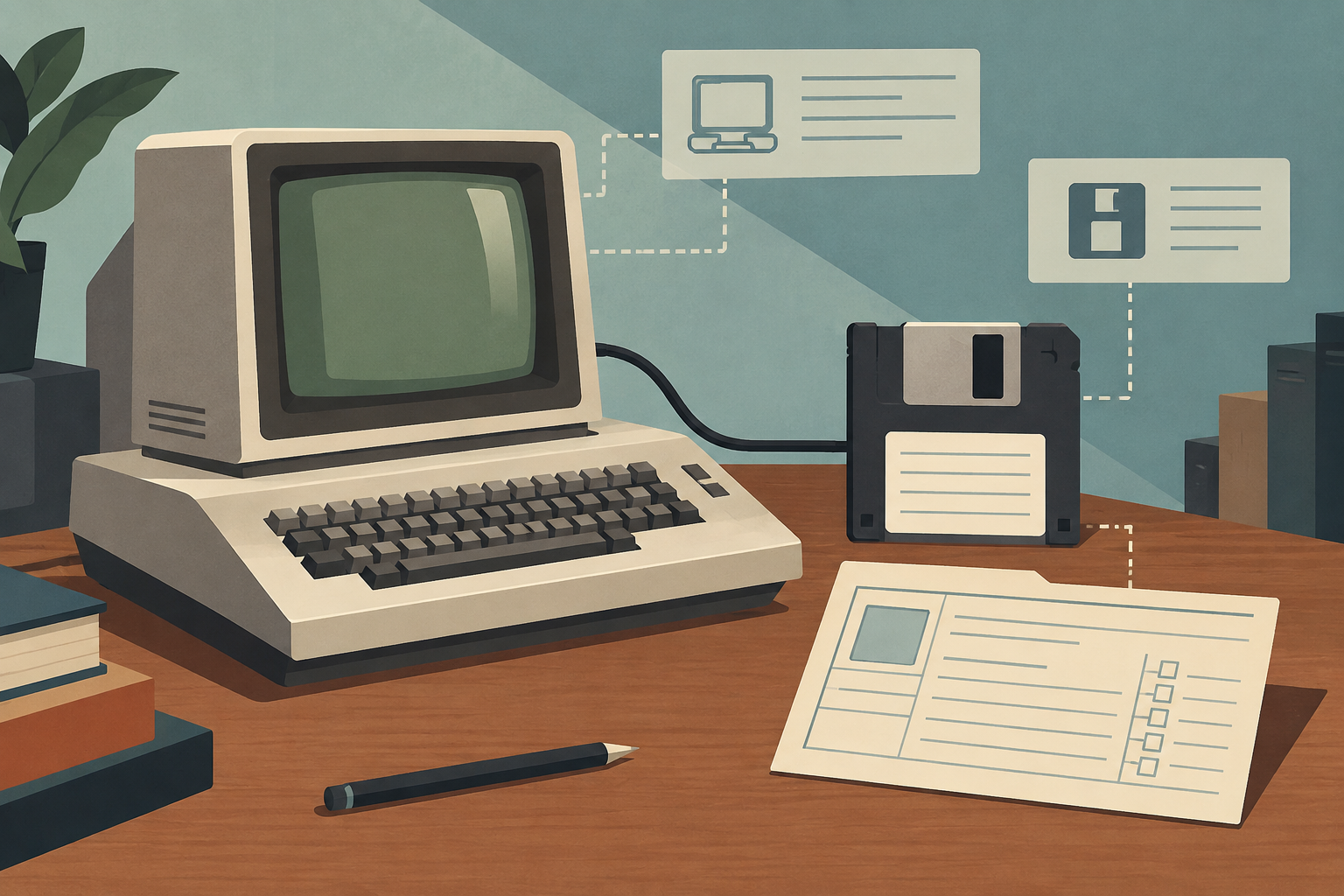
The source describes the Apple IIc as a compact version of the Apple II series, bringing a complete configuration into a small case apart from the display and power supply. It identifies the disk drive on one side. For this discussion, the important point is not a claim about performance but the physical arrangement: the storage device and the computer are presented together.
Storage as part of the object
A diskette can be described as an information carrier, but cataloguing an electronic document also requires recording where it is stored. The Catalan archival standard listed among the sources names diskettes and other physical media when discussing that descriptive unit. The Spanish National Library’s cataloguing rules also cover local-access computer files held on physical devices, including diskettes. These standards do not describe the Apple IIc specifically, but they help explain why documentation should identify both a medium and the computer associated with it.
Ports, limits and connections
The model description identifies integrated peripheral ports at the rear and the absence of internal expansion slots. It supports the claim that the design included built-in peripheral connections and, according to that source, did not retain the internal expansion arrangement of earlier Apple II models. It does not identify which particular devices an owner connected, how often they were used, or in what order. A photograph or specification sheet alone would not establish those habits.
What an inventory can record
A description of a home setup of this kind should distinguish what can be observed from what is assumed: the computer model, its integrated storage drive, visible ports, any surviving media and any accessories actually present. Archival standards support recording the physical unit in which a document is stored; they do not inventory the contents of Apple IIc diskettes or prove that a particular drive worked. A Spanish Ministry of Culture bulletin records publications supplied with a diskette, an example of how a carrier can form part of a documentary set. That example should not be mistaken for documentation of the computer discussed here.
What remains unknown
The available description characterises the design as compact and intended to be ready for use, but supplies no user testimony, connection manuals or records of household configurations. It cannot establish what data the diskettes contained, whether they originally belonged to a particular machine, or whether users exchanged them between computers. The strongest conclusion is narrower: the Apple IIc incorporated disk storage physically into the computer, while cataloguing standards show why the medium should still be identified as a material object. This distinction helps document hardware without turning a design description into an invented history of use.
- Decade
- 1980s
- Region
- Global
- Level
- Enthusiast
- Entities
- No linked entities
Sources and references
- 01 ARCHIVÍSTICA Y GESTIÓN DE DOCUMENTOSwww.cultura.gob.es · 2026-10-09
- Norma de Descripción Archivística de Cataluña (NODAC) ...cultura.gencat.cat · 2026-10-09
- Reglas de Catalogaciónwww.bne.es · 2026-10-09
- Computadoraes.wikipedia.org · 2026-10-09
- IBM PCes.wikipedia.org · 2026-10-09
- Apple IIces.wikipedia.org · 2026-10-09