An organizational shift behind the machine
IBM announced development of the 650 on July 14, 1953, at its laboratory in Endicott, New York. The project emerged as the company reorganized: Thomas J. Watson Jr. promoted product planning distinct from market analysis, while competition and the growth of computing increased pressure on IBM to offer electronic systems.
Engineer Frank E. Hamilton had initially been hired to work on a smaller version of the electromechanical Mark I calculator. He eventually led the electronic-computer project, whose staff grew from four to fifty. IBM had aimed the machine at its scientific and engineering customers, but it found a wider market. The company called the 650 the first mass-produced computer and the first to generate significant profits. It is also regarded as one of the earliest commercial computers designed for business use.
The drum shaped access to data
The 650 took its name from its main memory unit: a rotating magnetic cylinder. The first version could store up to 20,000 digits; later configurations reached 40,000. Data and program instructions were arranged in bands around the drum, with 50 words per band. As the cylinder spun at 12,500 revolutions per minute, each word became available when it passed beneath the read/write heads. IBM gave an average access time of 2.4 milliseconds.
The physical location of the data mattered: reaching a word meant waiting for it to pass under the heads. Seek instructions directed access arms to the appropriate track; a read instruction then moved information into access storage, while a write instruction returned it to the track. Memory was therefore not a passive store separate from computation. Its operation shaped the sequence of work and the arrangement of programs and data.
A system built from connected units
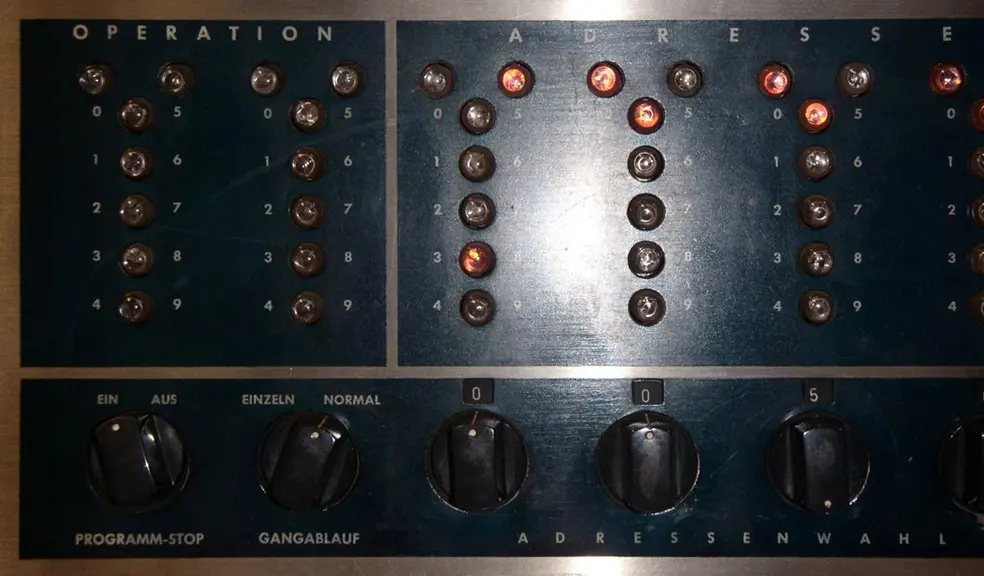
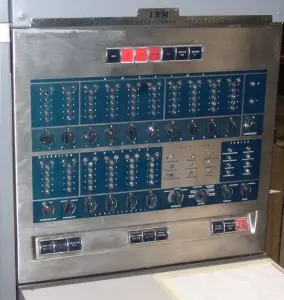
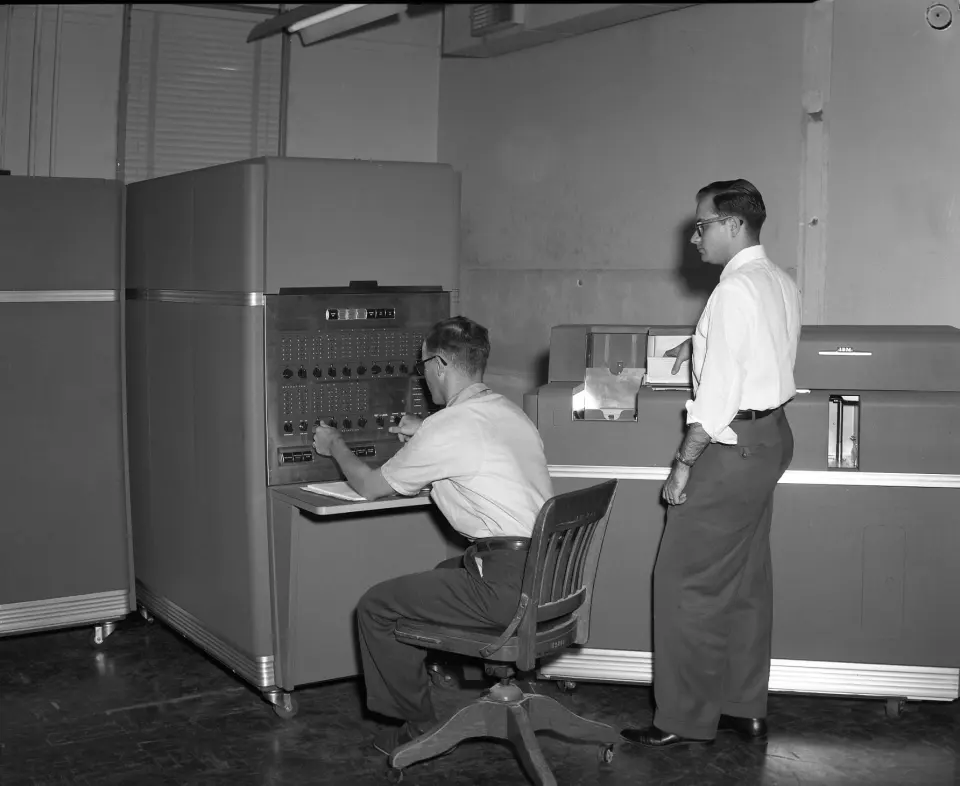
The IBM 650 could be expanded with peripherals that changed what it could do. Up to six IBM 727 magnetic-tape units could be connected to the console through the IBM 653 storage unit. An IBM 407 accounting machine provided printed output. The IBM 355 disk system added direct access to data and led to the 650 RAMAC.
These options show that the computer was more than its console or processing unit: its applications also depended on storage and output devices. It could handle tasks such as payroll, cost control, sales, research, and analysis, contributing to its reputation for versatility.
IBM also emphasized continuous processing for activities such as billing and inventory control. In batch processing, daily transactions were recorded on punched cards and calculated later, often overnight. The delay could leave a business without an up-to-date view of its stock. Continuous processing allowed some decisions—for example, whether to grant credit—to draw on more current information. The change was technical, but also organizational: it shortened the time between recording a transaction and seeing its consequences.
A machine for business and education
John Hancock Mutual Life Insurance Company took delivery of the first IBM 650 in December 1954. According to IBM, less than an hour later the machine was calculating commissions for 7,000 agents. The company eventually installed nearly 2,000 units worldwide, and production continued until 1962. Its spread brought computing within reach of smaller and mid-sized businesses that could afford the system, not just major research centers.
The 650 also became significant in universities. Computer scientist Donald Knuth recalled that IBM donated about one hundred computers during the 1950s on the condition that institutions teach computing courses. The machine thus helped process data while also training students and establishing computing as a university subject.
The IBM 650’s significance, then, lay in more than its magnetic-drum memory. Its modular design, storage and output options, and ability to handle varied workloads helped bring computing into organizations with practical needs. Its expansion in business and education shows how a machine conceived for scientific and technical settings could become a platform for changing office routines and making room for a new academic discipline.
Documentary gallery
- Decade
- 1950s
- Region
- North America
- Level
- Enthusiast
- Entities
- Computadora, Cuatro, IBM 650
Sources and references
- El IBM 650translate.google.com · 2026-11-03
- Breve historia del IBM 650 - Retro Computing MXretrocomputingmx.com · 2026-11-03
- Computadoras mexicanaswww.revista.unam.mx · 2026-11-03
- Computadoraes.wikipedia.org · 2026-11-03
- Historia de la ciencia y la tecnología en Españaes.wikipedia.org · 2026-11-03