A strip of paper pierced with holes may seem modest beside the electronics that followed. But when a machine reads those openings in sequence, paper becomes more than a surface: it is a physical way to encode information and direct operations. Perforated tape belongs to a history in which computing did not emerge in isolation. It reused methods of control and recording already present in other trades. Its passage between typesetting and early computers offers a view of that continuity without turning it into a straight line or claiming more than the evidence supports.
A strip a machine could read
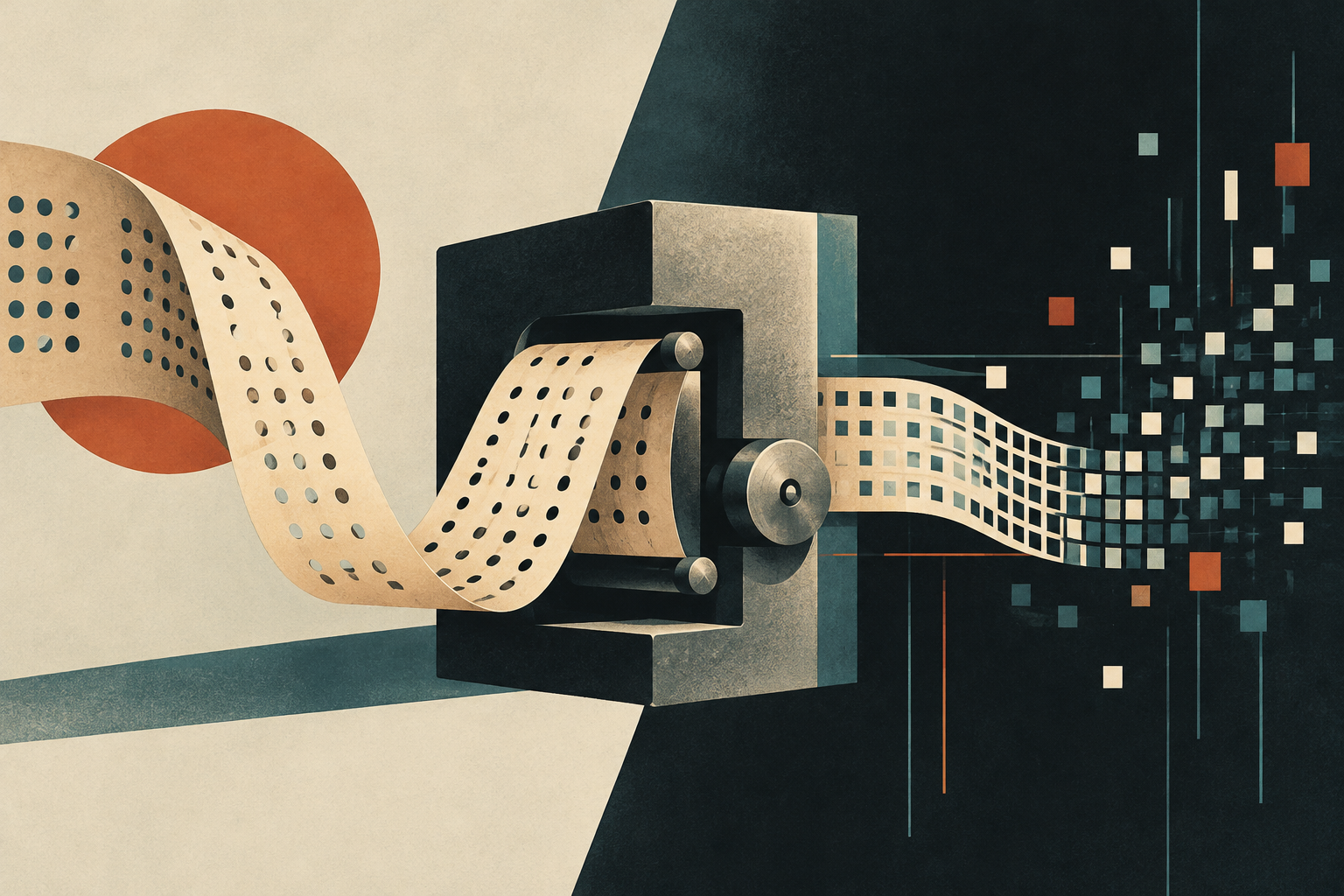
The principle is easy to describe: record information as perforations arranged along a band, then read them in sequence. The tape could carry instructions or data in a physical form a machine could interpret. Storage and control were therefore closely linked. The medium did not merely preserve a sequence; it could take part in the operation that acted on it.
Sequential reading is central to the format. Rather than presenting separate units, as punched cards do, tape offers a continuous succession. The available evidence describes this distinction and says tape could be read continuously and more quickly, but gives no measurements or conditions for comparison. The claimed advantage should therefore be treated as a general description, not a universal figure applicable to every machine.
From typesetting to computation
Printing provides a useful context for the technology. A page on the history of printing describes a contemporary Monotype system controlled by perforated paper tape and used in typesetting. That reference supports the link between tape and composition work, but on its own it does not establish when each use began or reconstruct every transition between printing equipment and computers.
The cultural significance lies in the transfer of a practical solution between settings. A method for organizing typesetting operations could serve as a precedent for thinking about instructions that a calculating machine could read. This does not mean printing alone invented computing, or that the two systems were identical. It means technical media often preserve ideas—recording, ordering, reading—even as the machines and tasks around them change.
Programs and data going in
The supplied evidence attributes to machines developed at the University of Pennsylvania between 1942 and 1946 the use of paper tape to enter programs and data into memory. It also mentions a teletype for writing out results. This gives a concrete picture of the exchange: tape carried information into the equipment, while the teletype produced a written output.
That claim needs clear limits. The materials include a museum source describing the procedure and a result that appears to repeat it in a crossword, but no detailed technical documentation for each machine. It is therefore not possible here to specify models, speeds, codes, quantities of tape, or the precise scope of use. The detail illustrates a practice; it does not establish a uniform design for all early computers.
Copying, carrying and wearing out
Tape had an evident quality: it could be kept as an object and moved. The original account also presents it as a medium that made physical copies of programs possible. Portability gave an instruction sequence an existence apart from the machine that executed it: it could be stored and fed in again, although the available sources do not explain copying procedures or their limitations.
Paper also imposed material conditions. It was vulnerable to wear, a fragility that contrasts with the apparent abstraction of digital information. Tape did not eliminate physical work: the medium had to be preserved and read correctly. Its history reminds us that early digital systems depended on tangible objects, their condition, and mechanisms capable of moving across them.
Continuity, not simple replacement
Perforated tape helps tell the history of computing as adaptation. A medium associated with typesetting could later play a part in entering programs and data. That relationship does not erase the differences between printing and computation; it shows how one technology can offer practical and conceptual resources to another without becoming its sole cause.
The limits of this account also matter. The evidence assembled here is brief and uneven: it includes a museum description, a page about printing, reference materials, and a social-media post pointing toward a broader history. It is not enough to establish a complete chronology of tape, rigorously compare all its uses, or claim that it generally replaced punched cards. Tape can be understood as a significant link, but not as the only path toward modern computing.
Paper in the history of memory
A perforated strip is a reminder that information was not always confined to circuits or magnetic surfaces. At one stage of computing, paper could make a sequence legible to a machine and carry instructions across moments and places. Its significance is not that it fully anticipated later systems, but that it made a lasting idea visible: data need a form in which they can be stored, interpreted, and put to work.
The conclusion is specific. Perforated tape connected practices of recording and control with the work of early computers, and its use in typesetting and data entry is supported by the available evidence. Beyond those points, a confident genealogy should be avoided. Paper was not merely a remnant of the printing trade; it was one of the material media through which machines learned to receive instructions.
- Decade
- 1950s
- Region
- Global
- Level
- Introduction
- Entities
- Museum, Cinta de papel perforada
Sources and references
- Del soporte papel perforado y cinta magnética... Al disco 3d holográfico anatómico-nanotecnológico: nuevos soportes magneto-ópticos y ópticos de almacenamiento masivo de informaciónopenalex.org · 2026-10-16
- Quien recuerda ésto? Quien los haya usado, creo que recordará ...www.facebook.com · 2026-10-16
- Historia de la imprenta Orígenes en Chinaprintingcailan.com · 2026-10-16
- Crucigrama de Historia de la Computación | PDF | Equipofr.scribd.com · 2026-10-16
- UN VIAJE A LA HISTORIA DE LA INFORMÁTICAmuseo.inf.upv.es · 2026-10-16
- de Comercio y Administración "BREVES ...ru.dgb.unam.mx · 2026-10-16