RetroPauseTelevision
Thematic archive · Television

The television that shaped our days

Before viewers could choose what to watch at any time, broadcasts gave shape to afternoons and brought families together. We revisit programmes, formats and habits to reconstruct the culture of the small screen.

Start here

Readings to help you find your bearings.

Analysis · 1960

When television came to Mar del Plata, the home changed with it

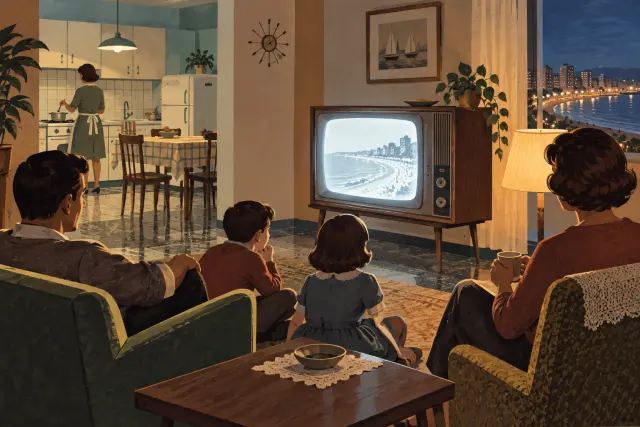
Television arrived in Mar del Plata in 1960, after viewers in Buenos Aires had already encountered the medium, but households still had to decide where the set belonged and who could watch. Inés Pérez’s oral-history study traces a transition marked by children visiting neighbors to see programs, televisions appearing in kitchens as well as living rooms, and different expectations across generations.

Open story

Television

A story in context

Television was a medium, a timetable and a shared conversation all at once. Schedules and recordings make it possible to study not only what appeared on screen, but also how it was presented and whom it addressed.

Here, both broadcasting and reception matter: series, game shows, advertising and children's programming. Cinema focuses on films; Animation on its techniques and works. Links between sections add context without repeating the same story.

Choose your path

Three perspectives on the archive.

Featured dossier

Before the television became a fixture: watching together in 1960s Mar del Plata

In 1960s Mar del Plata, television was not domestic from the outset. High prices, the arrival of local broadcasts and visits to watch at someone else’s home made viewing a shared practice shaped by age, economic means and ideas about household life and work.

Read article

Documented milestones

  1. 1935

    Siam Di Tella begins manufacturing household refrigerators

    Argentine company Siam Di Tella began manufacturing household refrigerators in 1935 and promoted them through advertisements and demonstrations.

    Read article
  2. 1947

    Construction begins on the gas pipeline between Comodoro Rivadavia and Buenos Aires

    Construction of the pipeline began in 1947 and was completed in 1949; expanding networks and lower supply costs encouraged the adoption of gas cookers.

    Read article
  3. 1948

    Television tests at the Trade Fair

    After the Spanish Civil War, Philips conducted television tests at the 1948 Trade Fair, before broadcasts began in Spain.

    Read article
  4. 1951

    Start of television broadcasts in Buenos Aires

    Argentine television began its broadcasts in Buenos Aires, establishing the starting point for the medium's diffusion in the country.

    Read article
  5. 1956

    Television broadcasts begin in Spain

    RTVE dates the beginning of television broadcasts in Spain to 1956, following tests conducted in earlier years.

    Read article

Latest additions

1960s

When television came to Mar del Plata, the home changed with it

Television arrived in Mar del Plata in 1960, after viewers in Buenos Aires had already encountered the medium, but households still had to decide where the set belonged and who could watch. Inés Pérez’s oral-history study traces a transition marked by children visiting neighbors to see programs, televisions appearing in kitchens as well as living rooms, and different expectations across generations.

2000s

Television Entered Homes at Different Speeds: The Case of Mar del Plata

In Mar del Plata, owning a television was not the first way to watch it: for years, neighbours’ homes, clubs and associations provided places to gather around a screen. Inés Pérez’s research shows how set prices, age, gender and domestic space shaped an uneven process of making television part of home life—one that did not move in a straight line from public to private viewing.

1970s

Ice, radio and gas: how everyday life changed in Argentine homes

Electric refrigerators and gas stoves did not enter every Argentine home at once. From the 1920s to the 1970s, infrastructure, prices, credit, local production and custom shaped access to these appliances, while radio and cars helped reorganize domestic work and leisure.

Contemporary

Beyond the static object in modern museum practice

Cultural institutions are integrating audiovisual archives to preserve not just devices, but the social context of broadcasting. This shift redefines how television memory and digital heritage are understood.

1970s

The migration of fear: from IMAX to streaming in three decades

Between 1970 and 2009, horror cinema shifted from a collective experience in large-format theaters to domestic digital consumption. This analysis examines how technology and international festivals redefined the distribution and reception of the genre.

1990s

What an articulated puppet reveals about animation production

Articulated puppets and their bases preserve practical decisions that a synopsis leaves out. Evidence from studies of Chilean and Peruvian animation and Cuban television shows both the value of these objects and the limits of what they can establish.

1950s

Clay, frame by frame: what production records can reveal

Clay animation turns physical manipulation into cinematic movement. Sketches and production materials can help examine decisions left outside the finished film, although the available evidence supports only a narrowly framed account of its early history.

Sources for the selected readings

Editorial review ·