An arrival that did not happen everywhere at once
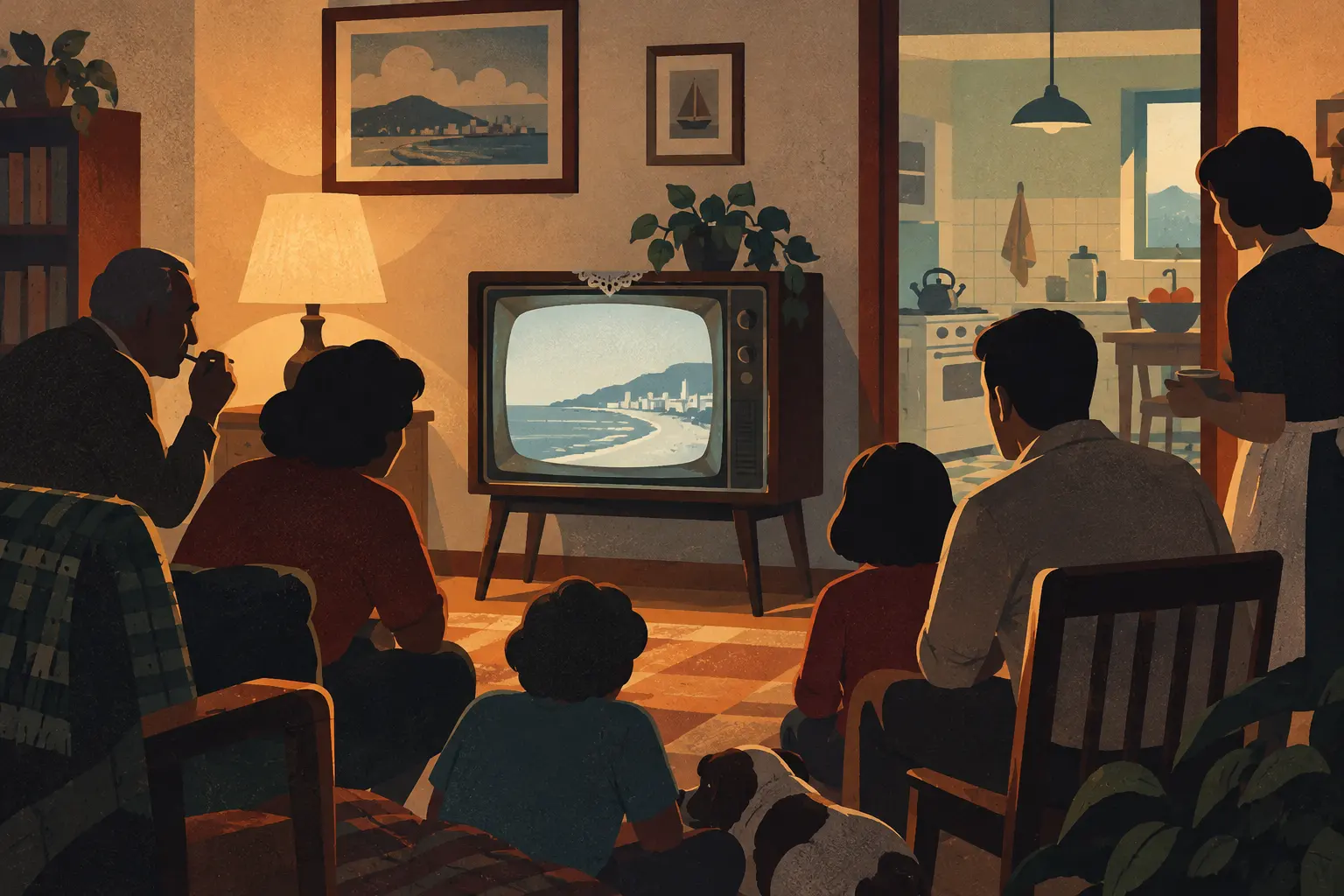
Television history is often told as a succession of technical innovations and landmark programmes. It can also be approached through a more domestic question: who had access to a set, where people gathered to watch, and how did the television alter the routines of the home? Inés Pérez’s study of Mar del Plata between 1960 and 1970 shows that television did not become part of household life through a uniform shift from public to private viewing. For a time, the two forms overlapped.
Argentine television began broadcasting in Buenos Aires in 1951. Mar del Plata, however, did not have a local channel until 1960, when Canal 8 began transmitting. That gap of almost a decade mattered: by then, stories and expectations about a medium already familiar to Buenos Aires residents had circulated in the coastal city. Television also reached Mar del Plata as sets were becoming more accessible, though they remained a significant purchase for many families.
Pérez reconstructs this process through interviews with people who experienced television’s arrival, read alongside local newspapers and municipal records. Her focus is not primarily on programmes but on the television set as an everyday object: where it stood, who could use it and what ownership meant. The study shows that domestic television was not automatically built into the device. It took shape through choices, relationships and material circumstances.
Watching at someone else’s home was part of the experience
In the early years, access to a television set was unequal. People without one could watch at clubs, neighbourhood associations or the homes of people they knew. Visits to neighbours’ houses figure especially in childhood memories: children moved more freely between homes to follow programmes, while adults did so less often.
This circulation was not merely a phase that disappeared as soon as a family bought a set. In Mar del Plata, watching at someone else’s home coexisted with purchasing televisions for family use. Some households shared access with relatives; others became gathering places for neighbourhood children. Practices depended on price, signal availability, social ties and economic circumstances. The local history therefore does not fit a single sequence in which people first watched collectively and then retreated into their own homes.
The memories Pérez collected also reveal a difference between those who hosted viewers and those who visited. One family remembered being the first in the neighbourhood to own a television and recalled children coming over to watch. Yet some neighbours interviewed did not recognise themselves in that picture of frequent visitors: they remembered more occasional visits to homes with which they had close ties. The contrast does not establish which recollection is more accurate. It shows how people’s positions shaped their accounts of a shared practice.
The set as novelty, status and source of unease
The television did not enter a neutral space. Its location and presence expressed competing values. For some families, owning a set signalled modernity, progress or status. One interviewee remembered his father choosing the most expensive model, an imported Philips, on the grounds that it had to be the best. The purchase meant more than receiving programmes: the television could embody aspirations and signal social standing.
Others approached the novelty cautiously. In one account, a mother resisted having a set at home even though she was willing to watch television elsewhere. Her objection concerned the object’s presence in the house, not necessarily the act of watching. That distinction helps explain why adopting a technology could be debated as part of the organisation of domestic space and the protection of family life.
The interviews are memories shaped in the present, not literal records of each day. Pérez treats them as situated accounts, attending to their contrasts, silences and emphases. Age, gender and social position affect who appears as a viewer, who makes the purchasing decision and which activities are considered worthwhile. Children remember programmes and schedules in detail; some adults, by contrast, describe television as entertainment that kept the children occupied.
The kitchen, domestic work and divided attention
A television could be placed in the living or dining room, where it was visible to family members and visitors. But in Mar del Plata it was also common for the first set to be installed in the kitchen. This placement did not map neatly onto a particular social class. The kitchen was not only a workplace; it was also changing, as technical improvements and new ideas about comfort and decoration brought it closer to everyday family life.
Watching television did not always require stopping other activities. The testimonies include accounts of viewing or listening while doing household tasks, especially in the kitchen. This divided attention matters for understanding domestic television: the set joined existing rhythms instead of always demanding a still, fully focused audience.
The relationship between television and domestic work also had a gendered dimension. Household labour was unequally distributed, and some contemporary discourse presented time spent watching television as wasted time, particularly when discussing women. At the same time, a programme could serve as a sound presence, allowing someone to follow it without leaving household tasks unfinished. Everyday life around the television therefore involved more than watching: it included listening, multitasking and negotiating who controlled time and space.
A local chronology, and a different history of the medium
The Mar del Plata case helps correct a history centred exclusively on Buenos Aires. In the capital, television reception during its first decade was strongly associated with public spaces. In Mar del Plata, shared viewing coexisted with wider access to sets and with the emergence of a generation that anticipated programmes and remembered their broadcast times. Elements that occurred one after another elsewhere overlapped here.
The moon landing offers another measure of how far television had become part of cultural life. One interviewed family, which still did not own a set, remembered watching the event on a borrowed television. The broadcast brought viewers of different circumstances together around an extraordinary transmission, but it did not mean that every household had a television. The cultural importance of a programme could grow faster than ownership of the equipment became widespread.
Television’s arrival also depended on programming and broadcast schedules. For younger viewers, remembering television meant remembering what was on and when. For others, its meaning lay in the novelty or prestige of the appliance, or in the time it gave adults while children watched. The medium became part of everyday life in different ways, not through one experience shared by everyone.
Domesticating television was a process, not a destination
The idea that a television naturally belongs in the home is the result of a history. In Mar del Plata, that history included expensive sets, communal viewing, visits between neighbours, disagreements about having a television at home and uses that varied from room to room. The move into the family living room did not immediately erase collective gatherings or make everyone’s viewing habits alike.
Studying the television set as an object shows how technology becomes part of social life: who can access it, who organises its use, and how space and attention are negotiated. It also reminds us that uses are not predetermined by a device’s design. They develop in relation to housing, work, family ties and generational expectations.
Pérez’s research thus offers a history of television that goes beyond what was broadcast. It foregrounds the practices that made viewing possible and the meanings attached to the set. Before television seemed like an inevitable feature of the home, it was a novelty that could be watched elsewhere, debated, shared—or awaited for months until a local signal began.
- Decade
- 2000s
- Region
- Latin America
- Level
- Enthusiast
- Entities
- Televisión, Buenos Aires, Argentina, Inés Pérez
Sources and references
- La televisión argentina: historia, composición y crítica de mediosdoi.org · 2026-11-06
- Historia de la televisióntranslate.google.com · 2026-11-06
- 9.1: La evolución de la televisiónespanol.libretexts.org · 2026-11-06
- La domesticación de la “tele”: usos del televisor en la vida ...journals.openedition.org · 2026-11-06
- Historia de la televisión en Chilees.wikipedia.org · 2026-11-06