An uneven modernization
The arrival of new appliances did not transform everyday life in Argentina overnight. An electric refrigerator could reduce the need for daily shopping; a gas stove could cut the time spent cooking. But those benefits depended on household income, energy networks, fuel prices and the way domestic tasks were organized. The history of these goods between 1920 and 1970 is also a history of who could gain access to comfort, and how domestic work and leisure changed.
Historian Fernando Rocchi examines four durable goods—electric refrigerators, gas stoves, cars and radios—to trace the relationship between production, commerce and consumption. His focus is mainly on the middle classes, a diverse sector that grew and became a key market. Their experience was not universal: access to services, household resources and place of residence made the spread of appliances highly uneven.
From daily ice to the electric refrigerator
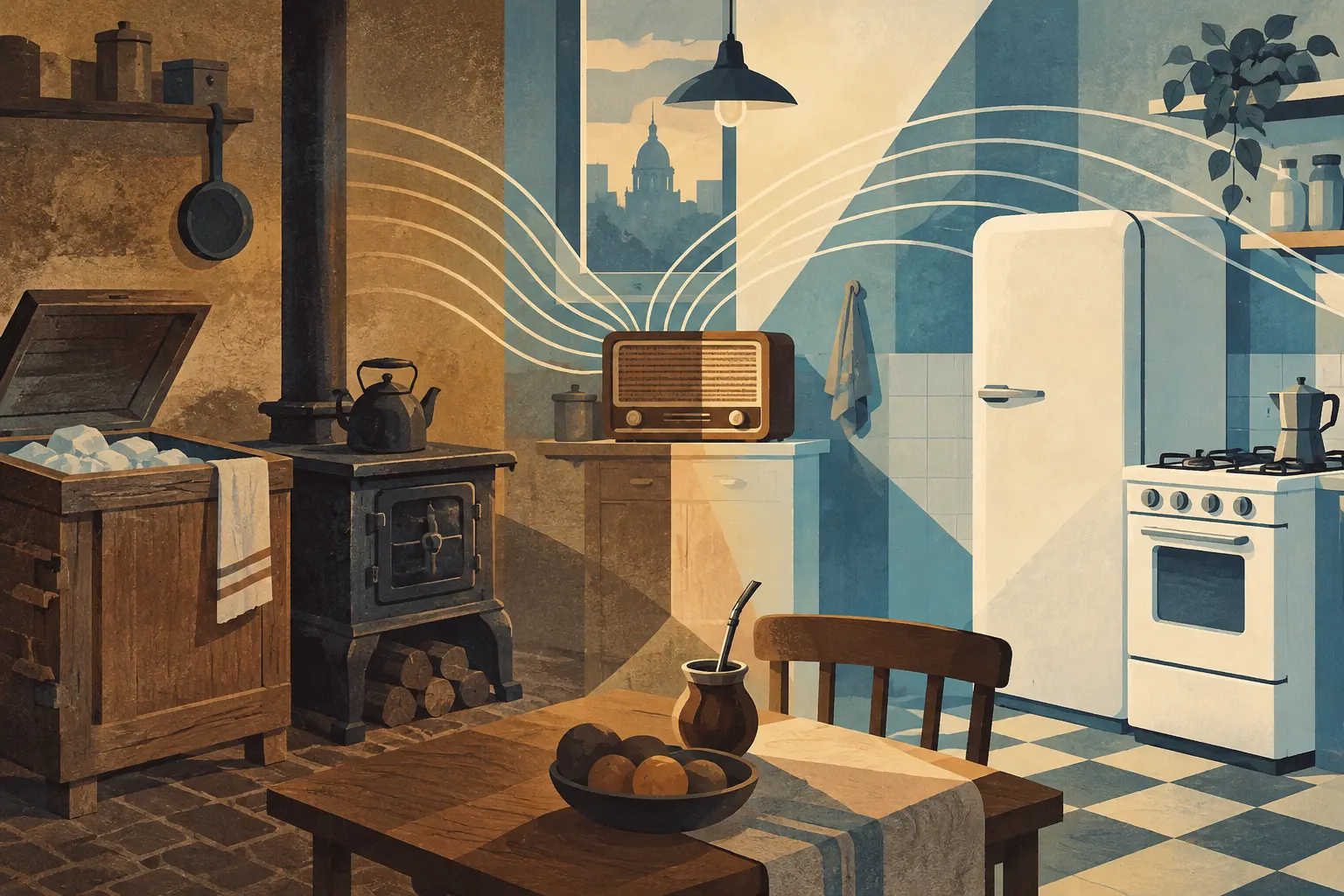
In the 1920s, many families stored food in wooden iceboxes cooled with blocks of ice. The ice had to be bought regularly, a practice that fitted the urban custom of shopping every day. US commercial agents attributed part of the initially low demand for household appliances to the relatively low cost of domestic service: a maid could handle daily shopping, leaving less need to store food at home.
The situation began to change as ice became more expensive and distribution more difficult. In the 1930s, those obstacles made electric refrigeration more appealing. Siam Di Tella began manufacturing household refrigerators in 1935 and promoted them through advertising and demonstrations. Selling a machine was not enough: the appliance required households to change routines and expectations. According to Rocchi, some buyers used it mainly to chill drinks, while others worried that refrigeration would alter the taste of food.
Adoption was gradual. The 1947 census recorded electric refrigerators in 3.4 percent of households and iceboxes in 20.4 percent. Domestic production increased during the first Peronist period, and installment plans enabled some workers to buy an appliance that cost several months’ wages. Even so, refrigerators did not become a mass-market good until the 1960s. More than 1.3 million were recorded in 1970, a figure that, according to the statistics cited by Rocchi, equaled 80 percent of electrified dwellings. That does not mean that 80 percent of all Argentine households owned one: the denominator includes only homes with electricity.
Cooking with gas: networks and alternatives
The shift to gas also depended on infrastructure. Construction of the pipeline between Comodoro Rivadavia and Buenos Aires began in 1947 and was completed in 1949. The expansion of gas networks and lower supply costs encouraged the adoption of gas stoves. For homes without a connection, bottled gas offered another option; its distribution expanded to towns in the interior during the second half of the 1940s.
The change was not purely technical. Architecture and advertising presented a clean, orderly kitchen as part of modernity and domestic comfort. Meanwhile, the working conditions, wages and social standing of domestic service were changing. Appliances did not immediately replace domestic workers. The study shows that the spread of appliances coincided with those changes, and that advertising also drew on concerns about the cost and availability of domestic help.
Production figures reveal the market’s shift: in 1937, more wood-burning economic stoves than gas stoves were manufactured; by 1946, gas-stove production had surpassed them. Argentine firms such as Longvie, Volcán and Orbis took part in this process. Yet owning a stove depended not only on buying it, but also on access to fuel and the ability to pay for energy.
Radio, cars and leisure
Household appliances promised to save or reorganize time; radio, by contrast, filled it with news and entertainment. Its expansion in the 1930s coincided with the development of a domestic industry that made much of the equipment. Radio dramas, often sponsored by soap and durable-goods manufacturers, brought listeners together in homes and shared spaces.
Rocchi emphasizes women’s role in household purchasing and their importance among the audience for these programs. That prominence helps explain the commercial strategies of the period, but it should not be mistaken for a uniform division of labor in every family. Advertising constructed ideals of domesticity and consumption; everyday life did not necessarily conform to them.
The car followed a different path. Argentina imported many vehicles in the 1920s, but the 1929 crisis and trade restrictions reduced purchases. The growth of local production and the automotive industry in the 1960s once again boosted car ownership. A car could shorten a journey while also making outings and recreational activities easier, placing it between a practical good and a source of entertainment.
In the 1950s and 1960s, television began competing with radio. The 1960 census recorded more than half a million television sets, although Rocchi notes that reported totals may have been lower than the actual number. Competition led radio to strengthen its emphasis on news, music and comedy.
Appliances in a social history
The adoption of these goods depended on several factors: wages and income, domestic production, credit, electricity and gas prices, network coverage and household habits. The middle classes drove a significant share of demand, as did, in some periods, working-class households with relatively high wages. Access nevertheless remained unequal across families and regions.
The spread of domestic comfort did not eliminate housework or make all homes alike. It changed how food was bought and stored, which fuels were used for cooking, and where people shared news and entertainment. Production statistics and advertisements help trace these changes, but they also show that an appliance could be an aspiration, a recent purchase or a persistent absence. Everyday life did not modernize at the same pace for everyone.
- Decade
- 1970s
- Region
- Latin America
- Level
- Introduction
- Entities
- Televisión, Cuatro, Buenos Aires, Heladera eléctrica, Argentina, SIAM Di Tella
Sources and references
- la evolución de los bienes durables en Argentina, 1920-1970journals.openedition.org · 2026-10-28
- la evolución de los bienes durables en Argentina, 1920-1970www.scielo.org.co · 2026-10-28
- Historia de lo cotidiano. La casa, la calle y la ciudad en ...portal.amelica.org · 2026-10-28
- La Unidad Popular chilena (1970-1973): balance ...www.redalyc.org · 2026-10-28
- Historia del País Vascoes.wikipedia.org · 2026-10-28