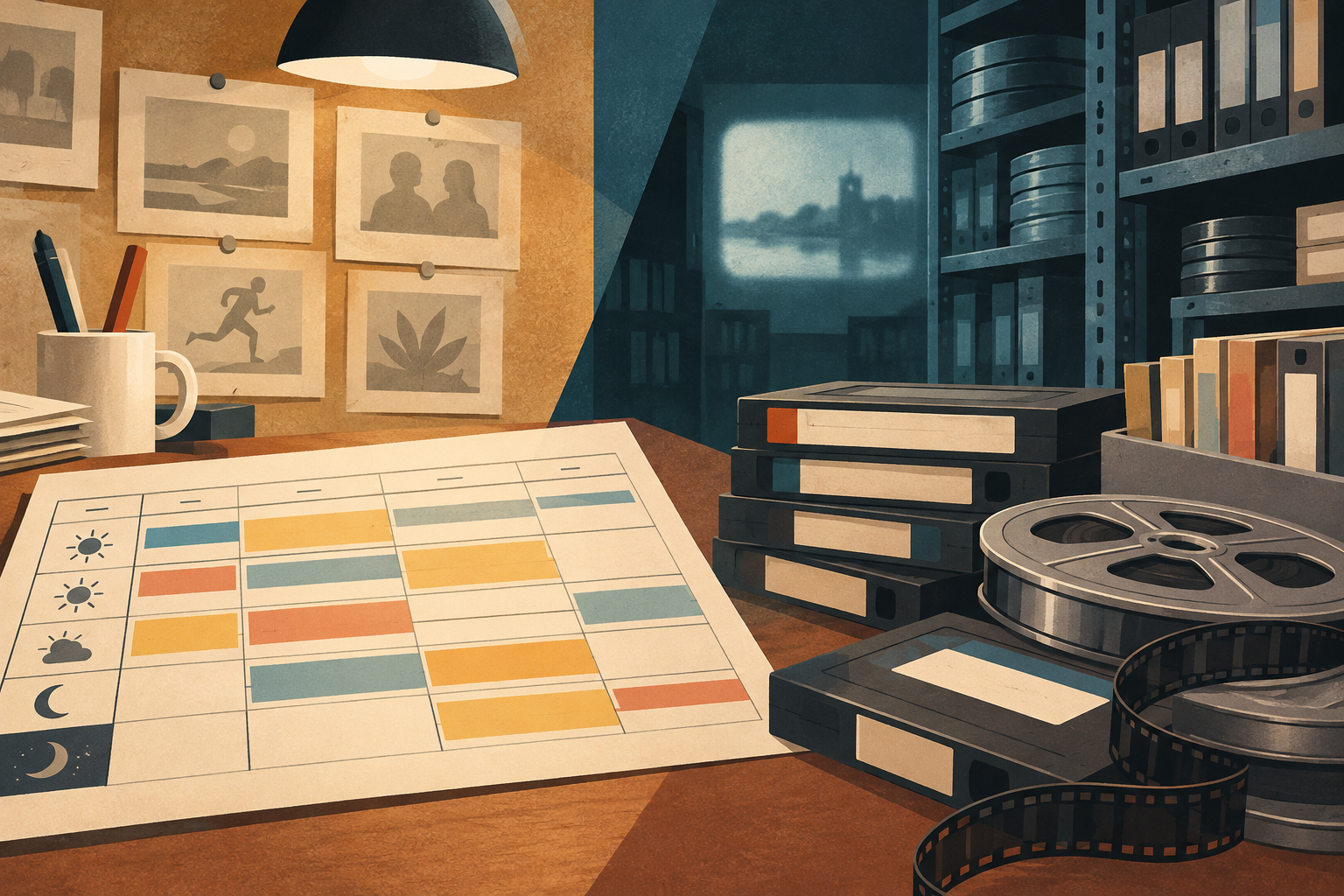
Television leaves different kinds of traces
A history of television cannot be reconstructed from a single kind of document. A preserved broadcast lets us revisit content; a study of preservation helps frame questions about how that heritage is maintained; a schedule, if one can be found, would document what was planned for transmission. These are not interchangeable records. Confusing them can turn a catalogue of available programmes into a supposed historical schedule, or attribute a particular circulation to a recording without evidence.
The evidence gathered here is a starting point, not a complete inventory. An academic study in the repository of the Complutense University of Madrid addresses the preservation of television’s audiovisual heritage. RTVE presents its archive as accessible through RTVE Play. Two other works place television preservation in debates about heritage: one concerns Spanish television archives, and another the Audiovisual Archive of RTVV. A 2007 academic chapter titled Television provides a further bibliographic lead. These records help define the problem; the excerpts available here are not enough to describe specific collections or detailed cataloguing practices.
What a preserved programme can show
A programme made available through an archive can be used to study what has been preserved and made accessible. RTVE’s description invites users to watch older programmes by streaming. That establishes an access route to the archive, but does not by itself prove that the archive is complete, contains every broadcast from a period, or preserves each item’s original broadcast context.
To reconstruct a particular broadcast, researchers would need to compare the recording with documents establishing its date, time, channel and place in the schedule. Such evidence might come from listings, newspapers, administrative records or archival descriptions, but the sources available here identify no specific collection of listings and provide no examples of such a comparison. Those materials should therefore be treated as research needs, not as sources already consulted for this article.
The planned schedule and what reached the screen
A schedule answers one question: what was announced or planned for a particular slot and date? A recording answers another: what content has survived and can be examined? Even where the two match, their relationship must be demonstrated. A schedule change, an incomplete broadcast or a copy separated from its original context could affect interpretation; without case-specific documents, however, none of these possibilities can be asserted as having occurred in a particular instance.
The studies of preservation and heritage matter because they frame the archive as an object of study, not as a transparent window onto the past. The HAL article’s title raises the relationship between Spanish television archives, heritage and a shop; the study of RTVV presents an audiovisual archive as heritage. Titles and bibliographic details point towards questions, but they do not allow us to summarise arguments absent from the supplied excerpts. A finished research account would need to consult the full texts and verify their definitions, examples and conclusions.
What changed when people could record?
The question of how everyday life changed once people could record television requires evidence about devices, availability, use and audiences. A collection of preserved programmes alone cannot tell us who recorded them, when a copy was watched, or whether recording displaced an appointment with a live broadcast. Nor does the present-day availability of content through streaming reveal how people accessed it in earlier decades.
The 2007 academic chapter may help broaden the bibliography on television, but the record available here supplies only its title, date and authorship. It offers no information in this context about domestic recorders, changes in schedules or audience habits. Those subjects require specific sources, such as equipment documentation, reception studies, contemporary advertising and attributable testimony. Without them, the question remains open.
An archive is a source and a limit
Television research becomes more precise when it distinguishes preserved broadcasts, announced programming and reception. Preservation and heritage studies help situate archival decisions; an online platform offers access to some content; but neither automatically replaces the other evidence needed to reconstruct a schedule or explain changing habits.
The conclusion supported by this evidence is deliberately limited: Spanish scholarship addresses television preservation and archives, and RTVE offers online access to its television archive. Reconstructing particular schedules or measuring the effects of recording programmes would still require locating and comparing specific documentation. The absence of that documentation among the results consulted does not prove that it does not exist; it means only that it has not yet been established here.
- Decade
- 1950s
- Region
- Spain
- Level
- Introduction
- Entities
- Televisión, RTVE Play
Sources and references
- La televisiónopenalex.org · 2026-10-08
- Preservación del patrimonio audiovisual de televisión El ...eprints.ucm.es · 2026-10-08
- Archivo de Televisión Española | Ver en RTVE Playwww.rtve.es · 2026-10-08
- Los archivos televisivos españoles, ¿ Patrimonio o tienda ...hal.science · 2026-10-08
- El Archivo Audiovisual de RTVV: Patrimonio ...www.metodosdeinformacion.es · 2026-10-08