Broadcast is not the same as archive
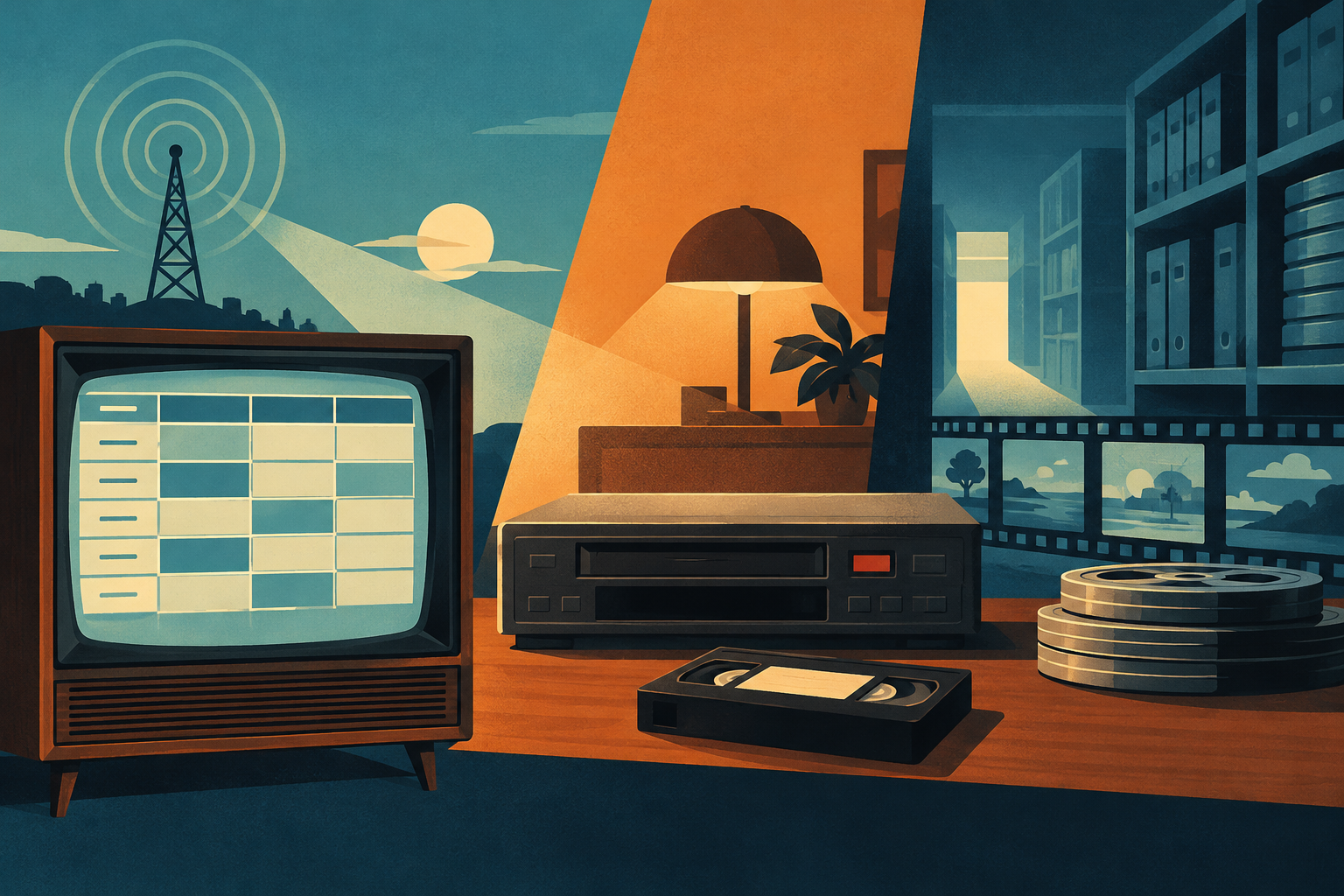
A television broadcast was an event located in a schedule; a preserved programme is a document that can be consulted later. The distinction sounds simple, but it changes the historical question. RTVE’s Televisión Española archive on RTVE Play provides access to audiovisual material, while research on preserving TVE’s television heritage approaches the archive as a matter of conservation. Neither, on its own, amounts to a complete list of everything that was broadcast.
That distinction helps avoid a tempting but mistaken conclusion: treating what can be watched today as a full picture of what audiences saw at the time. An accessible archive tells us about material that has been located, described and made available through that service. It does not automatically establish what aired in every time slot, what was not preserved, or how many people watched each programme.
What a schedule can tell us
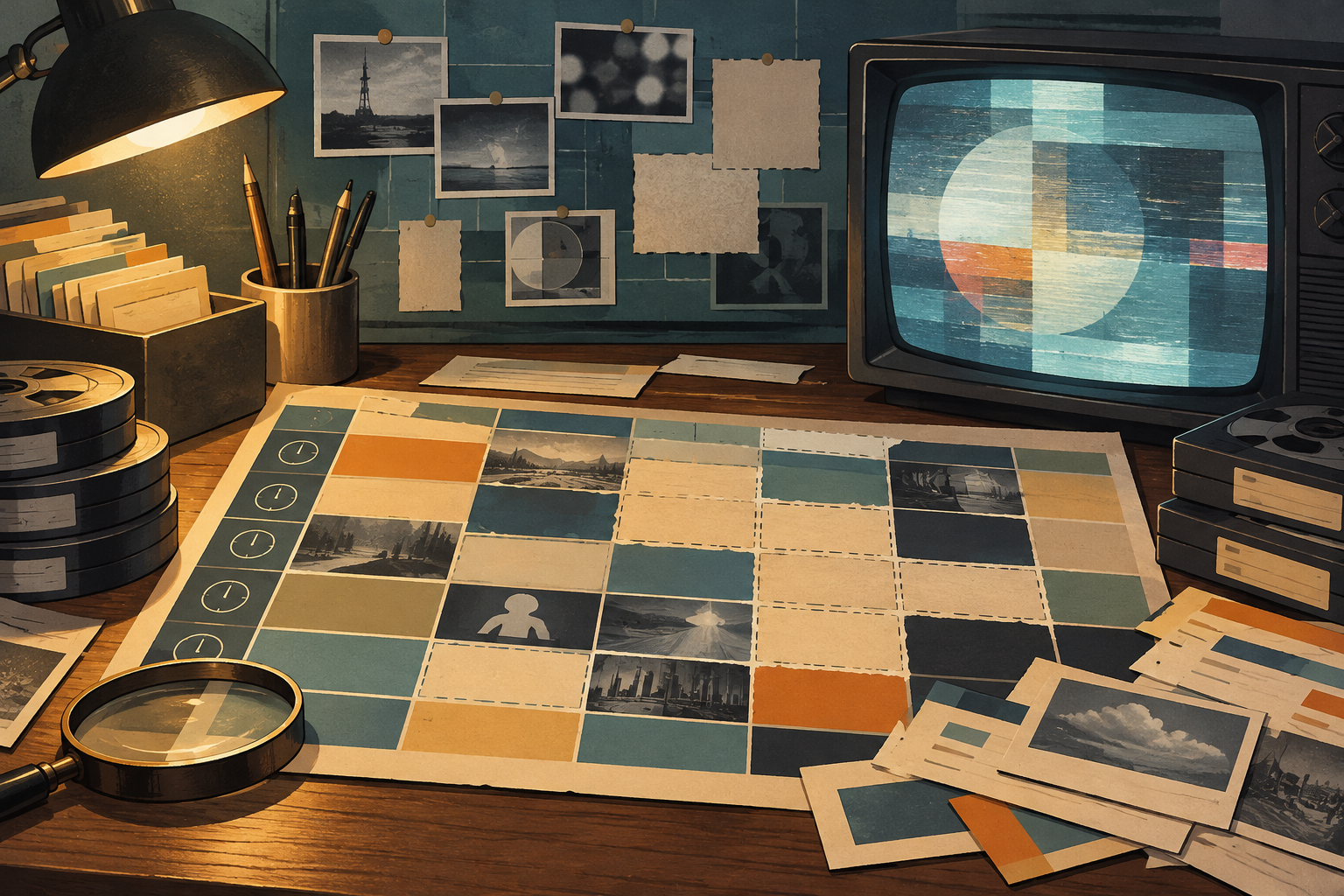
A schedule is a key source for reconstructing programming because it arranges content in time. It can help study time slots, continuity, changes and the relative placement of a programme. But a schedule viewed alone does not prove that the broadcast took place exactly as announced. To describe the gap between a plan and an actual transmission, it is useful to compare schedules with broadcast documents, archive catalogues, surviving recordings and contemporary newspapers where available.
The evidence assembled here does not include a particular run of schedules or a body of home recordings. It therefore cannot support a day-by-day reconstruction or quantify changes in scheduling. It can, however, suggest a method: describe each document according to its nature and scope. A programme listing records a plan; a recording confirms that a version of some content survives; a catalogue tells us how that material is described and whether it is available. These sources are related clues, not perfect substitutes for one another.
The archive as selection and access tool
RTVE presents its television archive as accessible on RTVE Play. That availability matters for research and for revisiting moving images, but access and completeness are different things. The academic work hosted by Complutense University focuses on preserving television audiovisual heritage and uses the TVE Archive as its example. Its subject makes clear that conservation is part of the medium’s history, not a neutral operation that simply leaves everything intact.
Description matters too. A record’s title, assigned date, tags and catalogue context can guide a search, but may not contain every detail needed to understand a broadcast. Television history is reconstructed by bringing the audiovisual document together with the information that makes it findable and places it in context. When one of those elements is missing, the gap should remain visible instead of being filled with an assumption.
Academic studies define their own questions
Academic references offer different scales of analysis. One article examines the expansion and social consumption of television in Spain during 1963–1969; another study addresses RTVE’s preserved material about programmes concerning the Spanish Civil War broadcast between 1956 and 1975. These temporal and thematic boundaries are useful because they show how an archive can be investigated through specific questions, rather than treated as an undifferentiated collection.
Those works should not be turned into evidence for a complete history of Spanish programming. A study of social consumption is not a census of broadcasts, and research on Civil War programmes does not describe all preserved production. Their value here is to point towards concrete lines of enquiry: relating content to its social context and examining how a subject appears in programmes that were broadcast and preserved.
A journalistic overview of the evolution of Spanish television from the 1970s to the 2000s can provide chronological orientation. Specific dates, programming changes and claims about particular cases should nevertheless be checked against studies and documentation directly connected to those cases. The detail of a conclusion should not exceed the detail of its sources.
Recording changes the question, but does not answer it by itself
Being able to keep a programme and watch it outside its scheduled transmission changes, in principle, the relationship between time slot and reception: the two no longer have to coincide. But the supplied evidence does not document the adoption, frequency or effects of home recording in Spain, nor does it allow us to date particular changes in viewing habits. A detailed chronology of such practices would go beyond what can be verified here.
A rigorous answer would require sources focused on the practice: equipment and format documentation, advertisements and manuals, studies of use, attributable testimony or research on audience habits. It would also be necessary to distinguish the existence of a device from its actual use. Finding a recording does not, by itself, prove who made it, when it was played or which routine it replaced.
A reconstruction that keeps its limits
Schedules help show how the offer was organised; audiovisual archives make it possible to study what has survived; catalogues help locate material; and academic studies analyse defined periods or problems. Newspapers may add context, provided they are checked against the claim being made. No single source answers every question.
The firmest conclusion is also the most cautious: television history is reconstructed by relating broadcast, preservation and reception without confusing them. The available sources identify the TVE archive as both a place of access and an object of research, and point to studies of social consumption and preserved programmes. They do not suffice to quantify all programming or to establish how recording changed habits. Making that boundary explicit does not impoverish history; it allows new evidence to be added without erasing what we still do not know.
- Decade
- 2000s
- Region
- Spain
- Level
- Enthusiast
- Entities
- Televisión, RTVE Play, Archivo de Televisión Española en RTVE Play, Sounds, Televisión Española
Sources and references
- Archivo de Televisión Española | Ver en RTVE Playwww.rtve.es · 2026-10-09
- Preservación del patrimonio audiovisual de televisión El ...eprints.ucm.es · 2026-10-09
- Historia y evolución de 40 años de televisión en Españalab.elmundo.es · 2026-10-09
- El archivo audiovisual de RTVE. Programas emitidos ... - Galego.gale.com · 2026-10-09
- La televisión en España: expansión y consumo social, ...raco.cat · 2026-10-09