The founding of Mushi Production in 1961 by Osamu Tezuka marked a turning point in the Japanese industry. Its first work, 'Aru machikado no monogatari' (1962), was experimental, but the real challenge came with television. The broadcast of 'Astro Boy' in 1963 required a massive production that exceeded the studio's traditional capabilities. To maintain the weekly broadcast schedule, the team resorted to ingenious solutions documented in sources from the time: reusing drawings, reducing the number of frames per second, and keeping parts of the image static. These techniques, often seen as economic limitations, ended up defining a distinct visual language. 'Limited animation' was not just a budget issue, but a narrative tool that allowed emphasis on dialogue and facial expression over physical action. This technical approach influenced later studios such as Toei Animation and, later, Studio Ghibli, which raised artistic quality but maintained certain production logics. Evidence suggests that technical efficiency was key to the international expansion of anime, allowing Japanese animation to become a mass cultural phenomenon. However, it is important to distinguish between technical necessity and artistic choice; many of these decisions were imposed by the urgency of television production, not by a preconceived aesthetic.
The post-war industrial context
Japanese animation in the 1960s operated in an environment of limited resources. Unlike major Western studios, Mushi Production did not have massive infrastructure. The arrival of television in Japan in 1953 changed the rules of the game. Before that, animation was a film product, with long production cycles and reduced audiences. Television demanded a weekly cadence that was almost impossible to sustain with traditional full animation techniques. Tezuka, aware of these limitations, sought an alternative path that would allow maintaining narrative quality without sacrificing the economic viability of the studio.
The technique of limited animation
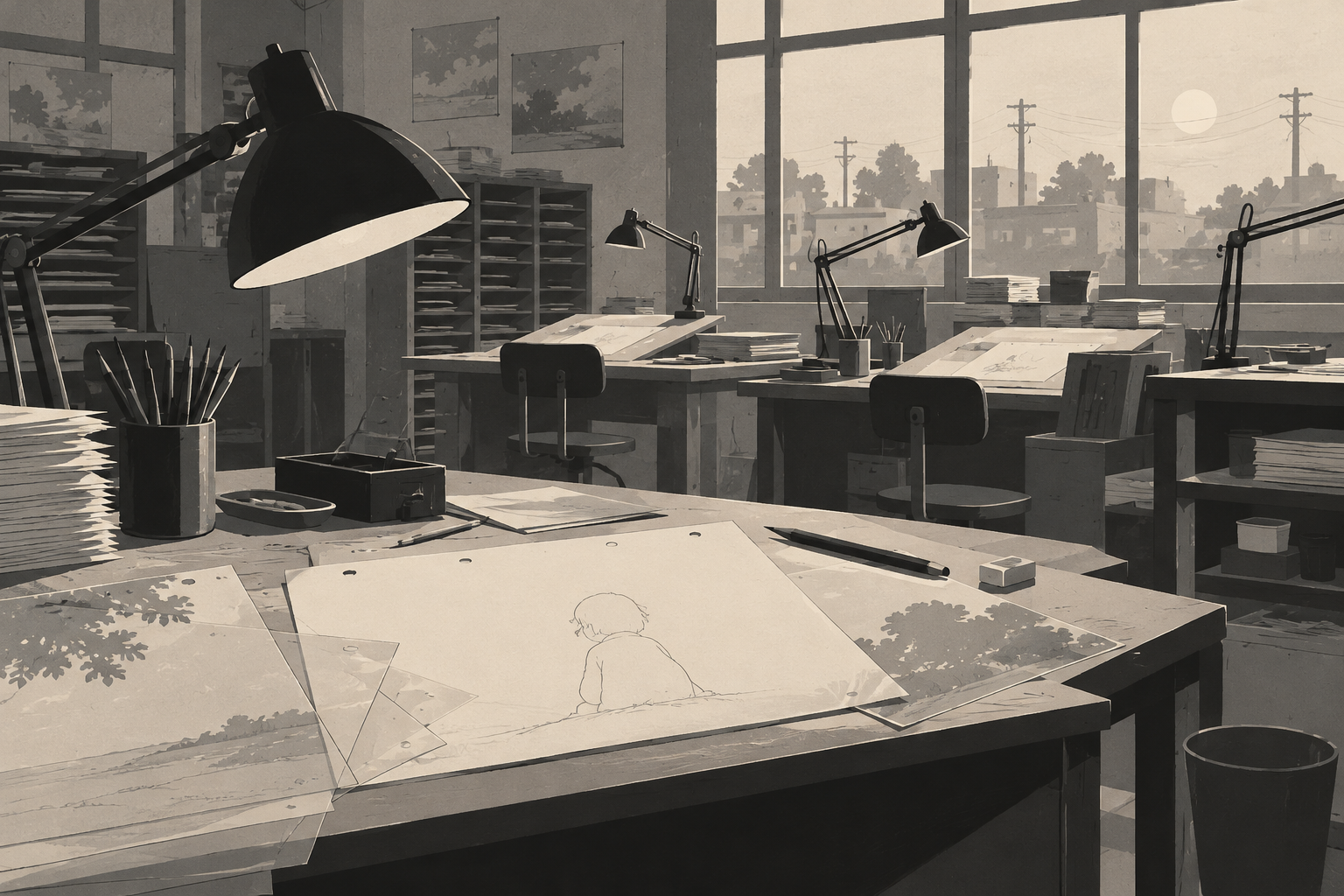
The term 'limited animation' refers to a series of techniques designed to reduce the number of original drawings needed per second of screen. Instead of drawing every movement, animators reused backgrounds, bodies, and facial expressions. This did not imply a lack of quality, but a reorganization of creative effort. The focus shifted from the fluidity of movement to the composition of the image and the use of camera effects. This technique allowed characters to speak and react with emotional nuances, while the background remained static, creating a sense of immediacy and focus on dialogue.
Astro Boy as a case study
'Astro Boy' (Tetsuwan Atom) was the first anime series regularly broadcast in Japan, starting on January 1, 1963. Its success was not only due to the story, but to Mushi Production's ability to produce weekly episodes consistently. The series established a production model that would be imitated by other studios. The use of reusable backgrounds and the reduction of animation in action scenes allowed the team to focus on key narrative moments. This was not a defect, but a feature that defined the visual style of the series and, by extension, early anime.
Influence on later studios
The techniques developed by Mushi Production did not disappear with the studio's closure. Toei Animation, which became the main anime studio of the 1970s, adopted and refined these production logics. Later, Studio Ghibli, although with much larger budgets, maintained certain composition and camera usage logics that had their roots in the limitations of the 1960s. Technical efficiency became an industry standard, allowing Japanese animation to expand internationally. The ability to produce high-quality content at a reasonable cost was key to the globalization of anime.
The distinction between necessity and aesthetics
It is crucial not to romanticize technical limitations. Many of the decisions made by Mushi Production were imposed by the urgency of television production, not by a deliberate aesthetic choice. However, the result was an aesthetic that became characteristic of the medium. 'Limited animation' was not just a solution to a problem, but a narrative tool that allowed emphasis on certain elements over others. This duality between necessity and aesthetics is a recurring theme in the history of animation, where constraints often generate innovation.
The cultural legacy of anime
Anime became a mass cultural phenomenon, not only in Japan but worldwide. The technical efficiency of the 1960s was a key factor in this expansion. By reducing production costs, Japanese animation could reach wider audiences and compete with other entertainment media. Today, anime is a technological art form and a commercial and cultural entertainment product. Its success is partly due to the industry's ability to adapt to technical limitations and turn them into creative advantages.
Conclusion
The history of Mushi Production and the development of 'limited animation' show how constraints can shape a distinct visual language. What began as a technical necessity became an aesthetic that defined anime and distinguished it from Western animation. This legacy remains relevant today, where efficiency and creativity continue to be pillars of the animation industry.
- Decade
- 1960s
- Region
- Japan
- Level
- Enthusiast
- Entities
- Televisión, Anime, Mushi Production
Sources and references
- (DOC) La historia de la animación japonesawww.academia.edu · 2026-10-19
- El manga y el anime tiene una historia de tradición detrás ...www.instagram.com · 2026-10-19
- Historia del anime - Wikipedia, la enciclopedia librees.wikipedia.org · 2026-10-19
- Historia del Anime y su Evolución | PDFes.scribd.com · 2026-10-19
- Historia del anime: cómo la animación japonesa conquistó el ...presda.com · 2026-10-19
- Historia del Anime: La Crónica Definitiva de 1917 a la Era ...codigoespagueti.com · 2026-10-19
- la latinización y la subcultura Otaku en América Latinawww.researchgate.net · 2026-10-19
- Animees.wikipedia.org · 2026-10-19