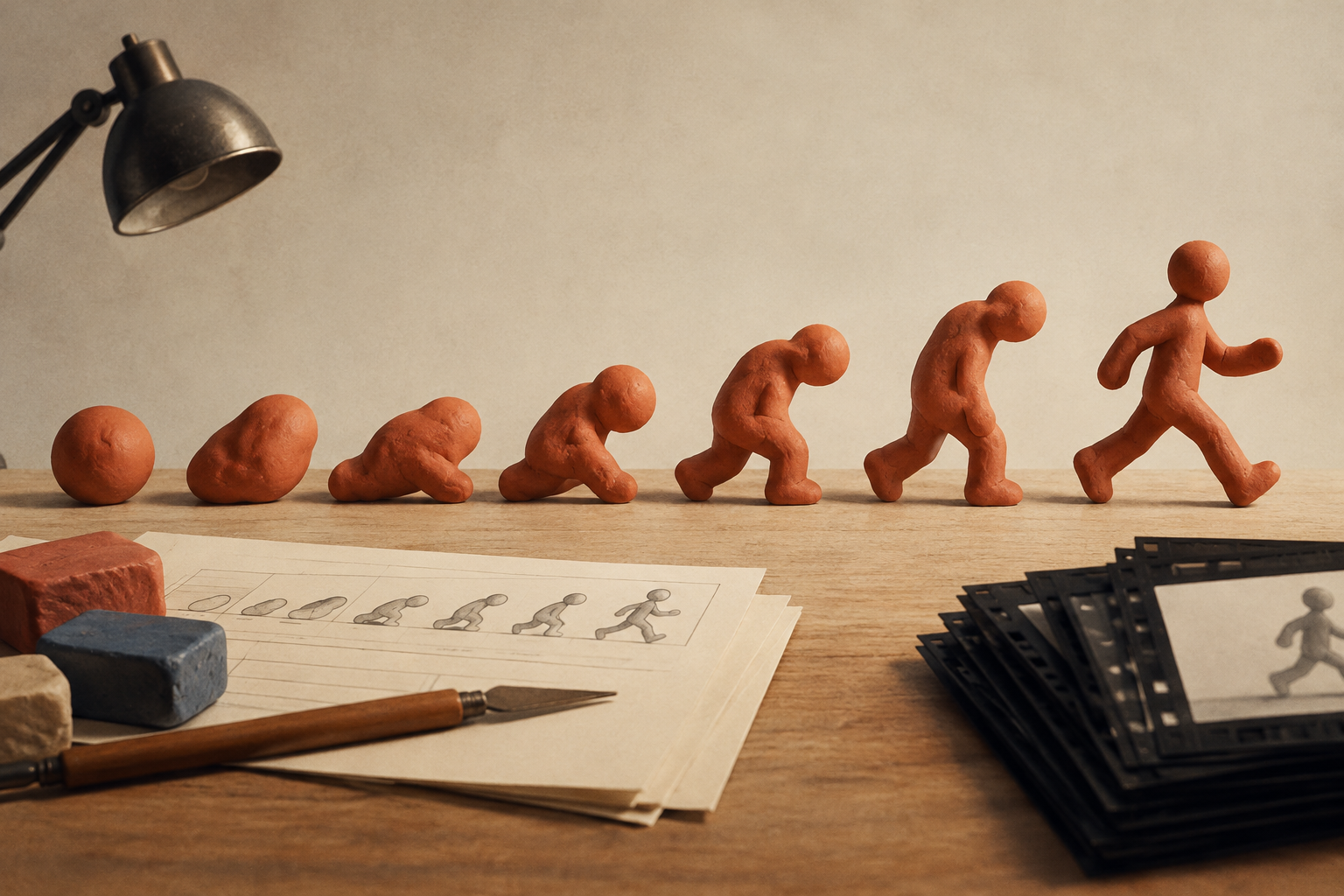
Clay animation turns malleable matter into movement through a succession of images captured after physical changes to a figure. That operation is more than a procedure: it makes a character’s shape, gestures and transformations depend on material intervention. To understand the technique historically, it is not enough to watch the projected result. Sketches and other production materials can help reconstruct decisions the finished film no longer explains, although the evidence available here cannot support a complete history.
A beginning that calls for caution
An academic source cited in the available material identifies two American films from 1908 as the first true clay animations: A Sculptor’s Welsh Rarebit Dream and The Sculptor’s Nightmare. The wording matters. It does not prove that no earlier experiments used objects or malleable materials; it establishes, more narrowly, what that source attributes to those two films. The year and titles offer a starting point, not a comprehensive chronology.
The distinction between clay animation and stop motion in its broader sense also requires care. A reference source describes stop motion as a category that can animate many kinds of objects and mentions clay figures among its common forms. Thus, not every frame-by-frame animation is claymation, and the presence of a malleable material alone cannot reconstruct how a particular work was made.
Movement as material work
In this technique, a figure changes between successive captures, and those variations are perceived as movement when the images are played back. The evidence describes this general principle but does not specify particular shooting processes, equipment, timings or continuity methods. It would be unwise to fill those gaps with a universal recipe: the sources document no particular production and do not establish that every work followed the same practices.
They do, however, support an aesthetic implication. Because the figure can be physically reshaped, changing form need not be an illusion added to an otherwise fixed image; it can become part of a scene’s visual language. This is an interpretation of the material process described, not a claim about any particular animator’s intentions. The technique’s history becomes clearer when material is considered as both a support and an expressive possibility.
What an archive adds to the film
A synopsis summarizes action and plot, but does not by itself show how a form was resolved, what alternatives were considered or which materials accompanied production. Sketches and working documents can offer clues to those decisions. Their value, however, depends on what has actually survived and on whether each item can be connected to the work. The supplied information supports the general importance of such materials, not the existence of a complete archive for the 1908 films.
This distinction changes the historical question. Rather than asking only what happens on screen, one can ask which traces allow us to describe how that image was made. An archive does not replace the film or provide direct access to artistic intention; it supplies partial evidence that must be read alongside the finished work and with its limits made clear.
From experiment to cultural circulation
The sources place animation with malleable materials within the broader history of stop motion and mention its use in film and television. They do not offer a detailed account of its consolidation, a reliable list of later productions or data with which to measure its reception. It is therefore possible to discuss the technique’s presence across media only in general terms, without assigning stages, milestones or influences that are not documented.
Its cultural significance also lies in the tension between craft and cinema. Viewers see a figure that seems to act, while the technique begins with matter that must be physically changed between images. The gap between a motionless object and perceived movement helps explain why the process deserves historical attention: the work is not only a narrative but also a record of a constructed transformation.
What can be said, and what remains open
The evidence provided supports a description of the frame-by-frame principle, a distinction from the broader category of stop motion, and the identification of two 1908 films that one source calls early examples. It also supports the potential value of sketches and production materials for examining aesthetic choices. It does not verify technical details of those films, establish a complete developmental line or provide an inventory of surviving archives.
That limit does not make the subject less valuable; it defines a more rigorous method. A history of clay animation should distinguish documented claims, interpretations grounded in materiality and questions that require primary sources. The concrete conclusion is that production materials matter because they reveal some of the work hidden by the screen—but only when each document is contextualized and not asked to prove more than it preserves.
- Decade
- 1950s
- Region
- Global
- Level
- Enthusiast
- Entities
- Televisión
Sources and references
- Gritos en plastilina. El dolor humano a través de la animación y la músicadoi.org · 2026-10-17
- Historia de la Animación: Técnicas y Orígeneses.scribd.com · 2026-10-17
- Animación stop motiontranslate.google.com · 2026-10-17
- La Animación Stop-Motion: Qué es, cómo se crea y ejemploswww.animum3d.com · 2026-10-17
- El cine de animacióneducomunicacion.es · 2026-10-17
- “Larry, despierta” Animación en stop motion - UP-RIDup-rid.up.ac.pa · 2026-10-17
- Historia del cine de animación | PDFes.slideshare.net · 2026-10-17
- Taller de animación `Stop Motion con Plastilina´www.madrid.es · 2026-10-17