A new medium on a different timetable
Television did not become domestic everywhere in the same way or at the same time. Mar del Plata offers a view of how a still-novel device moved from curiosity to a familiar part of the home—and how that process depended not only on price and availability but also on family relationships, habits, and the use of domestic space.
In her study of 1960–1970, Inés Pérez reconstructs this history through interviews with people who experienced the arrival of television and an analysis of contemporary discourse. Local broadcasting began in the city in 1960, when Canal 8 went on air. Until then, Argentine television could be received in Buenos Aires; residents of Mar del Plata had heard of the new medium before a local signal arrived. That difference in timing matters: shared viewing and the growing purchase of sets for private homes overlapped in the city.
Owning a television did not always mean being able to watch programs immediately. One interviewee’s family bought a set six months before Canal 8 began broadcasting. During that interval, the device was a promise as well as an object: waiting for the first program and trying to pick up distant signals were part of the experience.
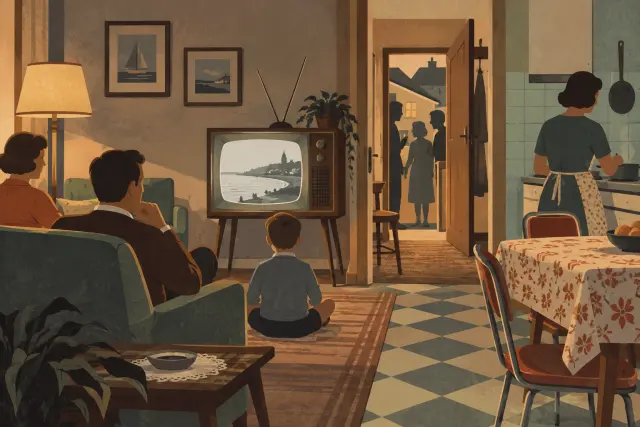
Television in someone else’s home
At first, sets were expensive, and many families did not own one. Watching could mean going to a neighborhood club, a community association, or a neighbor’s house. Pérez’s interviews suggest that children made these visits most frequently. Adults went less often, and memories of the visits do not always match: hosts might recall large groups, while visitors tended to describe themselves as considerate guests rather than members of a crowd taking over the house.
This was not merely a matter of scale. Sharing a television was not like borrowing a mixer or storing food in another family’s refrigerator. The set stayed in the host’s home and brought visitors together in front of the screen. The boundary between households became temporarily permeable for viewing, even though the television itself never left its owner’s home.
The local pattern did not exactly reproduce the experience of Buenos Aires. In the capital, viewing in public places had characterized television’s early years. In Mar del Plata, Pérez argues, watching together and acquiring sets for the home coincided. There was no single, orderly shift from public space to the family living room: different kinds of access and use existed side by side.
Living room, kitchen, and everyday work
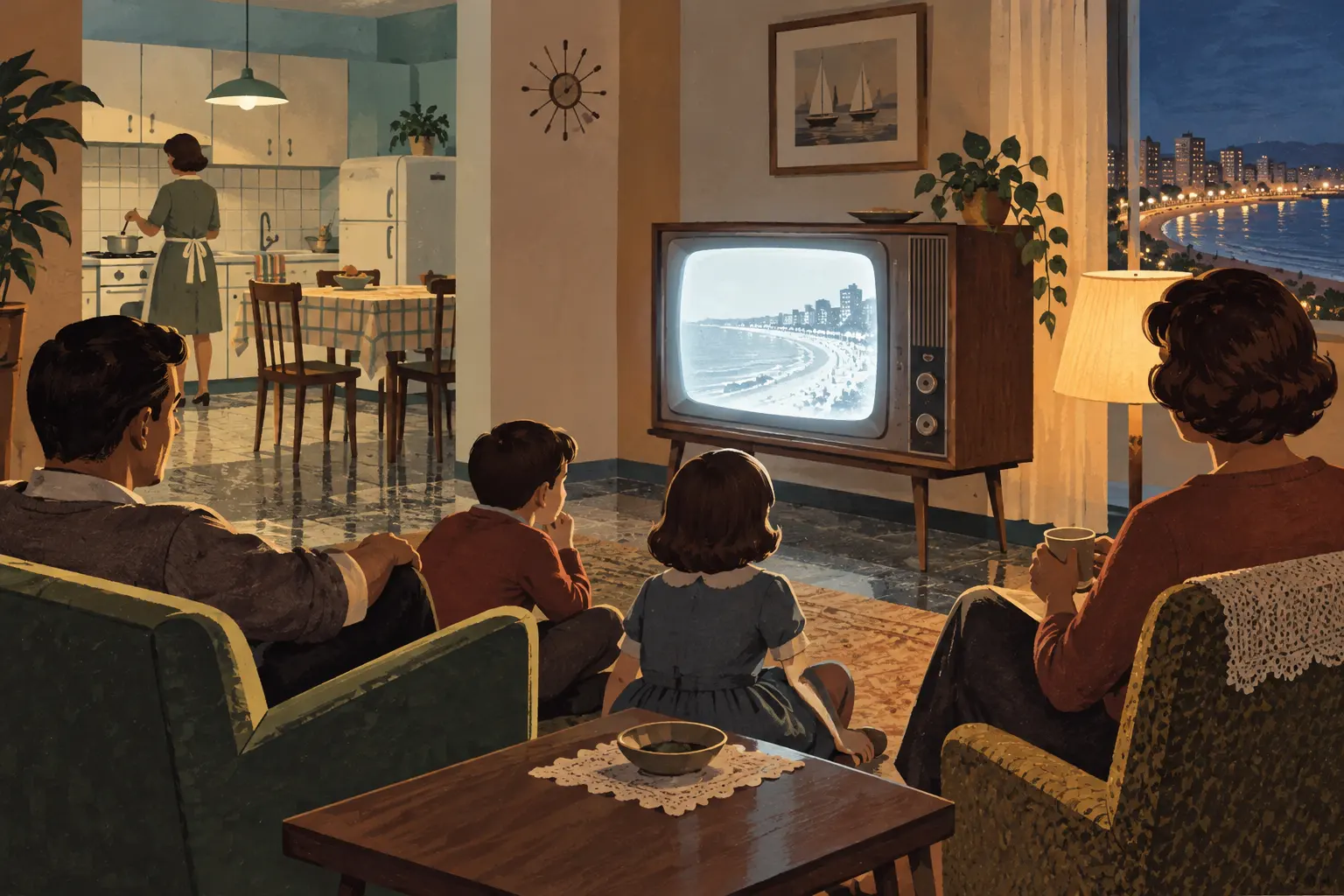
When families bought their first set, the living room or combined living-dining room was a common location. It could bring the family together, and visitors could see the television. Yet several accounts place the first set in the kitchen—a choice that cannot be explained simply by a family’s economic position.
The kitchen’s place in domestic discourse was changing. Magazines aimed at housewives increasingly presented it as a clean, comfortable, attractive room equipped with modern technology. In that context, a television could accompany household tasks and help make the kitchen a place to gather. Watching did not always require sitting quietly in front of a screen; it could happen alongside other activities.
That possibility coexisted with criticism. The press and accounts examined by Pérez include the idea that watching television could be a waste of time, especially when measured against housework. The set’s placement was therefore not a neutral decision about furniture. It was also bound up with who did the work, who could stop to watch, and how attention was distributed in the home.
The set as novelty, status, and memory
A television could signify modernity and social standing even as prices began to fall. Some families remembered with pride being among the first in their neighborhood to buy one. In one account, a father chose an imported Philips set because he wanted “the best”; decades later, the family still had the device. Its brand, origin, and cost were part of its meaning, beyond its ability to transmit programs.
Memories also vary by age. Adults tended to recall the set as a novelty, while those who had been children remembered waiting for the signal, broadcast schedules, and programs. For them, television became part of childhood and could seem, in retrospect, as though it had always been in the home. In some accounts, memory even shifts the dates, making the television appear to have been present from the narrator’s earliest years.
Pérez does not treat these differences as errors to be removed in pursuit of one definitive version. Interviews are narratives shaped by different family and generational positions; their emphases, silences, and disagreements help explain how people experienced the change. The history of domestic television is not simply a matter of counting sets sold. It also asks who had access, where the devices were placed, and what other activities shared the same space.
In Mar del Plata, television did not merely occupy a place in an already settled home. Its arrival altered boundaries between households, reorganized moments of togetherness, and brought the value of leisure into tension with work. The association between television and domestic life, later taken for granted, was made through concrete choices and negotiations.
- Decade
- 1960s
- Region
- Latin America
- Level
- Enthusiast
- Entities
- Televisión, Buenos Aires, Argentina, Inés Pérez
Sources and references
- Década de 1970 - Wikipediatranslate.google.com · 2026-11-07
- GALFER CUMPLE 70 AÑOS DE HISTORIAgalfer.com · 2026-11-07
- La domesticación de la “tele”: usos del televisor en la vida ...journals.openedition.org · 2026-11-07
- La Terceraes.wikipedia.org · 2026-11-07
- Historia de la modaes.wikipedia.org · 2026-11-07