Animation usually reaches its audience as a finished sequence: characters and objects seem to move continuously, while a synopsis explains what happens in the story. That result alone, however, cannot show how the material demands of making it were handled. An articulated puppet, its bases, and decisions to combine it with other techniques offer a way into that work. The evidence available here includes references to studies of animation in Chile and Peru and to Cuban television. Read cautiously, they show how production objects can act as documents, while also making clear that they cannot reconstruct a work in full.
From movement to construction
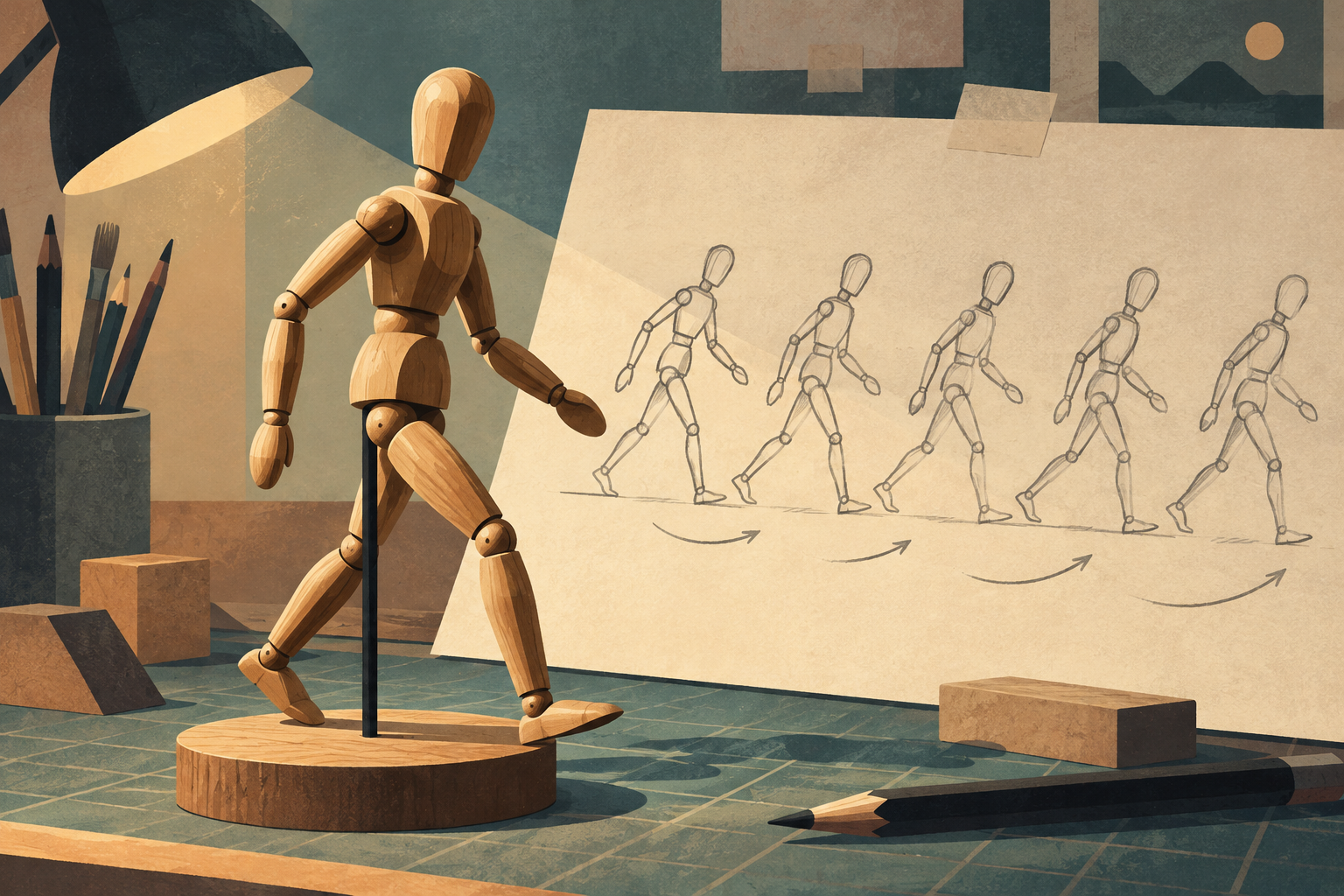
Puppet animation requires a character capable of taking different positions during production. A general history of animation describes the possibility of animating a character built around an articulated structure. This definition helps distinguish the production object from its final image: the puppet is not only the design seen on screen, but a material form that must make movement possible.
That distinction matters to animation’s cultural history. A synopsis may summarize actions and conflicts without recording the problems posed by a physical object or the solutions adopted. The puppet therefore connects two planes: it represents a character and participates in a working procedure. The evidence here supports that broad reading, but does not specify materials, particular mechanisms, or filming methods for individual productions.
A base is part of the process
A fragment from a study of Chilean animation history notes that several bases may be needed for a puppet because one can stop functioning. It is a small but revealing detail: the animated object is subject to use, and replacements or different supports may be necessary to keep production going.
The reference does not establish how many bases were made in a particular case, what they were made of, or when they failed. It does show that production records can preserve problems invisible in the finished work. Rather than treating a support as a minor detail, we can understand it as part of animation’s material infrastructure. This interpretation stays within the fragment’s limits: it records a possible need, not a universal procedure.
Techniques in combination
The source on Abel Molina and Cuban television animation mentions a form described as the union of drawing and the animated puppet. This indicates that work could bring different resources together rather than rely on a single technique. It also raises a specific historical question: how were visual and practical choices organized when drawings and articulated figures coexisted?
The material provided does not identify which productions used this combination, how work was divided, or whether the choice responded to resource constraints. It would therefore be unsound to present the mixture as necessarily economical or to assign it a particular artistic intention. The more limited claim is supportable: the cited documentation records techniques used together, a practice that a description focused only on plot might overlook.
The object as a document
A surviving puppet may offer clues about scale, articulation, maintenance, and its relationship to supports. A clue, however, is not a complete explanation. Reconstructing decisions requires connections between the object and other records, such as production documents, testimony, or images of the process. The sources available here are excerpts and references; they do not provide a catalogue of objects or a comprehensive analysis of a particular puppet.
This distinction is essential if interpretation is not to turn possibilities into facts. The need for several bases in the Chilean example does not prove that every puppet production faced the same issue. Nor does the Cuban reference to drawing and puppetry define a school or a general historical trajectory. Objects help researchers pose questions and narrow hypotheses, but their interpretation must remain tied to what has actually been documented.
What archives can recover
Historical studies of animation in Chile and Peru, alongside the reference to Cuban television work, place these questions in different contexts. They do not by themselves amount to a systematic comparison of countries, periods, or institutions. Their value here lies in showing that animation history can be approached through materials and practices, not only through finished works and their plots.
This approach broadens the idea of audiovisual heritage. An articulated puppet, a replacement base, or a record of combined techniques can help recover the conditions of creative work. Preserving such traces does not remove gaps, however: without information about provenance, use, and connection to a particular work, interpretation remains limited.
Reading without filling the gaps
The firmest conclusion is also a modest one. Articulated puppets and their supports can document technical needs and production decisions that a synopsis leaves out. The available references offer concrete indications—bases that may fail and a combination of drawing with an animated puppet—but do not permit a detailed reconstruction of the films or programmes involved.
Taking these limits seriously does not diminish the object’s interest; it makes the account more precise. The puppet is a starting point for studying how animation is made material, provided evidence is kept distinct from interpretation. The process then ceases to be an abstraction and appears as work sustained by objects, adjustments, and choices whose history merits documentation.
- Decade
- 1990s
- Region
- Global
- Level
- Enthusiast
- Entities
- Televisión
Sources and references
- La parentalidad en el cine documental animado ...repositorio.uniagustiniana.edu.co · 2026-10-17
- Historia de la Animación: Técnicas y Orígeneses.scribd.com · 2026-10-17
- El cine de animacióneducomunicacion.es · 2026-10-17
- Abel Molina y los animados de la televisión cubanawww.cubaperiodistas.cu · 2026-10-17
- El Cine de animación en el Perúcore.ac.uk · 2026-10-17
- HISTORIA DE LA ANIMACIÓN EN CHILErepositorio.uchile.cl · 2026-10-17