A preserved broadcast is not a schedule
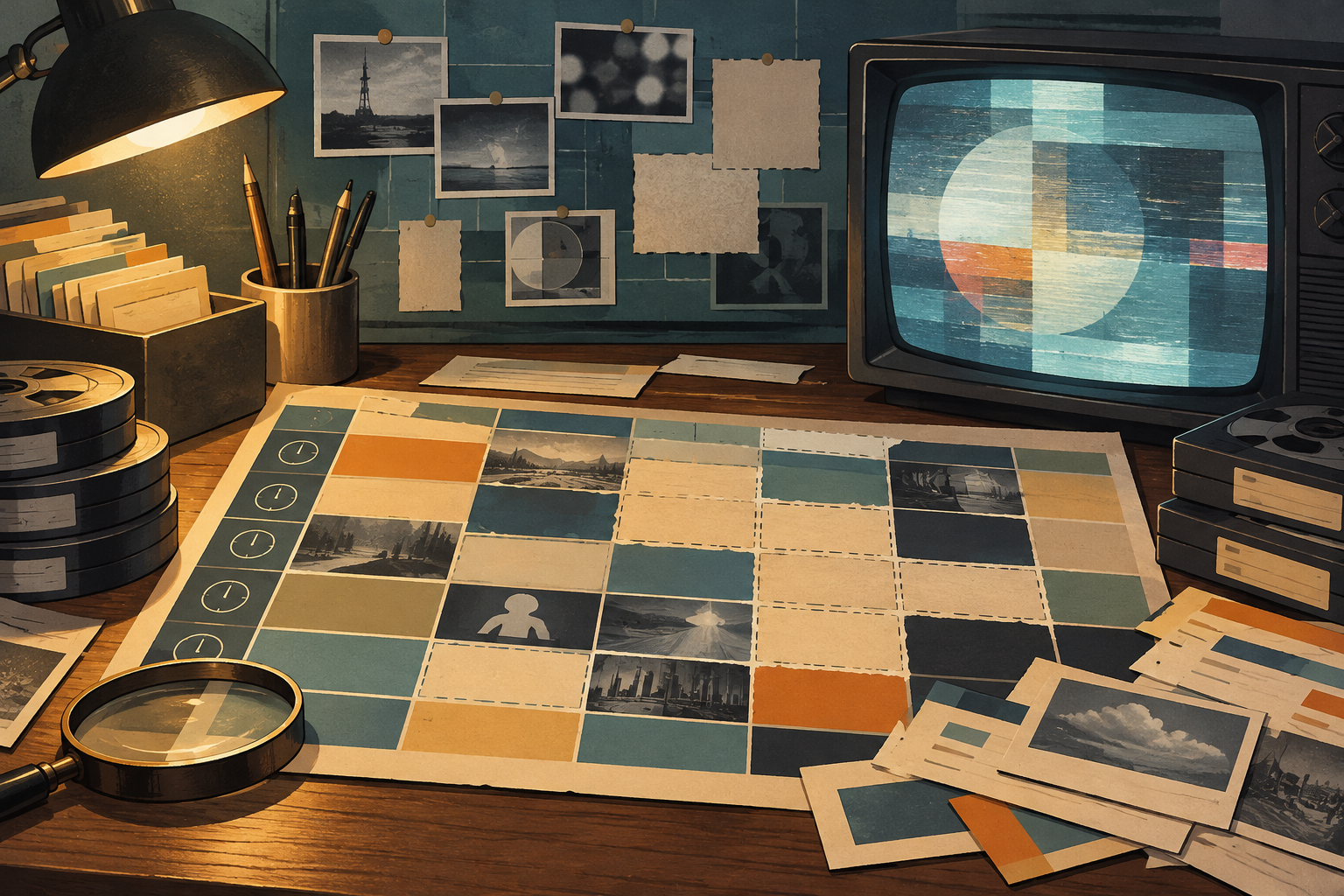
Finding a programme in an archive allows us to say that a copy or record is available there; by itself, it does not show what aired before or after it, at what time it was presented, or what filled the rest of the day. That distinction matters when studying television as both a medium and a shared timetable. A schedule is not merely a sequence of images: it is also an arrangement of time and an offer addressed to an audience.
The study on the preservation of television’s audiovisual heritage held at the Complutense University of Madrid offers a starting point for treating preservation as a heritage question. Its available summary places TVE’s first broadcast on 28 October 1956 and describes the archive as an institution that had accumulated decades of history. This reference helps frame questions about preservation, but the supplied extract does not detail record series, selection criteria, or finding aids. It should not be made to support more than it says.
Images, records, and silences
Reconstructing a broadcast would require comparing preserved images with sources that document programming: published schedules, internal documents, transmission records, or contemporary press. Without access to those specific materials, it is not possible to say which combination of sources survives for a particular day. Research must therefore distinguish located evidence from evidence that still needs to be sought.
Archives are also descriptive systems. A catalogue may make a title easy to find while omitting details important to researchers of schedules, advertising, continuity, or programming changes. A missing catalogue entry does not prove that a programme was never broadcast. It may reflect a preservation gap, incomplete description, or a search that failed to use the right name.
What the RTVE archive offers
RTVE presents its television archive as a collection of older programmes available through RTVE Play. It is a direct point of access and shows that the archive has a public life beyond institutional custody. Yet online availability does not amount to a comprehensive inventory of broadcasts. Nor does it by itself establish an item’s original transmission date, its place in the schedule, or the circumstances in which it was recorded.
This distinction matters to viewers. An online selection makes it easier to watch programmes again, but the experience of viewing them now does not necessarily reproduce their original reception: the order of access, the ability to choose, and the absence of a shared timetable alter the frame in which they are watched. That is an interpretation of a change in access, not a claim about specific viewing habits that the sources gathered here do not measure.
Preservation and reconstruction are different tasks
An academic work indexed at HAL raises, in its title, the question of whether Spanish television archives should be understood as heritage or as a shop. That question points to an institutional and editorial tension, but the supplied record is not enough to summarise the work’s conclusions. A rigorous account would need to consult the full text before attributing specific arguments to it.
The 2007 book chapter La televisión, by Emíli Prado, Matilde Delgado, Núria García-Muñoz, and Gemma Larrègola Bonastre, is another identifiable reference for broadening the framework. The information supplied here confirms its existence and authorship, not the detailed contents of its chapters. A bibliographic record can guide further research; it cannot replace reading the work.
Reading a schedule without filling it in by imagination
A useful reconstruction should identify the document behind every detail, distinguish a scheduled time from a recorded transmission time, and make gaps visible. If one source gives a title, another a time, and an archive preserves a recording, those pieces can be compared; their connection must be checked to establish that they refer to the same broadcast. Without that check, the connection remains a hypothesis, not a fact.
Researchers should also avoid turning an accessible collection into a total history of television. Preserved and described materials are valuable evidence, but they represent only what can be identified in the holdings consulted. The sources available for this proposal cannot provide a specific daily schedule or measure when viewing habits changed as recording became possible. They do, however, suggest a research route: distinguish catalogue, broadcast, and reception; trace records of scheduling; and make clear where evidence ends. The archive is not a supposedly complete window, but what it is: an indispensable yet partial source.
- Decade
- 2000s
- Region
- Spain
- Level
- Enthusiast
- Entities
- Televisión, RTVE Play, Televisión Española
Sources and references
- La televisiónopenalex.org · 2026-10-10
- Preservación del patrimonio audiovisual de televisión El ...eprints.ucm.es · 2026-10-10
- Archivo de Televisión Española | Ver en RTVE Playwww.rtve.es · 2026-10-10
- Los archivos televisivos españoles, ¿ Patrimonio o tienda ...hal.science · 2026-10-10
- Televisión Nacional de Chilees.wikipedia.org · 2026-10-10