Reading a home through its traces
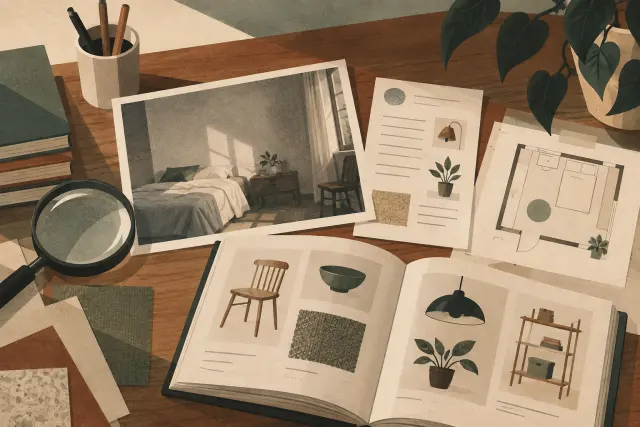
Photographs, catalogues and records describe different aspects of an interior. Comparing their roles helps frame useful questions without mistaking a partial image for a complete reconstruction of a room.
Open storyFurniture, lighting and objects shaped rooms and accompanied life at home. This landing page explores those interiors through their spaces and furnishings, without confusing the evocation of a period with historical reconstruction.
Readings to help you find your bearings.
Photographs and catalogues help us understand how an interior was arranged and who used it. Aesthetic choices coexisted with practical needs and different ways of living in each space.
This landing page focuses on domestic spaces and objects. Design explores the visual languages that shape them, while Everyday Life looks at the social practices that take place within them.
Three perspectives on the archive.
Room layouts and the ways domestic spaces were used.
Reading a home through its traces Photographs, Inventories and Objects: Reconstructing Life at HomeFurniture forms, materials and surface finishes.
Decoration can also be read as industrial history Furniture Leaves a Paper Trail: Reading Design Through the MNAD ArchiveLighting and objects that transform the feel of a space.
Restoring an Ambience: the Museo Cerralbo Case and the Limits of Bringing a House Back to Life Restoring an Interior: The Recovery of the Museo Cerralbo and Why Documenting Change MattersA historic interior cannot be reconstructed from a single photograph or inventory. Images, documents and surviving objects offer different clues about how a home was arranged, used and inhabited, while also revealing the gaps and choices that shape what can be known today.
Read articleThe building, conceived in 1860, was completed in 1892 after more than thirty years and three architectural projects. The archive record says the National Archaeological Museum moved there from that year, linking its history to a monumental new home.
Read articleIn the context of the National Historical Museum’s creation, buildings of the former War Arsenal were expanded and decorated with neocolonial features to host the event. The documentation does not detail the specific decorative choices.
Read articleThe restoration affected the façade, a building wing, the staircase and the rooms’ decoration, as well as the corridors and garden. The source does not specify the colours, materials or motifs used.
Read articleArgentine television began its broadcasts in Buenos Aires, establishing the starting point for the medium's diffusion in the country.
Read articleCanal 8 began broadcasting in Mar del Plata, marking the start of a local television experience for families in the coastal city.
Read articleA historic interior cannot be reconstructed from a single photograph or inventory. Images, documents and surviving objects offer different clues about how a home was arranged, used and inhabited, while also revealing the gaps and choices that shape what can be known today.
In 1960s Mar del Plata, television was not domestic from the outset. High prices, the arrival of local broadcasts and visits to watch at someone else’s home made viewing a shared practice shaped by age, economic means and ideas about household life and work.
Television arrived in Mar del Plata in 1960, after viewers in Buenos Aires had already encountered the medium, but households still had to decide where the set belonged and who could watch. Inés Pérez’s oral-history study traces a transition marked by children visiting neighbors to see programs, televisions appearing in kitchens as well as living rooms, and different expectations across generations.
Donated by Wulf Köpke to Madrid’s National Museum of Anthropology, a collection of 355 objects offers a way to explore rooms in a bourgeois Berlin home from the early twentieth century. Its value lies in the furniture and utensils, but also in the relationships between objects, documents and museum decisions that make it possible to reconstruct a domestic space without claiming to reproduce it completely.
PlayStation Home and IMVU made three-dimensional rooms more than chat backdrops: they were customizable spaces for welcoming others and controlling access. Their different combinations of private homes, shared venues, and virtual objects show how online social life was organized.
Photographs, catalogues and objects can help explain how a home was arranged, but none reveals everyday life on its own. Reading their contexts, materials and traces of use allows for more grounded interpretations without confusing documentation with display.
Canal 8’s arrival in 1960 did not immediately turn television into a private family possession. Drawing on interviews in Mar del Plata, historian Inés Pérez traces an uneven adoption shaped by expensive sets, children watching at neighbours’ homes, and televisions placed in either living rooms or kitchens.
A group of 355 everyday objects at Madrid’s National Museum of Anthropology offers a way to study rooms in an early-twentieth-century bourgeois Berlin home. Photographs, inventories and archives help connect the objects, while also revealing the limits of reconstruction and the role provenance plays in the histories museums can tell.
Furniture, photographs and inventories offer different clues to domestic life. Read alongside archival records and the history of a collection, they help researchers study an interior without mistaking a plausible interpretation for a complete reconstruction.
Furniture, photographs and inventories can help explain how a home was organized, but no object tells its whole story on its own. Collections at Madrid’s National Museum of Anthropology and Colombia’s National Museum show why sources must be read together—and why historical evidence should be distinguished from museum display.
Inventories, wills and dowry records reveal how furniture in colonial Córdoba shaped visits, marked differences in wealth and helped organize domestic spaces structured by gender hierarchies.
Household objects offer clues to everyday life, but their meaning depends on how they relate to photographs, inventories, catalogues and archives. Reading these sources together helps reconstruct fragments of a home without confusing documentation with interpretation.
Editorial review ·