The interior as a body of evidence
A historical domestic interior cannot be reconstructed simply by assembling furniture that looks right for a period. Understanding how a home was organized requires connecting objects with evidence of where they were, how they were used and how they came into a collection. Photographs, inventories, catalogues and personal documents each contribute different information; none provides a complete picture on its own.
A photograph can show an arrangement, but it is not a neutral window. Its frame leaves things out, and the placement of furniture may have been deliberate. An inventory may identify possessions without explaining where they stood. A surviving object can reveal materials, techniques, wear or repairs, but not necessarily who used it. Reconstruction begins by comparing these differences, not by smoothing them over.
A collection linked to a Berlin home
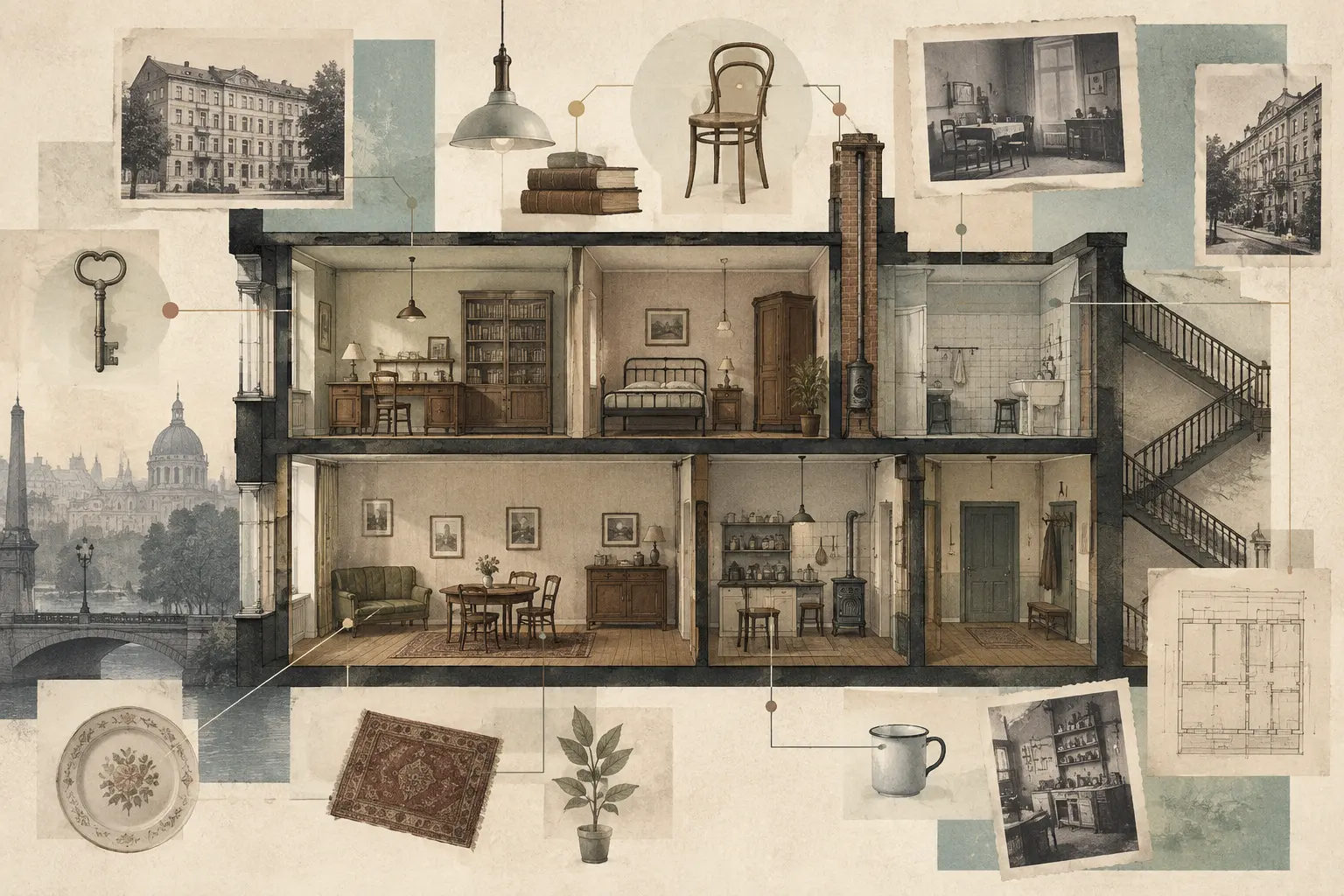
Among the European holdings of Madrid’s National Museum of Anthropology is a group donated by Wulf Köpke, a curator at Berlin’s Ethnological Museum. The collection description says that its 355 everyday objects help reconstruct different rooms in a bourgeois Berlin home from the early twentieth century. The group consists mainly of furniture, household utensils and other objects associated with urban life.
The collection offers a specific entry point into domestic material culture. It allows researchers to ask how objects related to one another and what activities may have taken place in different rooms. Its value, however, does not lie in presenting an intact house transferred to a museum. It is a collection that helps reconstruct rooms, not a complete reproduction of a dwelling in its original setting, with all its elements and relationships preserved.
That distinction matters because a museum arranges objects under conditions different from those of an inhabited home. Objects may be stored together as part of a collection, displayed separately or grouped to support interpretation. A present-day display should therefore not be mistaken for the original domestic arrangement. Reconstructing that arrangement requires records linking objects to spaces, images or inventories.
Provenance is part of the account
A collection’s history shapes what can be known about its objects. Provenance, acquisition dates, descriptions and links to photographs or other records help establish connections and identify gaps. If a group was formed through donations or transfers between institutions, those movements are part of its history, not an administrative footnote separate from interpretation.
It also matters which objects entered the museum and which did not. A selection of furniture and utensils may illuminate urban ways of life, but it does not automatically represent every Berlin home or every social experience of the period. Describing this home as bourgeois places the group within a particular social framework. That precision prevents a single case from being turned into a general portrait of the population.
The collection can offer clues about everyday life without answering every question it raises. A household object suggests possible functions; assigning it a specific use, locating it in a particular room or identifying its user requires documentary support. Where that connection is absent from the records, interpretation should remain a hypothesis or stay within what is documented.
From observation to careful reconstruction
A useful method combines sources without treating them as interchangeable. Photographs can offer clues about spatial arrangements; objects provide evidence about materials, manufacture and possible uses; inventories and archives help identify possessions and trace their histories. Comparing these records can suggest relationships between objects, while keeping distinct what is documented and what is inferred.
Seen this way, reconstruction does not mean filling every gap with an imagined scene. It means making visible the connections supported by evidence and acknowledging the questions that remain open. What activities took place in each room? What practical needs shaped its organization? Which social groups appear in the collection, and which do not? In the Berlin case, describing the home as bourgeois allows those questions to be posed from a specific social position rather than from an assumed universal idea of domestic life.
Objects, images and archives make it possible to study the home as material culture: a space organized for living, working and everyday tasks, but also a history that reaches the museum through choices about preservation and selection. Reconstructing it means attending to the things themselves, the records that accompany them and the limits of what each source can establish.
- Decade
- Before 1950
- Region
- Global
- Level
- Introduction
- Entities
- Museum
Sources and references
- Desarrollo y conservación del patrimonio cultural-natural en el contexto neoliberal y nuevas tecnologíasdoi.org · 2026-11-02
- Conservación y Restauración del Patrimonio Cultural en soporte Papel - Museo Jesuítico Nacional de Jesús Maríadoi.org · 2026-11-02
- Museos de moda del mundo: por qué son archivos vivosinstitutodemoda.com · 2026-11-02
- Museo Nacional de Colombiaes.wikipedia.org · 2026-11-02
- Museo Nacional de Antropología (España)es.wikipedia.org · 2026-11-02