The interior as a historical source
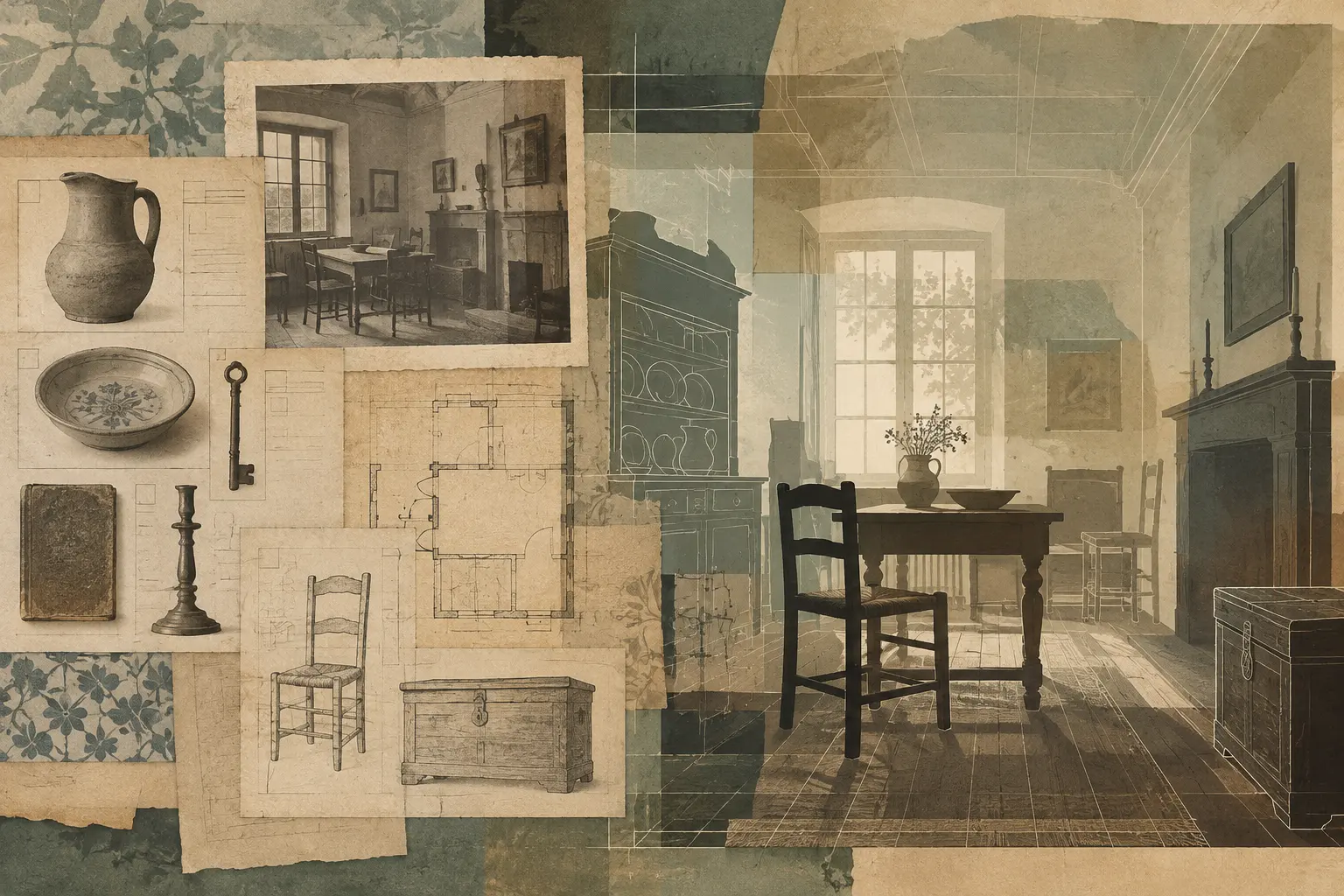
A room cannot be reconstructed from a single image or an isolated object. To investigate how a home was arranged and used, furniture, utensils, textiles and decorative objects must be considered alongside photographs, inventories, catalogues and provenance records. Each source answers different questions: a piece of furniture offers clues about materials and possible uses; a photograph records one arrangement from a particular viewpoint; an inventory may list what a house contained without explaining how its contents were used.
Museum collections show both the promise and the difficulties of this work. Madrid’s National Museum of Anthropology holds a European collection that includes domestic objects and furniture. Among its holdings is a group assembled by Wulf Köpke, curator at Berlin’s Ethnological Museum, made up of everyday objects that can help reconstruct rooms in an early twentieth-century bourgeois Berlin home. It is a valuable starting point, but not an intact house transferred to a museum: interpretation depends on knowing how the group was assembled, which objects it contains and what documentation accompanies them.
What an object can tell us
Objects do not speak for themselves. Their value as evidence depends on information that places them in context: provenance, date, materials, manufacture, repairs and relationships with other pieces. Research on textiles in Spanish museum collections reflects a shift in how they are understood: no longer only consumer goods, they are also treated as evidence of ways of living and making. The same perspective applies to furniture and utensils. Wear, alteration or repair may record an object’s use rather than constitute a defect to be erased.
Records extend what can be learned from an object. A photograph may show where things stood and how they related within a room; a catalogue can trace their classification; an acquisition document may identify who collected them and under what circumstances. Comparing these sources helps distinguish documented information from interpretation. A room arranged in a museum can help us picture an interior, but it is not automatically a complete reproduction of a historic home.
Photography: evidence and framing
Images are essential to research on interiors, but they have their own limitations. The frame selects what appears, the camera fixes a moment, and the purpose of the photograph influences how it is presented. A domestic photograph may show an actual arrangement without explaining whether it was everyday, exceptional or staged for the camera. Comparing it with other images and written records helps prevent one photograph from being treated as a complete account of a home.
Museum photographic holdings can document collections, exhibitions and recording practices. The National Museum of Anthropology preserves graphic materials in different formats and techniques, connected to the institution’s history and the formation of its collections. To study an interior, it matters who made an image, when and for what purpose, as well as which objects are visible. Photography provides spatial clues, but it also belongs to a history of classification and representation.
A collection has a history of its own
A collection is not a neutral sample of all homes from a given period. Its objects reflect decisions about acquisition, preservation and classification, and may represent regions, social groups or domestic activities unevenly. The history of Colombia’s National Museum offers an example of how collection-organising criteria change and how institutional narratives shape the representation of a nation. Exhibiting objects also constructs a story.
When visiting a gallery or consulting an archive, it helps to distinguish three levels: the object that survives, the documented information known about it and the interpretation proposed by the museum. It is also worth asking which voices and practices are absent. Furniture and objects from a bourgeois home can reveal much about one way of life, but they cannot by themselves describe domestic experience across an entire society.
The National Museum of Anthropology in Madrid also shows how European collections have taken shape through different processes, including donations, purchases, fieldwork and transfers between museums. The Berlin group assembled by Köpke is notable for its ability to evoke rooms in an urban home; other holdings may be organised around individual objects or different categories. How a collection entered a museum, and what documentation survives, affects the questions researchers can ask.
Reading sources together
Reconstructing an interior is an exercise in comparison. Examine the objects and their materials, study images, consult catalogues and archives, and consider conservation conditions. Then relate spatial arrangements to practical needs and social uses, without confusing a plausible hypothesis with an established fact. Photographs help show how a space was presented; objects provide material evidence; records trace their histories and support discussion of their context.
Decoration thus becomes more than a repertoire of styles: it becomes a source for studying domestic life. A room can reveal resources, customs and hierarchies when its contents are read alongside their records and the limits of each interpretation are acknowledged. Archives and collections are not transparent windows onto the past. They allow us to ask more precise questions about who lived in a home, how its objects were used and which parts of that life have survived.
- Decade
- 2000s
- Region
- Global
- Level
- Introduction
- Entities
- Museum, Museo Nacional de Colombia
Sources and references
- Desarrollo y conservación del patrimonio cultural-natural en el contexto neoliberal y nuevas tecnologíasdoi.org · 2026-11-01
- Los tejidos en las colecciones de los museos españoles, una larga historia de valoración y conservaciónopenalex.org · 2026-11-01
- Museos de moda del mundo: por qué son archivos vivosinstitutodemoda.com · 2026-11-01
- Museo Nacional de Colombiaes.wikipedia.org · 2026-11-01
- Museo Nacional de Antropología (España)es.wikipedia.org · 2026-11-01