The history of television in Mar del Plata does not begin when every family could own a set. In the early years of local broadcasting, watching television could mean going to a club, a neighbourhood association or a neighbour’s home. In historian Inés Pérez’s account, these journeys—and the choice to place a set in the living room or the kitchen—show that television’s place in domestic life was built gradually and unevenly, in ways that differed from the experience usually associated with Buenos Aires.
Pérez examines this process in her article Domesticating the TV: The Uses of Television in Everyday Life. Mar del Plata (Argentina), 1960–1970. Her research draws on interviews with 21 people who lived through the spread of television sets in the city. Their recollections do not form a single, uniform memory: age, gender, social position and family relationships shape both what people recall and how they tell it. Pérez reads the interviews alongside photographs and contemporary discourse to ask not only where the set stood, but who used it and what owning one meant.
A late arrival—and one people anticipated
Argentine television began broadcasting in Buenos Aires in 1951, but until 1960 its signal could be received only there. That year, Canal 12 began operating in Córdoba and Canal 8 in Mar del Plata. For the coastal city, this marked the start of local television; for many households, buying a set remained an expensive decision. The interviews Pérez studied often place the arrival of a television at home around 1966 or 1968, although some families bought one earlier.
Cost was not the only consideration. Owning a television could signify modernity and status, but the new appliance could also inspire suspicion. One interviewee recalled that her mother resisted having “that machine” in the house, even though she and her daughters watched television elsewhere. As the daughter understood it, the objection was directed at the unfamiliar object in the home, not necessarily at watching television itself.
The first years therefore combined public viewing with the gradual adoption of television in private homes. Some families shared a set with relatives; others went to clubs, neighbourhood associations or neighbours’ houses. In the accounts Pérez collected, it was chiefly children who went to watch. Adults did so less often, while for younger viewers another household could become a familiar extension of their own space for play and socialising.
This should not be mistaken for a simple continuation of earlier communal practices. Pérez notes that sharing appliances such as cookers and refrigerators had been more common among previous generations, but was less typical by the 1960s. The television again crossed the threshold between homes, but in a particular way: it was mainly children who went to watch at a neighbour’s house.
Where the set stood shaped domestic life
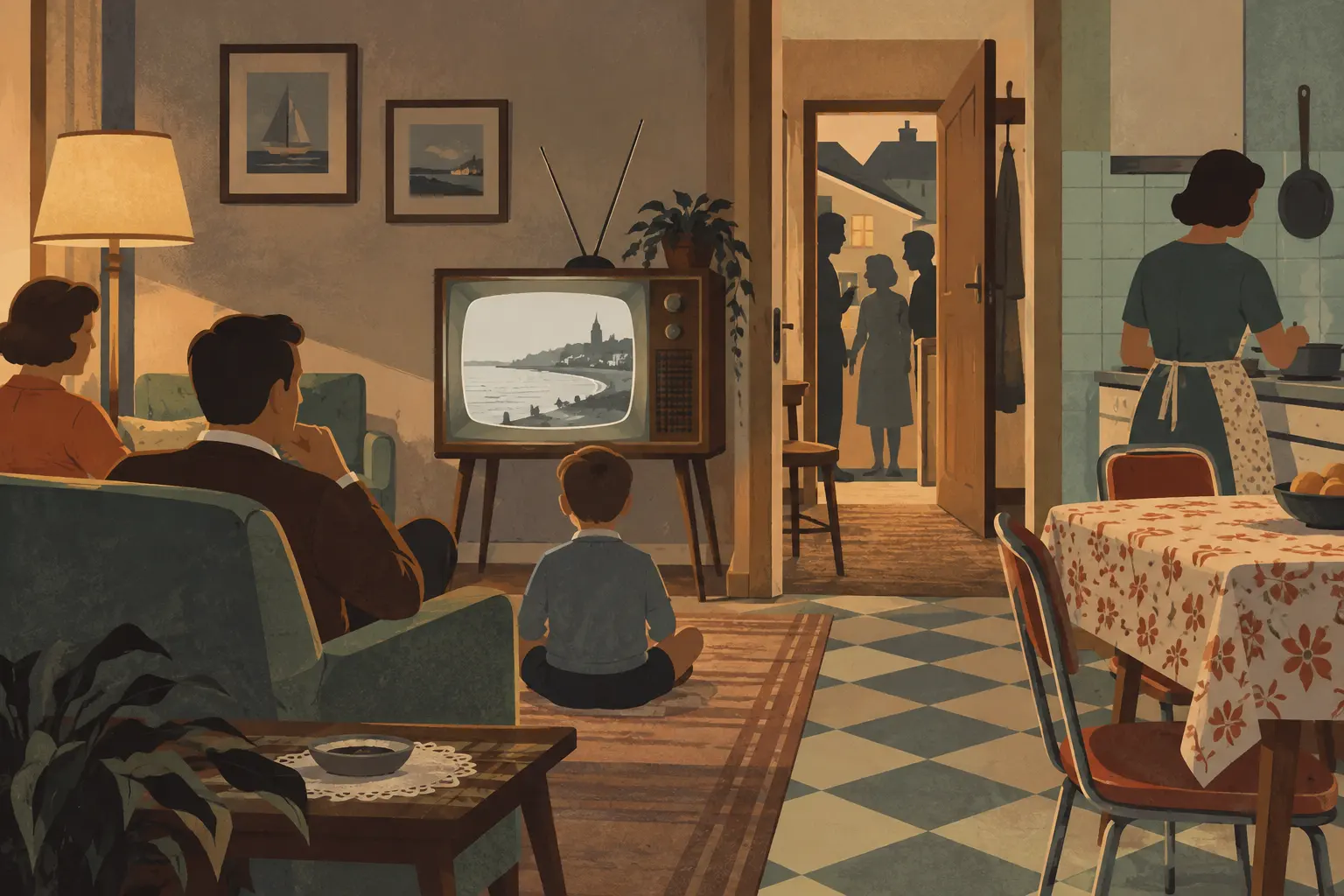
When a television entered a home, it might be placed in the living room or combined living-dining room, shared spaces where visitors could see it too. In other households, it went into the kitchen. Pérez cautions against explaining this difference solely by social class: among her interviewees, families from different backgrounds chose the kitchen. Placement reflected family habits and the way work and time were organised at home.
In the kitchen, television could accompany an activity already under way. It did not always demand undivided attention: someone could follow the sound while working and turn to the screen at particular moments. But this overlap between entertainment and domestic labour had a gendered dimension. Articles and advice aimed at housewives could portray television as a distraction from household tasks; at the same time, putting a set in the kitchen made it possible to watch without entirely stopping work.
The choice of room was therefore more than a matter of decoration. It reflected expectations about who should work, rest or be entertained in each space, and how those uses were negotiated within a family. In the living room, the set could gather family members and remain on view to guests. In the kitchen, it became part of the routines of those who spent much of their day there.
The television was also displayed as a valuable possession. Some interviewees remembered their families taking pride in buying an expensive set early. Its brand and price could be associated with modernity and progress. One family’s purchase of an imported Philips television before Canal 8 began broadcasting illustrates both the cost and the distinction of being among the first to own one. Possession could signal status even before the appliance had become an established part of everyday life.
Waiting for broadcasts, and remembering them
The arrival of the local channel did not coincide with the arrival of a television in every home. One couple interviewed by Pérez remembered buying a set about six months before broadcasts began and impatiently waiting for Canal 8 to go on air. For children, that wait and the programmes that followed could remain vivid memories. Adults, by contrast, sometimes recalled television for the time it kept their children occupied.
Other accounts show how memory can compress separate dates. One interviewee initially thought the television had been in her home since she was born; a conversation with her sister led them to reconsider the memory and connect it to the start of local broadcasting. The episode points to an important distinction: establishing a chronology is not the same as understanding how an object came to feel like a natural part of the home. Oral testimony helps investigate both, provided its emphases, hesitations and reinterpretations are taken seriously.
Even families that waited years to own a set could watch major broadcasts on a borrowed television or at someone else’s home. The Cortés siblings, for example, remembered watching the Moon landing on a television lent to them by a neighbour. The event helped them date the arrival of a set in their own home, but it also shows how a broadcast could bring people together when they did not yet own a television.
A home without a single model
The Mar del Plata case describes neither a uniform transition nor a universal model of the Argentine home. Canal 8 began broadcasting in 1960, but households bought televisions at different times, and their uses depended on resources, age, family habits and individual expectations. A television could be a conspicuous status object, company while someone cooked, a reason for children to visit neighbours, or a novelty some adults preferred to keep out of the house.
Photographs help reconstruct the material arrangement of rooms; interviews reveal the movements, routines and meanings that images alone cannot show. Together, they demonstrate that domesticating a technology is not simply a matter of bringing it into a house. It also involves deciding where it goes, how it is shared and which activities it accompanies. In Mar del Plata, television became domestic through those choices, while connections between home and neighbourhood persisted.
- Decade
- 1960s
- Region
- Latin America
- Level
- Introduction
- Entities
- Televisión, Buenos Aires, Argentina, Inés Pérez
Sources and references
- Manuel Casado Ariza, "La cerámica con decoración geométrica del Carambolo"doi.org · 2026-11-03
- Década de 1970 - Wikipediatranslate.google.com · 2026-11-03
- usos del televisor en la vida cotidiana. Mar del Plata ...journals.openedition.org · 2026-11-03
- Historia medieval de Españaes.wikipedia.org · 2026-11-03
- Historia de la modaes.wikipedia.org · 2026-11-03