The interior as a historical source
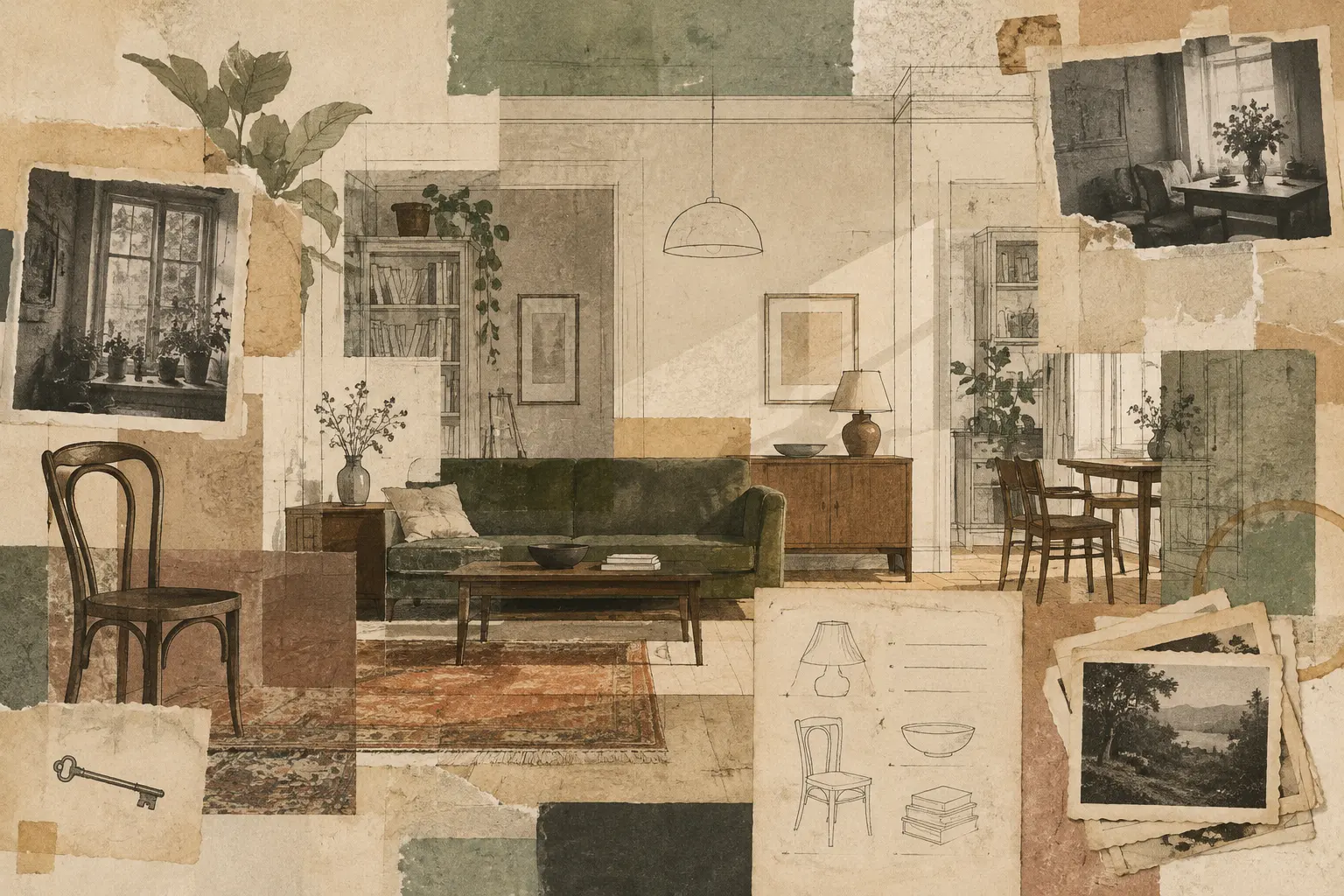
Reconstructing a home from the past means bringing different kinds of evidence together. Photographs may show how a room was arranged; inventories may record possessions and descriptions; surviving objects make it possible to examine materials, techniques and wear. None provides a complete picture on its own. Much of their value lies in comparing them and asking what each records, for what purpose and from whose perspective.
Domestic decoration can therefore be read as more than appearance: it is part of material and social life. The placement of furniture, work surfaces, storage and lighting raises questions about the activities that took place at home and who could use its spaces. These are historical questions, not automatic answers. Interpretations need to be supported by evidence that converges.
What a photograph shows—and leaves out
A photograph records a particular scene, not a room in all its complexity. The frame excludes areas; lighting may conceal details; and a space prepared for the camera may not reflect its usual appearance or use. An image can locate a piece of furniture or an appliance, but it rarely explains who used it, how often or what it meant to the people who lived there.
The circumstances in which a photograph was made help interpret what it depicts. Comparing several images can reveal what remained consistent and what changed; knowing how and why they were taken may help distinguish an everyday scene from a presentation arranged to be seen. Even then, a photograph does not speak for itself: a visible arrangement does not prove a particular use, and an apparently empty room tells us nothing about who did the work that kept the home running.
Inventories and objects: records with different reach
Inventories, catalogues and archival documents may provide names, quantities, descriptions and relationships between possessions. But an inventory serves a particular purpose and reflects the categories of the person who compiled it. It may focus on items with economic or legal value, leave out everyday things, or describe some rooms in greater detail than others. A list should not be mistaken for a comprehensive portrait of a home.
Furniture and household objects offer another kind of evidence. Their form, construction, materials, repairs and signs of use can help researchers consider their function. A table, for instance, might have been used for work or gathering; that reading would need to be tested against its dimensions, marks of wear and documented location. Objects may also move or change function over time. Their provenance and relationship to other records matter as much as their present appearance.
Cross-referencing sources brings both agreement and discrepancy into view. If a photograph suggests a layout and a document records an object, each offers a different kind of information. The aim is not to force every source into one version of events, but to explain what supports an interpretation and where more than one possibility remains open.
Absence is part of the record too
An object or practice missing from a photograph or catalogue is not proof that it did not exist. An interior photograph may exclude the people who performed domestic work; an inventory may omit ordinary things; and a collection of objects may reflect choices that favoured particular materials, owners or styles. Such absences invite us to examine how the record was made and whom or what it left out.
The history of collections matters as well. Objects that enter a museum or archive are not necessarily a balanced sample of domestic life. Acquisition and preservation decisions may give greater visibility to striking pieces or those associated with recognised owners, while ordinary objects and poorly documented labour remain less visible. Keeping this filter in mind prevents us from treating what survives as a complete representation of the past.
Conservation and material history
When an object enters a collection, its documentation may bring together information about provenance, materials, techniques, dimensions, repairs and context of use. This turns an object into a researchable source that can be compared with other evidence. For textiles, material history may include use, repair, alteration and reuse—processes that belong to an object's life, rather than interruptions to some presumed original state.
Conservation also shapes access. Light, humidity, heat, dust, pests and handling can damage textiles, so not everything can remain on display permanently. An exhibition presents a selection under particular conditions, not an entire collection or necessarily the setting in which the objects were used. Conservation records and archival images help distinguish the historic object from later decisions about storage, mounting and display.
Reconstructing without erasing uncertainty
Reconstructing an interior involves several scales: the room as a whole, the objects it contains and the traces of manufacture and use they preserve. Photographs and catalogues can guide research; inventories and archives provide context; objects allow close examination of materials, structures and wear. Comparing these sources helps us understand how aesthetics and practical needs related to one another, and to ask who took part in everyday life at home.
A rigorous reconstruction does not turn clues into certainties. It explains what the evidence can support, distinguishes observation from interpretation and preserves questions the sources cannot resolve. The interior then becomes more than a static backdrop: it emerges as a space of relationships, tasks and decisions whose history can be pieced together from partial testimony.
- Decade
- 2000s
- Region
- Global
- Level
- Enthusiast
- Entities
- Museum
Sources and references
- Los tejidos en las colecciones de los museos españoles, una larga historia de valoración y conservaciónopenalex.org · 2026-11-08
- Museos de moda del mundo: por qué son archivos vivosinstitutodemoda.com · 2026-11-08
- CONSERVACIÓN Archives - Página 4 de 5evemuseografia.com · 2026-11-08
- Museo Nacional de Colombiaes.wikipedia.org · 2026-11-08
- Museo Nacional de Antropología (España)es.wikipedia.org · 2026-11-08