Furniture did more than equip homes in late-eighteenth-century Córdoba: it also shaped the social life taking place within them. In inventories, wills and dowry records, Cecilia Edith Moreyra finds evidence of how people received visitors, arranged rooms and made differences of wealth and gender visible. The documents describe specific possessions, but reading them also raises questions about the practices and relationships that gave each space its meaning.
The reception room: welcoming guests and marking rank
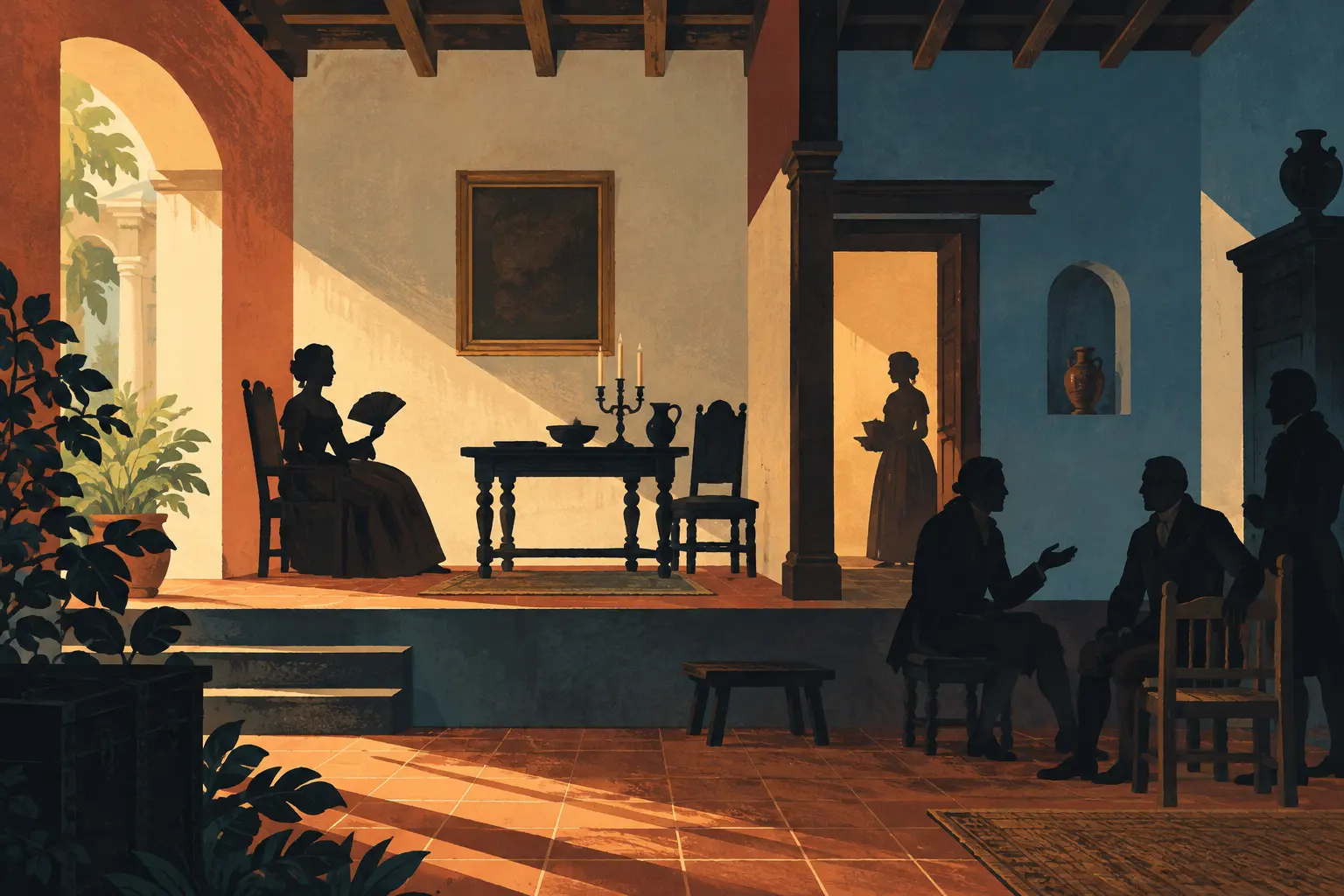
In affluent homes, the reception room was a major setting for sociability. Seating could be plentiful: one elite household had sixty-six pieces of furniture for sitting, including armchairs and stools. Other homes had only a few seats, sometimes fewer than the number of residents. The quantity and quality of furnishings reflected resources and the capacity to receive visitors, but the best-documented and wealthiest homes cannot stand for every household.
Seats could also help organize positions within the room. Stools were generally simpler and less comfortable than armchairs; the latter might be reserved for the householders or distinguished visitors. Moreyra considers interpretations that link the height and comfort of seats to family and social hierarchies. Yet inventories do not record who occupied each seat on every occasion: they support this reading without allowing us to reconstruct every interaction.
Tables and writing desks combined practical use with prestige. Some tables, made from valuable woods and appraised far above the usual prices, stood out among the possessions of affluent families. Desks could be costly and ornate even in homes where residents had little ability to write. Their value therefore did not necessarily depend on their use for writing: they could also signal status and store prized belongings.
Boxes and chests, by contrast, appear in households across different economic levels. They held clothing, tools, books and other possessions, and were easy to move. Social differences emerge in their number, size, finish and value: some families owned several, while others kept their belongings in a single chest.
The estrado: a defined space for women
Some reception rooms had an estrado, a raised platform usually covered with rugs. Women of the household could sew there and receive visits from women of similar social standing. Low stools, cushions and small tables furnished the area. Its raised level distinguished it from the rest of the room, marking out a particular space within a shared setting.
Documents record estrados with platforms, rugs and different kinds of seats. Moreyra notes that stools seem to have gradually displaced cushions, but cautions that this trend is not enough to establish a general change in women’s social position. The objects document particular arrangements; they do not justify turning them into a uniform evolution or assuming that every home had an estrado.
The bedroom: rest, privacy and violence
A matrimonial bed might include a bedstead, curtains, hangings, a mattress, sheets and pillows. Dowries from some affluent families list new and costly bedding; other inventories describe worn beds or too few beds for everyone in the household. The contrast reveals substantial material inequalities and puts the comfort of elite homes into perspective.
Curtains and folding screens helped create privacy in shared domestic spaces. The bedroom was a place for sleep, prayer and married life, but it could also be a setting for violence against wives. Privacy, then, did not necessarily mean safety or autonomy: unequal gender relations persisted within the household.
What the documents can show
Moreyra’s study focuses mainly on households in the city of Córdoba, using inventories, wills and dowry records to reconstruct furniture, values and the arrangement of rooms. These records vary in detail and were produced in particular circumstances; they describe possessions more clearly than everyday uses or the relationships among the people who shared them.
Read in context, furnishings help us consider how domestic practices intersected with social hierarchies. A chair provided a place to sit, but its comfort could distinguish one person from another; a table brought users together without making their roles or access equal; a chest stored possessions and made them portable. Material culture thus offers a way into the history of everyday life, provided that objects are understood within the relationships and inequalities that gave them meaning.
- Decade
- Before 1950
- Region
- Latin America
- Level
- Introduction
- Entities
- SEAT
Sources and references
- LAS FUENTES PARA EL ESTUDIO DE LA VIDA COTIDIANAdoi.org · 2026-10-29
- FAMILIA Y VIDA COTIDIANA, II.doi.org · 2026-10-29
- LOS PROTAGONISTAS DE LA VIDA COTIDIANA, IV.doi.org · 2026-10-29
- Guía de investigación históricatranslate.google.com · 2026-10-29
- Vida cotidiana y entorno material. El mobiliario doméstico ...journals.openedition.org · 2026-10-29