Reconstruction is not set dressing
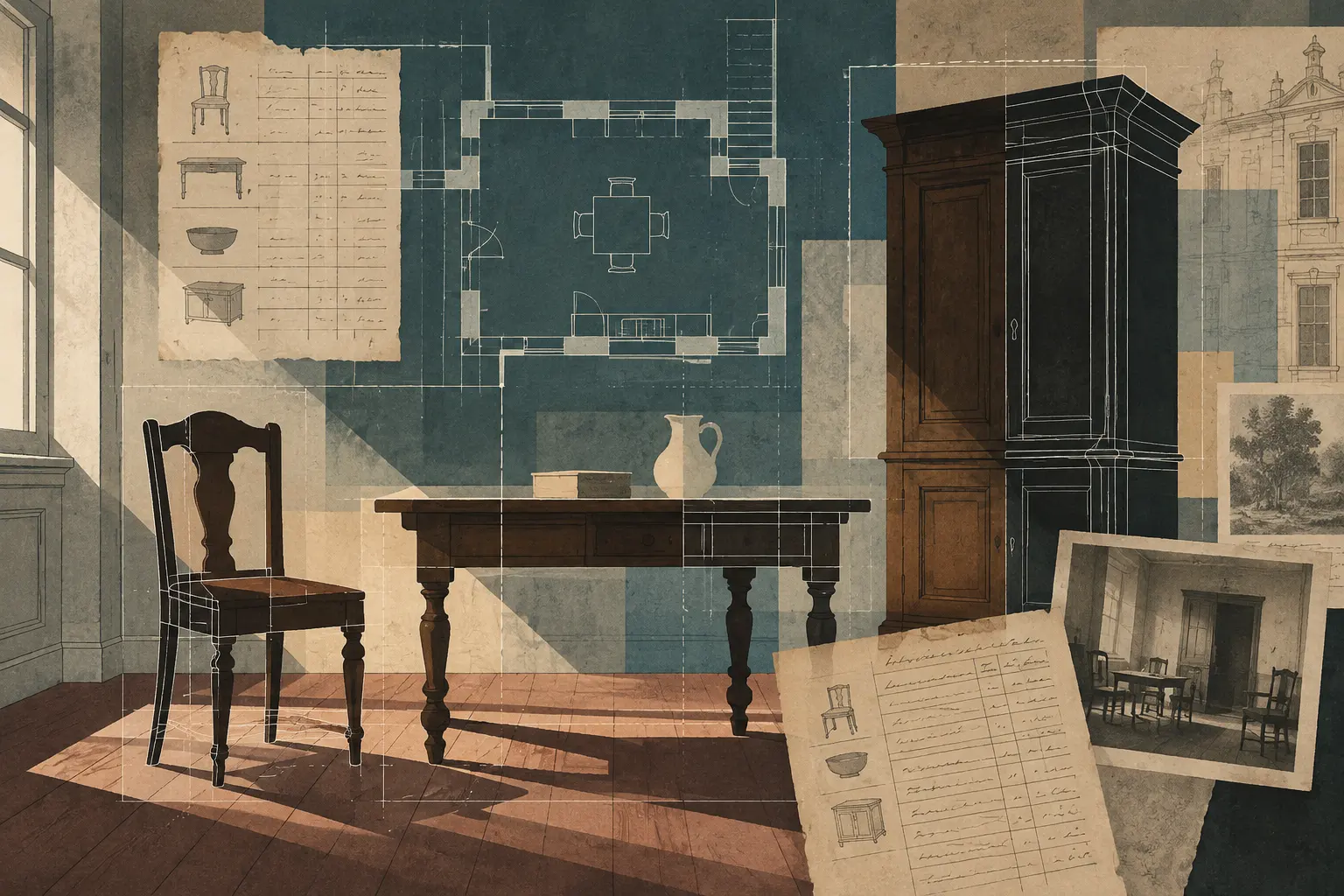
Reconstructing a historical interior does not mean arranging old furniture as though it could restore a room to its original state. A surviving object can tell us about materials, manufacturing techniques and possible uses, but its meaning also depends on provenance, location and the people who may have used it. Photographs, inventories, catalogues and collection records provide connections that an isolated object cannot preserve.
The distinction matters because an exhibition offers an interpretation: it selects objects, arranges them and places them in relation to one another. That display can help visitors imagine how a home was organized, but it is not a direct record of a historical scene. Studying a domestic interior requires separating what is documented from what is inferred and from what has been constructed for display.
A Berlin home represented in a Madrid collection
The European collections of Madrid’s National Museum of Anthropology offer a specific example. A group assembled by Wulf Köpke, a curator at Berlin’s Ethnological Museum, entered the Madrid museum’s collection in the 1990s. It comprises 355 everyday objects, mainly furniture and household items, associated with different rooms in an early twentieth-century bourgeois home in Berlin.
The collection makes it possible to study the material organization of that home through its objects and the relationships they suggest. On its own, however, it is not a representative sample of every Berlin household: it documents a particular group, shaped by what was preserved, assembled and recorded. Keeping that scale in view prevents one case from becoming a sweeping claim about domestic life in an entire period.
Furniture in context
Dimensions, materials, construction techniques and signs of use offer starting points for investigating a piece of furniture. In relation to other objects, it may prompt questions about storage, work or dining surfaces, and the distribution of activities within a room. Such clues become more persuasive when checked against records of provenance, date, acquisition and context, as well as related images and documents.
An object’s shape does not unambiguously determine its function. It may have changed use, location or meaning over time. It may also have entered a collection through purchase, donation or transfer without a precise record of its earlier context. Material analysis therefore needs to be paired with an assessment of what the documentation establishes and how far the evidence supports an interpretation.
Photographs and records as complementary sources
A photograph may preserve spatial relationships that a single piece of furniture cannot show: where objects stood, possible routes through a room, the presence of people, or connections between rooms. But every image has a frame and a purpose. It leaves parts of the space outside the picture, while its date, occasion and commissioner shape what appears. Comparing several images and checking them against inventories or catalogues can help distinguish a habitual arrangement from a scene prepared for the camera.
Museum archives add another dimension: an object’s history within the institution. The National Museum of Anthropology preserves records relating to its institutional history and the formation of its collections, as well as visual materials and historical documentation. These holdings help researchers investigate how objects entered the museum, which names and categories they received, and how they were interpreted or displayed. Such records are not optional extras; they are part of the evidence needed to trace an object’s history.
A different frame of comparison: Colombia’s National Museum
Colombia’s National Museum offers a contrasting point of reference. Its history collection classifies furniture and household objects among its testimonial objects, alongside clothing, tools and other materials. This category invites questions about how objects from domestic life enter a broader historical collection and relate to institutional narratives about society, territory and identity.
The two cases do not document the same type of home or share the same scope. Köpke’s group concerns rooms in an early twentieth-century bourgeois Berlin home; in Colombia, domestic objects belong to a broader historical collection. Comparing them helps reveal how collection categories and interpretive frameworks differ, not erase distinctions of place, provenance and function.
What a museum displays—and what the evidence supports
A gallery, catalogue or exhibition photograph constructs a narrative by selecting and relating objects. It is useful to distinguish three levels: the preserved object, the information documenting its history, and the interpretation proposed by the display. An exhibition can make a hypothesis about domestic space easier to understand, but it may also suggest a unity or continuity that the records do not establish.
A reconstruction is stronger when each conclusion can be tied to identifiable sources: objects, images, catalogues and archives. Specific uncertainties should remain part of the reasoning rather than being resolved through imagined scenes. Furniture then ceases to be picturesque background and becomes a way to investigate the material life of the home, the organization of its spaces and the limits of what has survived in museum collections.
- Decade
- 2000s
- Region
- Global
- Level
- Introduction
- Entities
- Museum, Museo Nacional de Colombia
Sources and references
- Desarrollo y conservación del patrimonio cultural-natural en el contexto neoliberal y nuevas tecnologíasdoi.org · 2026-10-29
- Museos de moda del mundo: por qué son archivos vivosinstitutodemoda.com · 2026-10-29
- Museo Nacional de Colombiaes.wikipedia.org · 2026-10-29
- Museo Nacional de Antropología (España)es.wikipedia.org · 2026-10-29
- Patrimonio cultural inmueble de Alcalá de Henareses.wikipedia.org · 2026-10-29