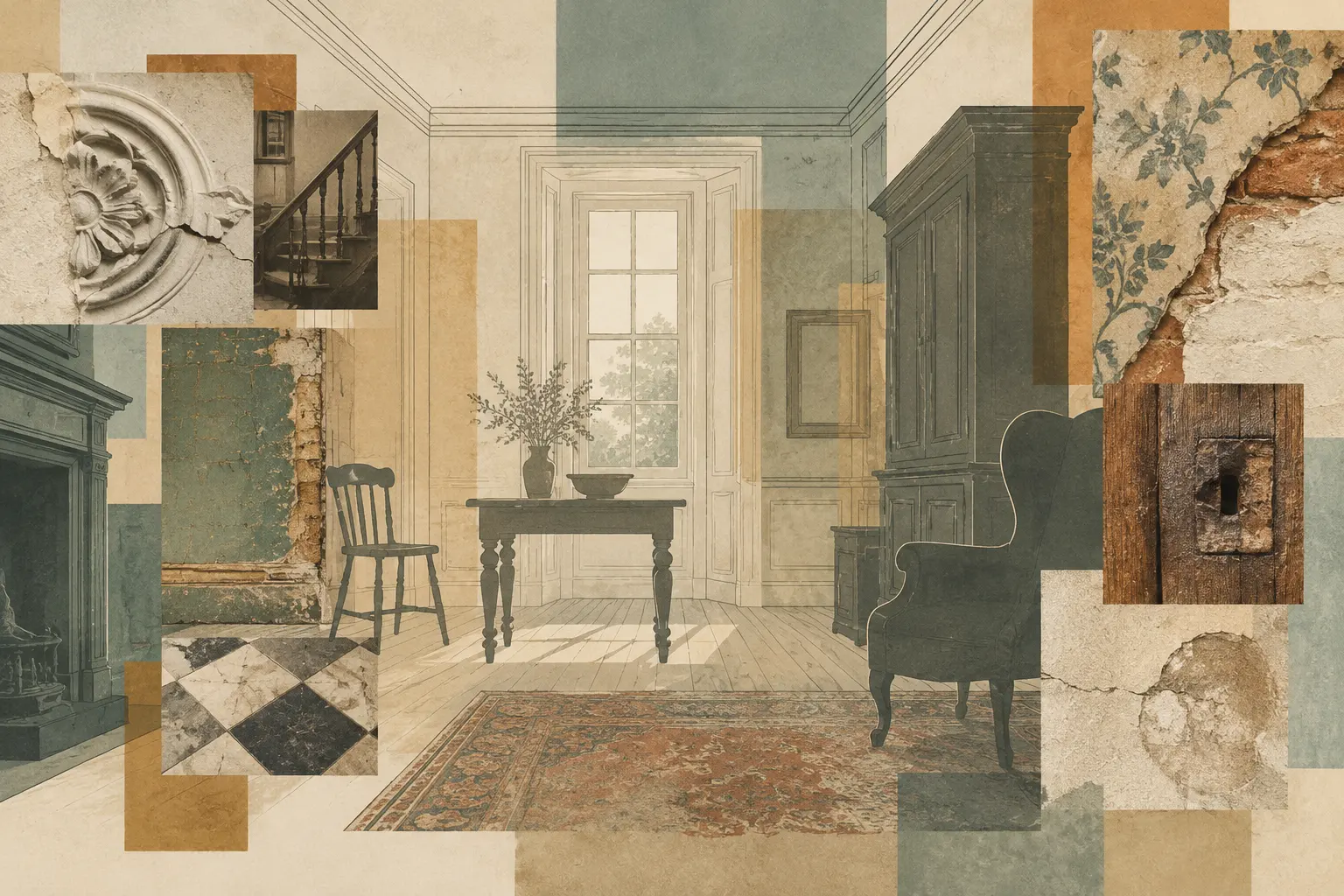
The interior as a historical source
A domestic interior is more than a collection of furniture. The position of a table, the relationship between work and rest areas, the objects kept in view and signs of repair can offer clues about how a home was organized and who used it. No single object, however, fully explains those relationships. Reconstructing them means combining sources and paying attention to what each can—and cannot—show.
A photograph records a space at a particular moment. It may preserve information about furniture, decoration and layout, but it also depends on framing, lighting and the photographer’s purpose. A room prepared for a sales catalogue serves a different purpose from a family photograph or a museum record. The visible scene is a source, not a complete account of everyday life.
Photographs, objects and documentation
Catalogues identify and describe objects, and may connect them with materials, measurements, techniques, provenance or date. Collection documentation can also bring together photographs, archives, correspondence and other records. The more layers of information preserved alongside an object, the more opportunities there are to study how it was made, circulated and used.
Research on garments in museum collections offers a useful method for examining household objects too. Looking at an object is only a starting point: its construction, materials, signs of use and context also matter. An altered seam or a domestic repair may be historical evidence, not an imperfection to erase. Applied to furniture and utensils, the same principle raises questions about what wear reveals and what later interventions have changed.
An image and an object may corroborate one another, but they can also conflict or leave questions unanswered. A photograph shows a visible arrangement; a record may clarify an object’s provenance; material examination can help distinguish original construction from later alterations. Comparing these forms of evidence helps avoid treating a photograph as a neutral scene or assigning an object a use the sources do not support.
The museum and the home as interpreted spaces
Museum collections make objects and their documentation accessible, but display also constructs a narrative: it selects pieces, proposes connections and guides the viewer’s attention. It is useful to distinguish the documented object from the way it is presented. An installation can make an interpretation understandable, but it does not in itself prove that a historical room was arranged in exactly that way.
Spain’s National Museum of Anthropology holds European collections that include household objects and furniture. Among them is a collection donated by Wulf Köpke, described as allowing the reconstruction of different rooms in an early twentieth-century bourgeois home in Berlin. Its interest lies not only in each piece of furniture, but also in how the objects are documented and what relationships can be established between them.
Conservation shapes what visitors can see. Light, humidity, dust, gravity and handling can damage materials, so collections cannot always be displayed permanently. Rotation and suitable supports are part of the decisions that make it possible to preserve objects while keeping them accessible over time.
Reading traces without erasing their context
When studying an interior, it helps to separate several questions: what materials and techniques can be identified? What functions does the layout suggest? Which people appear in the documentation, and which are absent? What signs of use survive? What curatorial choices shape the display? The answers will not always be conclusive. Preserving that uncertainty is more rigorous than turning a partial scene into a complete picture of domestic life.
Photographs, catalogues and objects offer complementary perspectives on the relationship between aesthetics and practical needs, making and use, and everyday experience and institutional memory. A reconstructed interior is not a transparent window onto the past, but an interpretation grounded in sources. Its strength depends on making both the evidence and its context visible.
- Decade
- 2000s
- Region
- Global
- Level
- Introduction
- Entities
- Museum
Sources and references
- Desarrollo y conservación del patrimonio cultural-natural en el contexto neoliberal y nuevas tecnologíasdoi.org · 2026-11-05
- Museo de Arte y Diseño Contemporáneo: orígenes, desarrollo institucional y contexto de un museo en movimientoopenalex.org · 2026-11-05
- Los tejidos en las colecciones de los museos españoles, una larga historia de valoración y conservaciónopenalex.org · 2026-11-05
- Museos de moda del mundo: por qué son archivos vivosinstitutodemoda.com · 2026-11-05
- Museo Nacional de Antropología (España)es.wikipedia.org · 2026-11-05