Reconstructing a home through relationships
A historical home cannot be reconstructed simply by gathering furniture. The arrangement of objects, their materials, signs of use and associated documentation help us ask how rooms were organized and what activities may have taken place in them. Ethnographic collections provide a concrete starting point when they preserve objects that can be studied in relation to one another rather than only as isolated pieces.
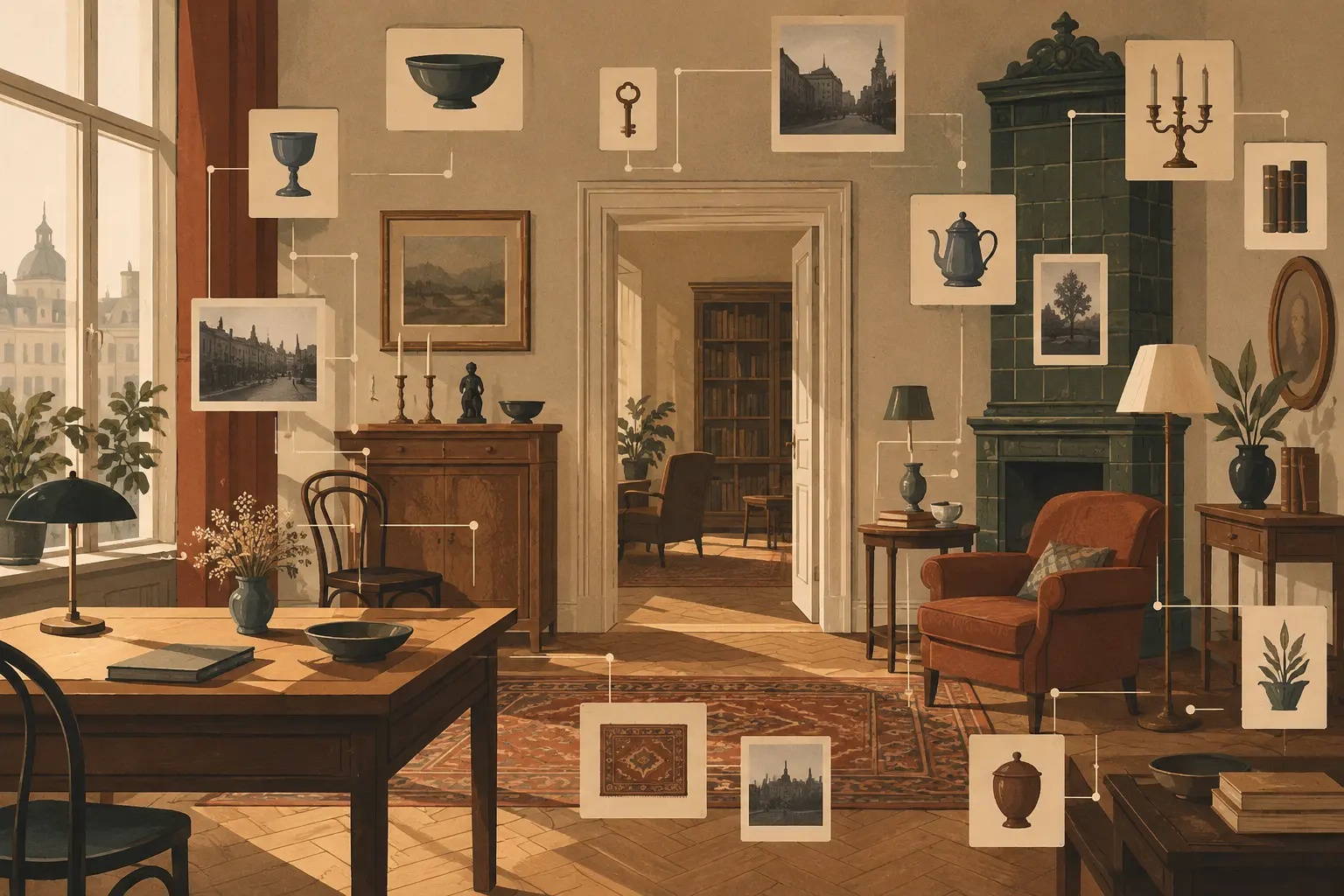
The European collection at Madrid’s National Museum of Anthropology includes 355 objects donated by Wulf Köpke, a curator at Berlin’s Ethnological Museum. The collection description states that they make it possible to reconstruct different rooms in a bourgeois Berlin home from the early twentieth century. Furniture, household utensils and other objects associated with everyday urban life predominate.
The group invites us to consider how its objects relate to one another and to the spaces with which they are associated. Those relationships matter: a piece of furniture may suggest one way of arranging a room; a utensil, a task; and the combination, a possible coexistence or separation of household functions. Such readings, however, are hypotheses that need corroboration. The presence of an object alone does not establish who used it, how often or under what circumstances.
From objects to questions about domestic life
Moving from an isolated object to a more robust interpretation requires collection records, information about provenance and context, photographs, catalogues and other documentary sources. Documentation helps distinguish what is known about an object from what is inferred by comparing it with others. It can also reveal which parts of a collection are well documented and which depend on more tentative interpretations.
Photographs and catalogues are not merely illustrations. If they show a room or a group of belongings, they may provide clues about placement, grouping and display. They should be read alongside collection records and the history of the collection’s formation: an image can document a particular arrangement without necessarily showing every way a home was used.
This approach moves from an evocative image of an interior to more precise questions: what a space may have been used for, which objects were associated with it and what documentation supports that reading. It also makes clear that a collection formed mainly around furniture and utensils may reveal some aspects of domestic life more clearly than others. Without complementary evidence, certain practices and experiences remain less visible.
The collection has a history of its own
Köpke’s donation makes it possible to study a Berlin home through objects assembled as a group, but the collection is not a transparent window onto the past. Its composition reflects decisions about what to collect and preserve; its organization and display reflect later choices. Selection determines which elements become available to researchers and the public, while the categories used to describe them can shape interpretation.
Musealization transforms objects: it removes them from ordinary use, records them and arranges them for preservation and study. This makes close examination possible, although it can obscure the practical relationships that once gave objects meaning in the home. Researching an interior therefore means attending both to the objects and to the decisions of selection, classification and presentation that have made them visible as a group.
The collection offers both a possibility and a method: aspects of domestic space can be reconstructed by relating objects to one another and comparing them with documentation. Photographs, catalogues and records take us from an evocative image of a room to testable questions about its arrangement and use. The result is not a complete reproduction of everyday life, but a more precise historical interpretation that recognizes how it is constructed.
- Decade
- Before 1950
- Region
- Europe
- Level
- Introduction
- Entities
- Museum
Sources and references
- Desarrollo y conservación del patrimonio cultural-natural en el contexto neoliberal y nuevas tecnologíasdoi.org · 2026-11-07
- Museos de moda del mundo: por qué son archivos vivosinstitutodemoda.com · 2026-11-07
- Oportunidades educativas en conservación y preservacióntranslate.google.com · 2026-11-07
- Museo Nacional de Antropología (España)es.wikipedia.org · 2026-11-07
- Patrimonio cultural inmueble de Alcalá de Henareses.wikipedia.org · 2026-11-07