The interior as a historical source
Reconstructing a room from the past involves more than assembling furniture from a particular period. An interior also bears traces of use: cooking, resting, receiving visitors or storing belongings. To investigate those practices, objects need to be connected with the people, spaces and moments in which they were used.
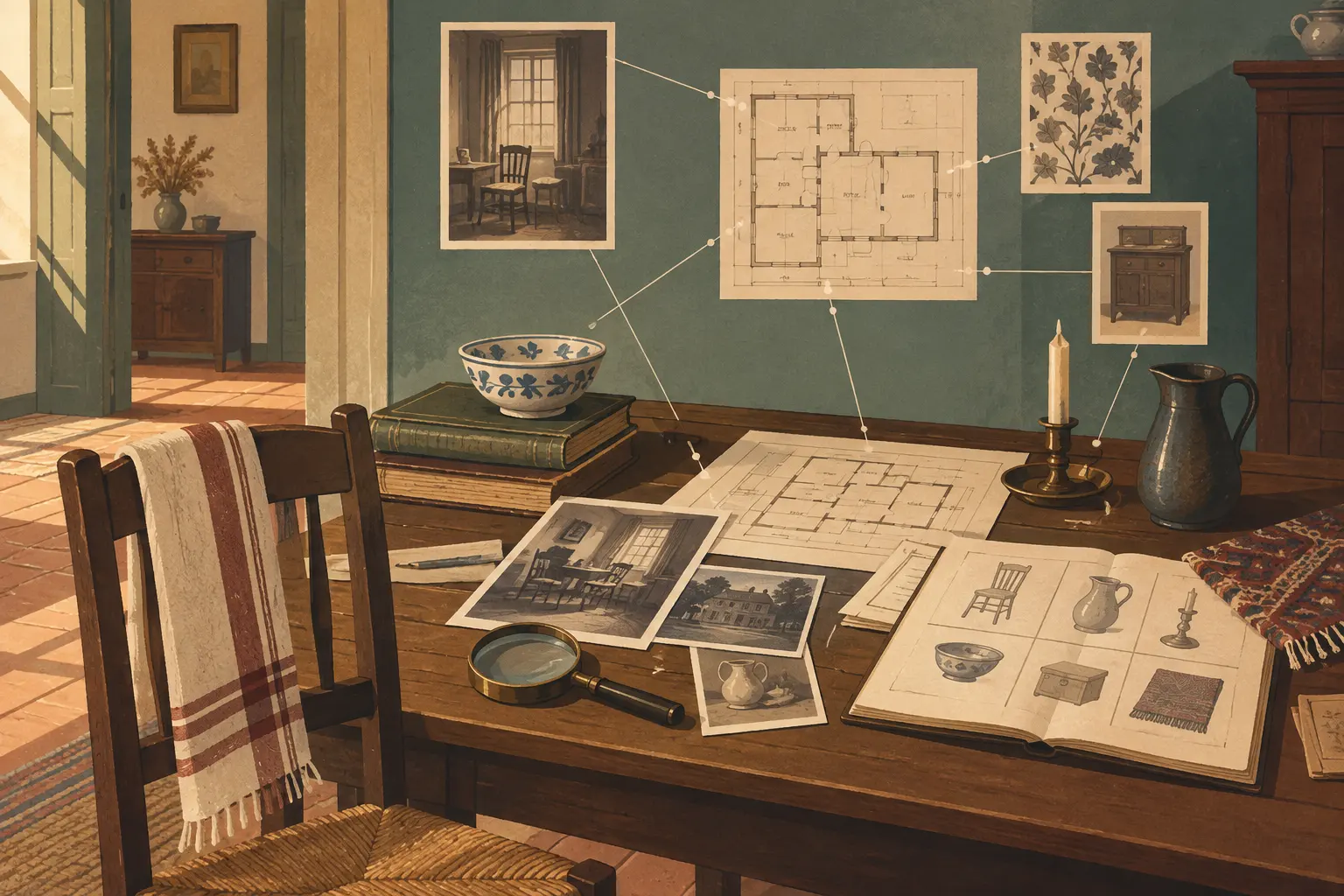
Furniture can suggest a function, but it cannot prove one by itself. A table, for instance, may have served different purposes depending on its position and what surrounded it. Photographs offer evidence of how objects were arranged; catalogues and records can help identify models, materials and commercial channels. Each source answers different questions and becomes more useful when read alongside the others.
From object to context
Research begins by describing what can be observed: materials, form, measurements, techniques, marks and signs of repair or wear. These traces can prompt questions about manufacture and use, but they should not automatically be turned into a personal story. A visible alteration documents a material change; attributing it to a particular person or need requires further evidence.
Researchers then compare provenance records, inventories, photographs, catalogues and, where available, floor plans or descriptions of the home. An image may show how some objects were arranged at a particular moment, but not necessarily the whole house or its customary patterns of use. A catalogue, likewise, documents products and commercial offerings; it does not prove that a particular object was bought or installed in a specific home.
These distinctions matter because sources are not interchangeable. An inventory may record possessions, while a photograph offers a partial view. A catalogue can help establish how available goods were described, but not who acquired them. Research becomes more precise when it asks what each document can establish—and what it leaves out.
Collecting also means selecting
Museum collections make some objects visible and leave others out. Research on textiles in Spanish museums describes a shift in how they have been valued: for a long time they were treated as consumer goods; today they are also recognized as evidence of ways of living and making. Conservation aims to respect the original while attending to both its material qualities and its history.
The history of a collection shapes what can be told through it. Decisions about acquisition, classification and display determine which objects are preserved and how they are presented. A museum archive is therefore not a neutral window: it preserves valuable traces, but also reflects institutional criteria and the questions different periods considered important.
This perspective makes it possible to consider interiors without reducing them to sets. Furniture, textiles and household objects can offer evidence of techniques, changing tastes, everyday tasks and forms of organization. Their interpretation, however, depends on the available documentation and on how the collection in which they are now preserved was formed.
Reading sources together
Comparing photographs with other records can help distinguish lasting features from temporary changes. A plan or inventory may add to what is visible in an image; a series of photographs may reveal changes in how a space was arranged. Even so, each image captures a particular viewpoint and moment. It does not necessarily represent the full experience of the people who lived there.
The relationship between a document and a material object matters too. Furniture detached from its context can be difficult to interpret; an unidentified image may leave questions of place and date unresolved. When several sources agree, a hypothesis gains support. When they diverge, the discrepancy is meaningful as well: it may point to change, incomplete records or later interpretations that deserve reconsideration.
Observation, documentation and interpretation
A careful analysis separates three levels: what can be observed in an object or image; what the documents allow us to state; and the interpretation that connects this evidence. This distinction makes it possible to ask who used a space, what activities took place there and how practical needs interacted with aesthetic choices—without presenting a hypothesis as certainty.
Photographs, catalogues, inventories and surviving objects help reconstruct fragments of domestic life, not a universal experience. Their value lies in connecting material culture with the contexts of its production, use and preservation. Read together, they turn a room from a mere visual composition into a place from which to investigate how home life was organized.
- Decade
- 2000s
- Region
- Global
- Level
- Introduction
- Entities
- Museum
Sources and references
- Desarrollo y conservación del patrimonio cultural-natural en el contexto neoliberal y nuevas tecnologíasdoi.org · 2026-10-25
- Los tejidos en las colecciones de los museos españoles, una larga historia de valoración y conservaciónopenalex.org · 2026-10-25
- Museos de moda del mundo: por qué son archivos vivosinstitutodemoda.com · 2026-10-25
- Diseño y patrimonio cultural: cómo asegurar la conservación ...turia.uv.es · 2026-10-25
- Museo Nacional de Colombiaes.wikipedia.org · 2026-10-25