RetroPauseInternet
Thematic archive · Internet

The internet before we were always connected

Personal websites, forums and connections you had to wait for: we explore the services and communities that shaped life online before being connected all the time.

Start here

Readings to help you find your bearings.

Analysis · 1990

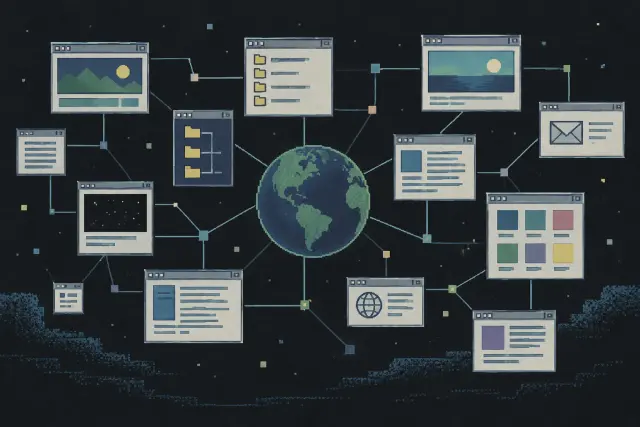
The pages that remain from the 1990s web

Personal pages, directories, webmail, and online communities shaped a web very different from today’s. Archived captures reveal what those services offered and how they invited people to participate—provided we distinguish the date a page was preserved from the history of the service itself.

Open story
History · 1990

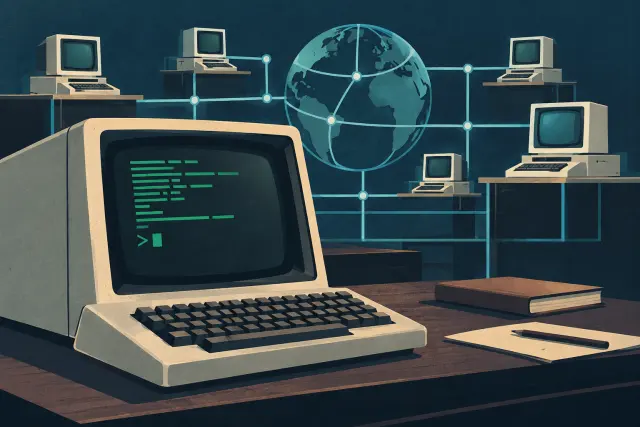
The Internet Before the Browser Window

The Web made the Internet more visible, but it did not create it. Email and other network services already enabled communication and remote access before links and browsers brought the network to a wider audience.

Open story
Internet

A story in context

Archived pages, screenshots and documentation help reconstruct how these services were used, without confusing the date of a memory with the date of the service it recalls.

This section looks at the connections between people and services. Desktop software and physical equipment are documented in their own sections.

Choose your path

Three perspectives on the archive.

Featured dossier

Web archives: what captures preserve—and what they leave out

Web captures document how online services presented themselves and changed over time, but they do not restore how those services worked in full. Their historical value depends on reading them alongside other records and distinguishing what they show from what can only be inferred.

Read article

Documented milestones

  1. 29 October 1969

    ARPANET sends its first message between UCLA and Stanford

    On 29 October 1969, ARPANET attempted to send the word “LOGIN” from a computer at UCLA to one at the Stanford Research Institute. The receiving system got only the first two letters before failing, but the exchange is regarded as the network’s first message. It marks a milestone in connecting research computers, not the birth of the Web, which came decades later.

    Read article
  2. December 1970

    The Network Working Group advances ARPANET protocols

    In December 1970, the Network Working Group, led by S. Crocker, was working on a host-to-host protocol and network software for ARPANET.

    Read article
  3. 1971

    Ray Tomlinson creates the @ email address format

    In 1971, Ray Tomlinson created the email address format incorporating the @ sign, a key step in networked communication.

    Read article
  4. 1972

    Ray Tomlinson develops email tools for ARPANET

    In 1972, Ray Tomlinson developed tools for sending messages between connected computers and adopted the at sign to separate the user name from the destination system.

    Read article
  5. 1974

    TCP/IP proposal by Cerf and Kahn published in 1974

    In 1974, Vinton Cerf and Robert Kahn published the proposal that laid the foundations of TCP/IP, enabling interconnection of heterogeneous networks.

    Read article

Latest additions

1990s

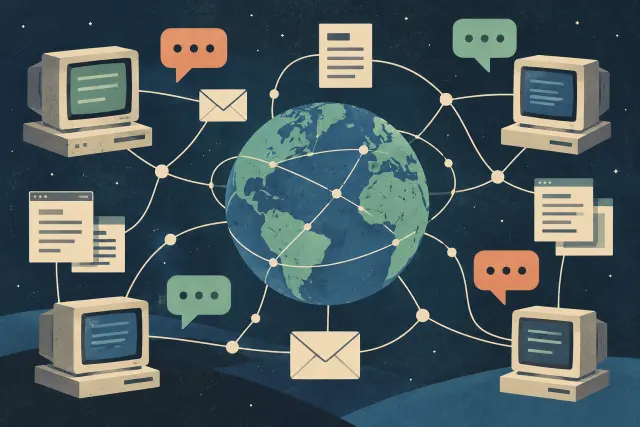
Email, Usenet and chat: social life online before social media

Before profiles and feeds, online social life took shape through email, mailing lists, Usenet groups, chat and personal websites. Each tool set a different pace and pattern of participation, while the Web coexisted with services that were already connecting communities across distance.

2000s

Web archives: what captures preserve—and what they leave out

Web captures document how online services presented themselves and changed over time, but they do not restore how those services worked in full. Their historical value depends on reading them alongside other records and distinguishing what they show from what can only be inferred.

2000s

2000s Fashion: Diverse Styles and a New Circulation of Trends

From low-rise jeans to boho and skinny styles, 2000s fashion brought together distinct aesthetics. Celebrity photography, television and early forms of online shopping made certain garments more visible and sped up their passage from image to consumption.

1990s

The Internet Became Social Before Social Media

Long before social platforms, email, Usenet and online services had already turned computer networks into places for exchange. The Internet’s expansion depended as much on shared protocols and institutional cooperation as on new ways to publish, communicate and gather.

2000s

Digital Photography: From the Camera to the Connected Phone

Digital photography did more than replace film with sensors and memory. As cameras became part of connected phones and networks, images increasingly became objects of exchange. The shift changed everyday photographic practice without erasing older traditions, while renewing debates about documentation, reality, and the circulation of images.

1990s

The pages that remain from the 1990s web

Personal pages, directories, webmail, and online communities shaped a web very different from today’s. Archived captures reveal what those services offered and how they invited people to participate—provided we distinguish the date a page was preserved from the history of the service itself.

1990s

Before the Feed, the Internet Was Already a Place to Meet

Before social networks gathered conversations into a single stream, people wrote by email, debated on Usenet and took part in forums and personal websites. These spaces show that online social life did not begin with Web 2.0.

1990s

Before social media, the internet already connected communities

Email, Usenet, mailing lists and bulletin board systems made early networks places for people to meet long before social platforms became mainstream. The Web did not invent online sociability; it expanded and reorganized communication practices already in motion.

Sources for the selected readings

Editorial review ·
