2000s fashion was not a uniform shared by everyone, but a repertoire of styles that coexisted and changed throughout the decade. Clothes moved among runways, shops, magazines, television, celebrities and, increasingly, the internet. Looking at garments alongside photographs and surviving objects helps distinguish the most visible media images from the varied ways people dressed in everyday life.
A decade of simultaneous styles
At the start of the 2000s, codes from the late 1990s persisted as a futuristic aesthetic spread: black and silver, leather, trench coats, and visible belts or straps. Fashion History Timeline also notes a return to more conservative dress after the September 11, 2001 attacks, particularly in the United States. But the decade cannot be reduced to a single shift. Retro references, boho, sportswear, music-inspired looks and luxury garments all coexisted, combined differently by different people.
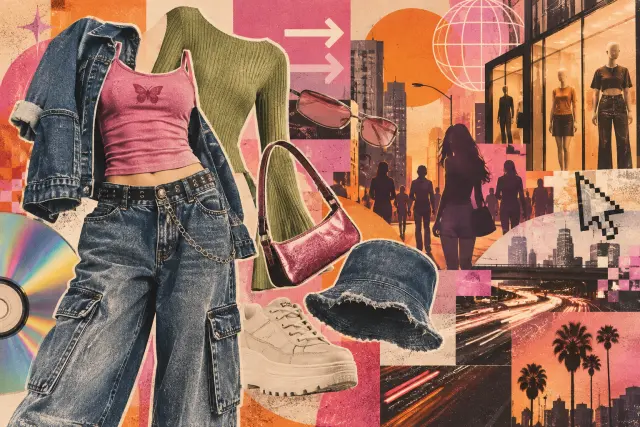
Denim was one of the most persistent elements, although its cuts and pairings changed. Low-rise, flared jeans were prominent early on; skinny jeans gained ground in the middle of the decade, while other silhouettes, including bootcut, remained in use. Distressed and ripped styles also became commonplace. Rather than a linear sequence in which one shape replaced another, this evolution shows how the same garment could adapt to different occasions and ways of presenting oneself.
Garments turned into style signals
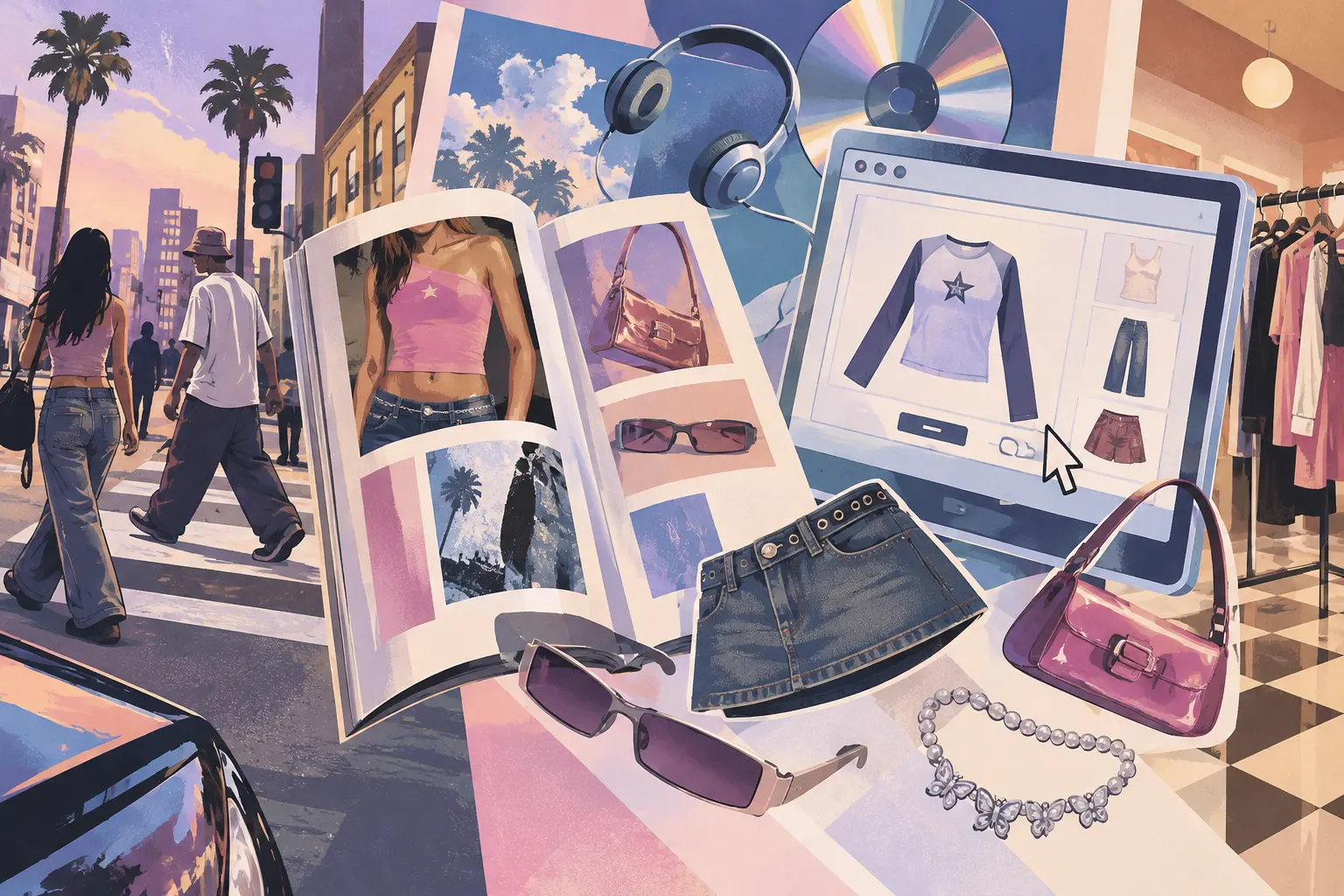
Some items became recognizable far beyond their function. Fashion History Timeline lists velour tracksuits, Ugg boots, trucker hats and baguette bags. Boho mixed vintage clothing with boutique and designer pieces; denim miniskirts were worn with shearling-lined boots, while cropped tops and low-rise jeans exposed the midriff. These pairings describe widely circulated styles, not what everyone wore.
Fashion was not limited to runway garments. Celebrity outfits photographed on red carpets, at events and in tabloid coverage offered images that were easy to recognize and reproduce. Celebrities did not create trends on their own: they helped make them visible and connect particular garments with a public image.
Music, gender and menswear silhouettes
Music offered other repertoires of dress. British indie and the post-punk revival were associated with skinny jeans, band T-shirts, blazers, narrow ties and military-inspired jackets. The slim silhouette of Dior Homme under Hedi Slimane engaged with these codes and was also adopted by more accessible fashion chains. In parallel, hip-hop influenced styles drawing on wide-legged jeans, sportswear, padded vests and basketball sneakers. These were distinct scenes, with their own contexts and forms of appropriation, not fixed or universal categories.
Casual clothing also gained prominence in menswear: polo shirts, cargo trousers, rugby shirts and tracksuits formed part of a widespread repertoire. Toward the end of the decade, fitted tailoring and references to earlier periods coexisted with music and street styles that challenged the boundary between formal and casual dress.
From magazines to screens and online shops
Trend circulation accelerated with the instant sharing of images and the growth of online retail. Fashion appeared in magazines, on television and on websites; some television productions even let viewers identify the brands worn by characters. Gossip Girl, which premiered in 2007, shows how costume could become part of a series’ appeal and encourage some viewers to seek similar clothes. This link between image and shopping expanded fiction’s influence, although it does not mean every audience followed its suggestions.
The Karl Lagerfeld collaboration with H&M, launched in 2004, offered another way to bring runway design to a retail chain. Fashion History Timeline notes, citing specialist press, that the garments sold out quickly. The attention generated by the collaboration helped make visible a model that other retailers followed. The growth of e-commerce and the production of affordable copies shortened the distance between runway and shop, and between a media image and the desire to dress similarly.
At the end of the decade, the recession coincided with renewed interest in handmade clothing and fabrics with an artisanal appearance. That interest did not displace fast fashion or global trends; rather, it reveals tensions between rapid consumption, aspiration and the search for individuality. Studying garments alongside photographs, magazines and their contexts makes it possible to tell the story of 2000s fashion without turning a highly visible trend into everyone’s experience.
- Decade
- 2000s
- Region
- Global
- Level
- Enthusiast
- Entities
- Televisión, Internet, Karl Lagerfeld
Sources and references
- 2000-2009 | Cronología de la historia de la modatranslate.google.com · 2026-11-04
- Historia de la moda - Wikipedia, la enciclopedia librees.wikipedia.org · 2026-11-04
- Biblioteca — Historia de la Modahistoriadelamoda.net · 2026-11-04
- Historia de Barcelonaes.wikipedia.org · 2026-11-04
- Anna Wintoures.wikipedia.org · 2026-11-04