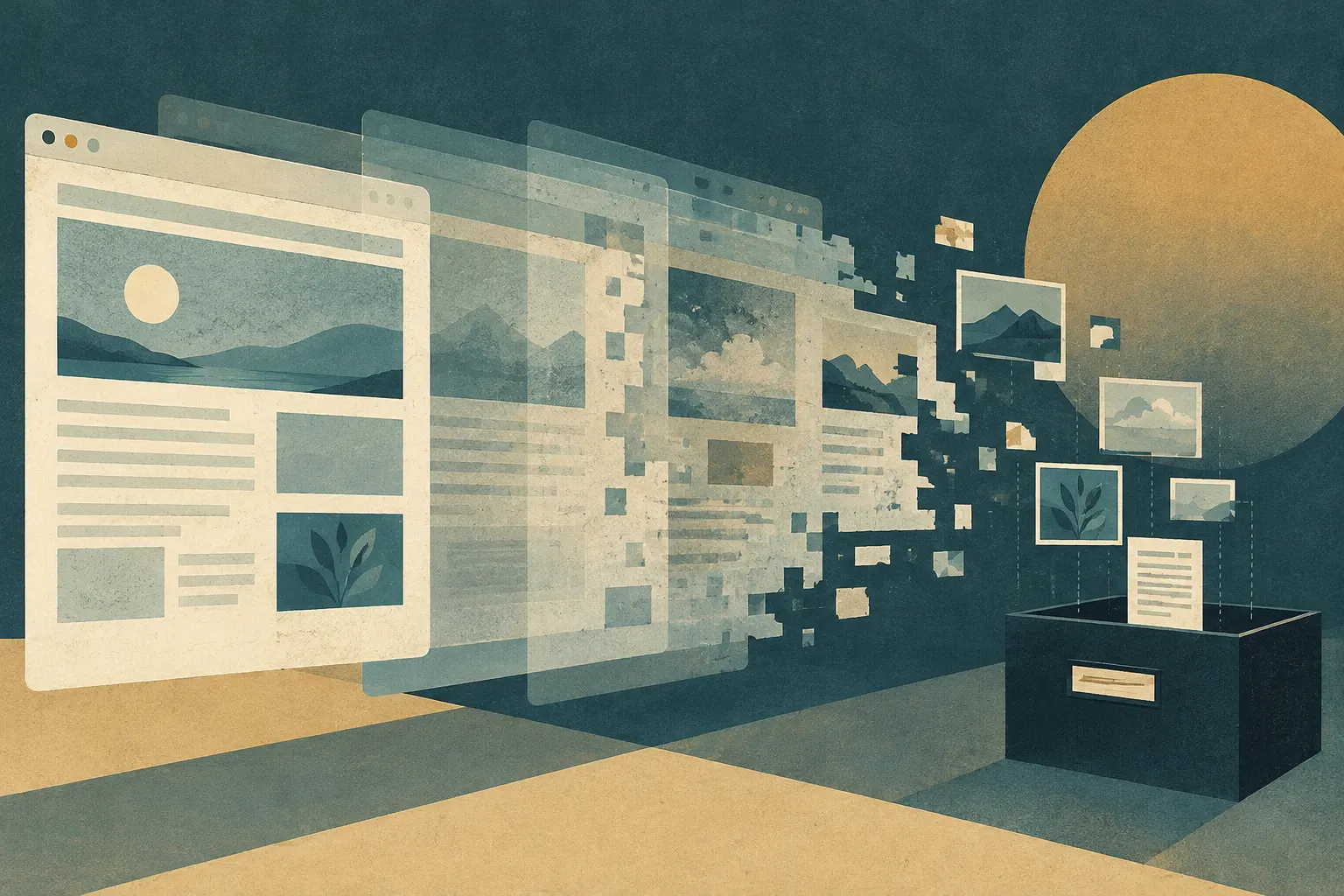
A capture preserves a view, not an entire service
Web archives preserve traces of a medium in constant change. Their captures make it possible to revisit earlier versions of pages and study their design, text, images, and the information they offered at a particular moment. They are documents of Internet history, but they are not time machines: preserving a page does not restore every function of the service it belonged to.
A capture may show an interface without reproducing its databases, interactive features, or relationships between users. Some links may no longer lead to their destinations, and external elements may not have been saved. When reconstructing a discontinued service, an archived page is therefore one piece of evidence, not the original experience recovered in full.
Change becomes part of the record
Web pages are not static documents. Their content changes, links stop working, and sites close. Preserved captures make it possible to compare versions and observe shifts in design, language, and content. Changes that might otherwise go unnoticed become part of a record that can be consulted.
A collection, however, does not automatically represent everything that once existed online. Each archive gathers material according to its aims, criteria, and capacity to capture it. A collection’s scope depends on what was recorded, when it was recorded, and under what conditions it can be consulted. A single capture, then, cannot stand as a complete portrait of the web at a given time.
The Spanish Web Archive, coordinated by the National Library of Spain since 2009, preserves websites and web content as documentary heritage. Its collections include Spanish domains and specialized captures. Access to its holdings is governed by the institution’s conditions. Internationally, UNESCO has published guidelines on preserving digital heritage, while the International Internet Preservation Consortium (IIPC) brings together institutions working to preserve web content. These efforts place capture and long-term access within an archival and cultural responsibility as well as a technical one.
What a capture can show
Captures are useful for studying how a service presented itself publicly: the structure of its pages, its text and images, and some links that may still be accessible. Arranged in chronological order, they can reveal visible changes. Other records—such as manuals, promotional materials, or institutional documentation—may provide information a page cannot, including terms of use or the intended way to access a feature.
It helps to distinguish direct evidence from interpretation. An archived image can establish that certain content appeared in the captured version; by itself, it cannot prove how the service behaved in every circumstance. The experience may also have depended on accounts, personalized content, interactions, databases, or external components that changed or were not preserved. Other sources are needed to investigate those aspects, and sometimes they support only partial conclusions.
Dates also require context. The date of a review, a later recollection, or a subsequent mention should not be confused with the period when the service was active. Interpreting a capture depends on knowing when it was recorded and how it relates to other documentary evidence.
From preservation to cultural history
Preserved pages can support research into more than their appearance. Their text and images may show how a service addressed the public and what forms of online communication it used at the time. Comparing versions can reveal changes in a site’s language and presentation; setting them alongside additional documentation can help place those changes in the context of the service’s operation and public use.
Web archives share a challenge with other cultural institutions: preserving material, describing it, and making it available for consultation. Digitization enables new forms of access, but it does not remove the need to catalogue and contextualize collections. For websites, rigorous description also means making clear that what survives may be only part of a service.
Web archives do not return the Internet to a past state. They offer documents through which changes can be observed and what users could see at particular moments can be studied. When researching a discontinued service, a capture is a starting point: its significance becomes clearer when compared with other records and when what it shows is carefully separated from what can only be interpreted.
- Decade
- 2000s
- Region
- Spain
- Level
- Enthusiast
- Entities
- Archivo de la Web Española, Internet
Sources and references
- Museos interdisciplinarios: Investigación arqueológica, conservación y comunicación en el santuario arqueológico de Pachacamacopenalex.org · 2026-11-08
- Memorias de archivosopenalex.org · 2026-11-08
- cómo la preservación web está redefiniendo los archivos y ...museotech.org · 2026-11-08
- Breve Historia de la Transformación Digital en Museosevemuseografia.com · 2026-11-08
- Patrimonio cultural digital: guía completa y prácticaartgonuts.com · 2026-11-08