Online life did not begin with opening a browser
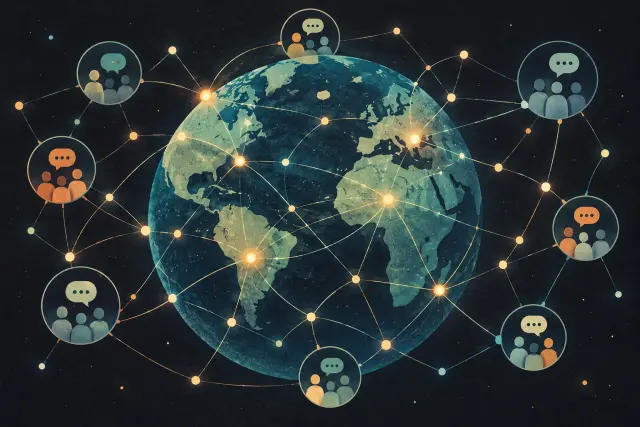
The everyday history of the internet is often told through services that feel familiar today: profiles, posts and conversations arranged in a continuous feed. Yet people were writing to one another, arguing and forming online communities long before that model took hold. Email, Usenet, forums and personal websites shaped this early sociability, even though not all of them worked as websites or depended on a central screen.
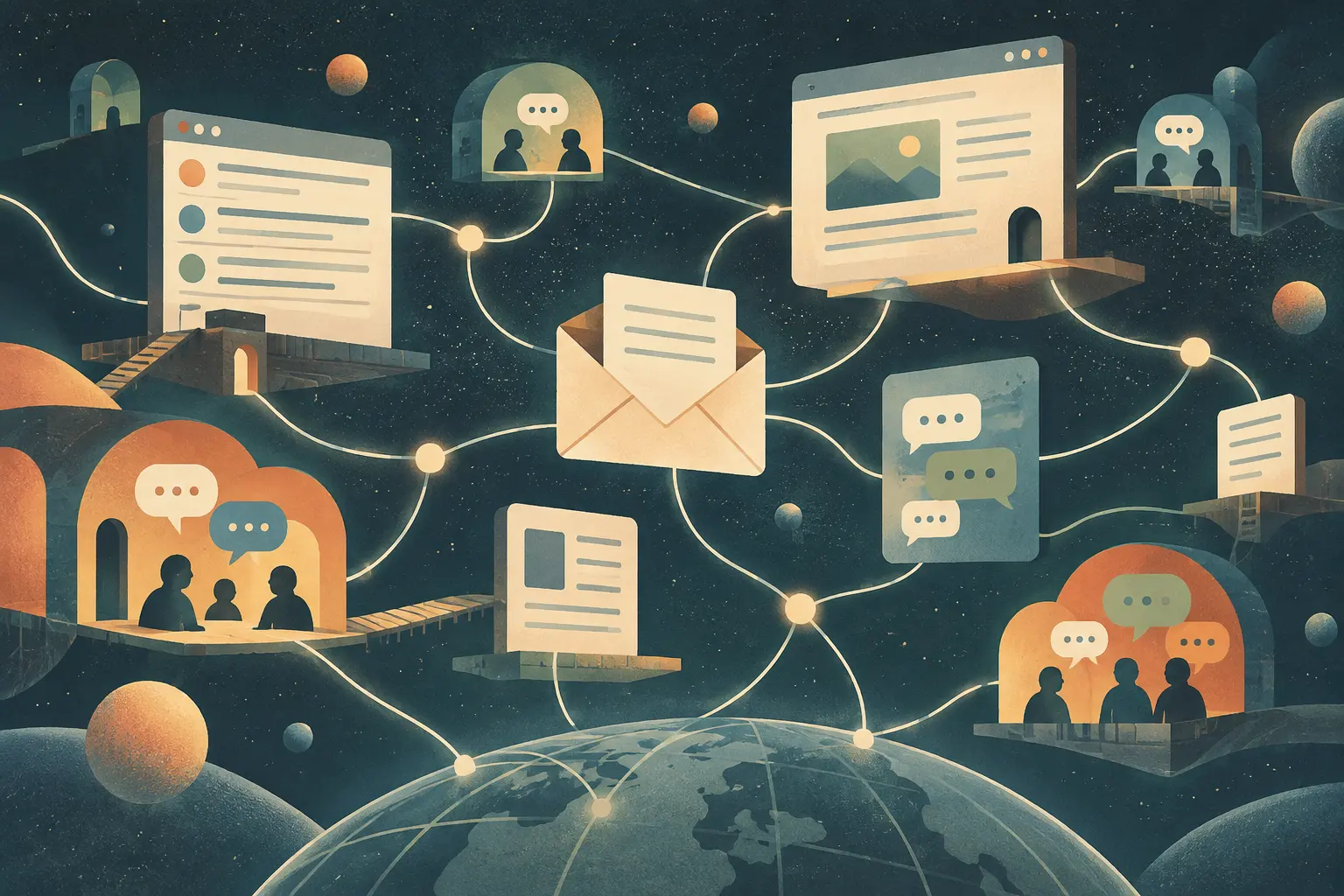
The distinction matters. The internet is an infrastructure of networks that exchange data through shared protocols; the World Wide Web is a system of linked documents running on that infrastructure. Usenet, for instance, distributed discussions among indirectly connected computers. It was neither a website nor a social network in today’s sense, but it was a space for sustained conversation.
Messages and discussion across a distributed network
Email quickly became a fundamental tool for networked communication. The Internet Society’s history, written by people involved in the development of the internet, recounts that Ray Tomlinson created the address format using the @ sign in 1971, and that tools for sending, reading and organizing messages expanded its uses the following year. Email also helped coordinate technical work: a technology for exchanging information became a means of collaboration as well.
Usenet offered a different experience. Its topic-based groups let messages travel between systems without requiring a permanent connection to ARPANET. Distribution through UUCP helped computers outside that network participate. Conversation did not depend on a company or a single portal; it emerged from connections between nodes and the practices of their users. Each group could develop its own conventions, recurring topics and sense of belonging.
Forums and electronic bulletin boards extended this culture in varied ways. Some were tied to commercial services or local communities; others ran on software installed on servers. Personal websites, in turn, gave people a place to publish writing, links and interests without going through a publishing institution. Maintaining a page, replying in a forum or following a newsgroup were distinct ways to take part—and they were not always visible to someone who only browsed the Web.
The Web widened access; it did not invent conversation
The Web, developed at CERN and opened to the public in the early 1990s, made linked documents more accessible. Browsers such as Mosaic made it easier to use for people without specialist technical knowledge. Over time, search engines, directories and personal websites made information easier to find and publish. But the Web did not immediately replace email or Usenet: the services coexisted and complemented one another.
In the late 1990s and early 2000s, web services proliferated that let people create profiles, publish content and interact through a browser. “Web 2.0” became popular as a label for the emphasis on participation and user-created content; it did not name a new technical version of the internet. The term points to a shift in how services and participation were organized, though it can also make practices that already existed seem new: commenting, sharing information and forming communities.
The most visible difference lay in how these activities were brought together. In earlier spaces, a conversation might be scattered across messages, groups or separate pages. Later services tended to combine profiles, posts and interaction in one interface. That concentration made it easier to follow and display other people’s activity, but it does not mean the earlier period lacked online social life.
Reading the traces without mistaking them for the experience
Archived page captures help reconstruct how a service appeared at a particular moment: its design, links, published text and some visible features. They do not necessarily show how the service behaved in ordinary use, how many people took part or when it actually began. The date of a preserved page is not, by itself, the launch date of a platform; nor does it automatically confirm a date remembered by a user.
To understand a vanished service, archived pages can be compared with manuals, messages, contemporary announcements and technical documents. RFCs, for example, trace how protocols and conventions were described, while institutional documents and historical studies help place them in the development of networks. Each kind of record sheds light on a different part: technical documentation describes rules; pages show what was published; testimony can contribute memories of use.
This history is not an inevitable path from ARPANET to today’s social networks. The Internet Society presents it as a process with technological, organizational and community dimensions. Historians have questioned accounts that assign one event—often ARPANET’s beginnings—the whole origin of a story shaped by many networks, institutions and communities. Looking at everyday services brings those connections back into focus: people did not wait for a feed to start relating to one another online.
- Decade
- 1990s
- Region
- Global
- Level
- Introduction
- Entities
- World Wide Web, Internet, ARPANET, Usenet
Sources and references
- Historia de Internettranslate.google.com · 2026-10-28
- Historia de Internet: ¿cómo nació y cuál ha sido su evolución? -www.telefonica.com · 2026-10-28
- 10 Hitos de la historia de Internet | EUDE Business Schoolwww.eude.co · 2026-10-28
- Una breve historia de Internetwww.internetsociety.org · 2026-10-28
- La historia del origen de Internet I partewww.nougir.com · 2026-10-28