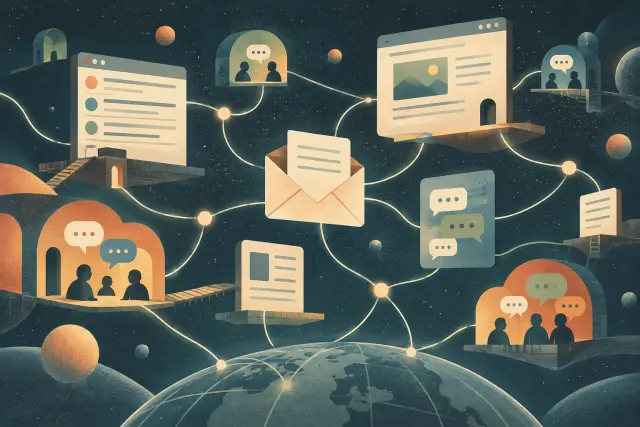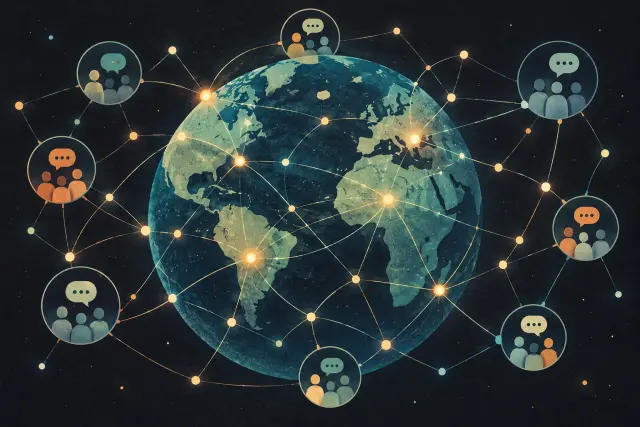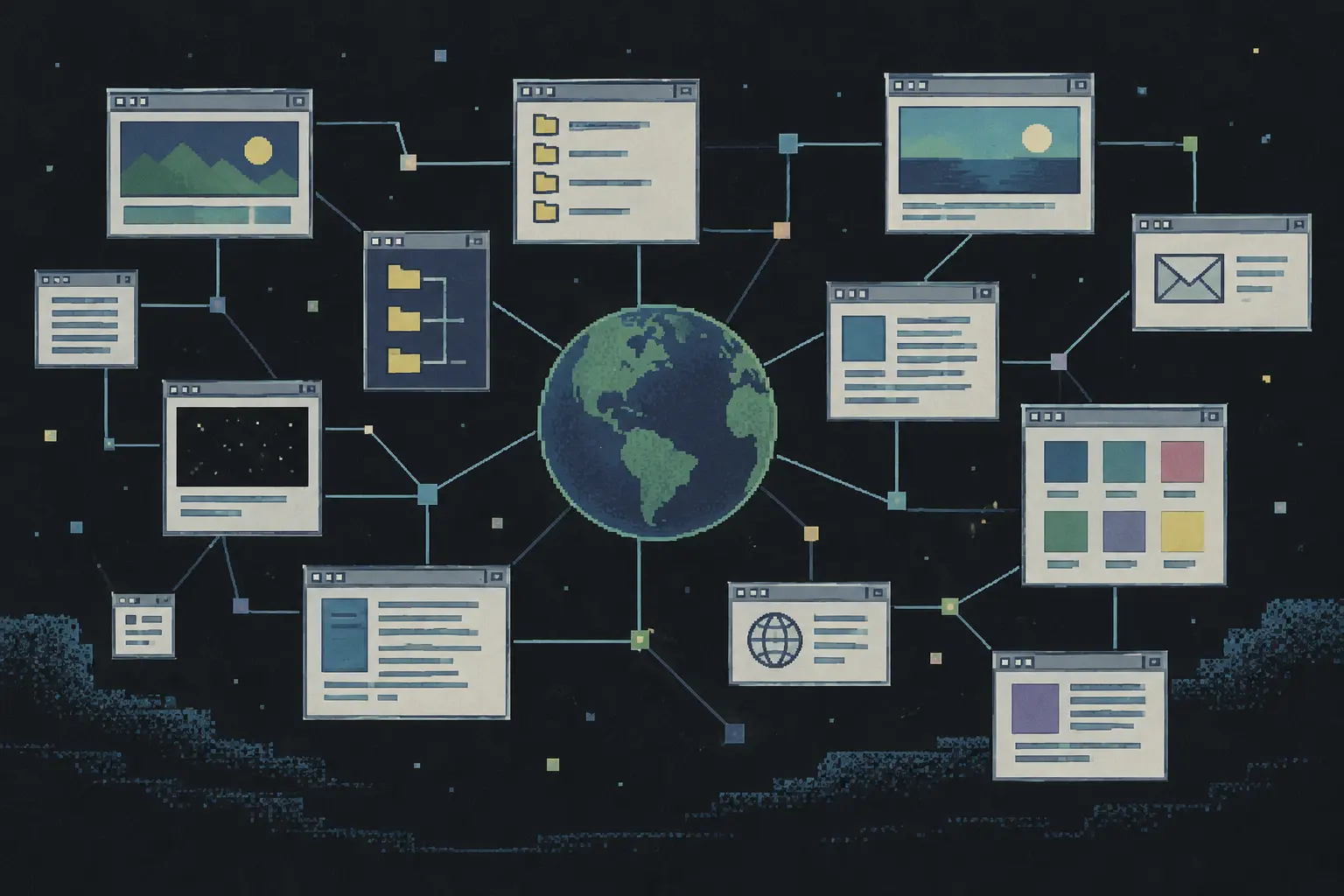
The web of the 1990s was not an unfinished version of today’s social networks. It was a varied collection of personal pages, directories, webmail, and online communities, alongside older internet services. Archived pages help reconstruct how these spaces presented themselves and what kinds of use they encouraged. They do not, by themselves, reveal the whole experience: each is a trace of an interface at a particular moment.
The Web within the internet
The internet and the World Wide Web are related, but they are not the same thing. The internet connects networks through shared protocols; the Web is one of the systems that runs on that infrastructure. During the 1990s, the public web broadened the ways people could find information, communicate, and take part in communities, while incorporating commercial services. This was an expansion built on existing networks and practices, not an overnight replacement.
Email and discussion groups, for instance, were already central to network culture before browsing the Web became commonplace. Usenet and mailing lists coexisted with personal sites and directories. A browser interface made many services easier to access, but earlier spaces and tools remained part of the digital landscape.
What a preserved page can tell us
An archived page can show how a service described its features, which links it highlighted, and what instructions it gave newcomers. A homepage may reveal how a portal was organized; a help section, the rules it communicated; a registration form, the information it requested. Read together, these pieces help us study the experience a service proposed without mistaking a capture for the entire system.
Different kinds of documents answer different questions. Specifications and RFCs help explain protocols and interoperability decisions; institutional histories place the development of networks and their communities in context. Captures, by contrast, bring us closer to the public interface a person might encounter. Together, they offer complementary perspectives: the infrastructure, the organization of a service, and how it presented itself to users.
A capture’s date is not a service’s date
The date a page was archived or accessed is not necessarily the date a site launched. A service may have begun before its earliest available capture, changed its name or features, or stopped operating while some pages survived. Reconstructing its history means comparing captures from different moments with contemporary documents and attributable historical accounts.
Archiving can also leave things out. A capture may not preserve images, scripts, or external links, and it may not reflect features available to every user, region, or type of connection. It is therefore more reliable to describe what is visible—a listed option, a link, or an instruction—than to infer how the service worked in every circumstance.
From wider access to varied participation
The spread of graphical browsers and web pages brought online information within reach of people who did not use specialist tools. The range of services grew: portals and directories organized content, webmail made messages accessible through a browser, and online communities provided spaces for ongoing conversation. This expansion was uneven and did not eliminate differences in access; academic, commercial, and hobbyist infrastructures continued to overlap.
In the early 2000s, “Web 1.0” became popular retrospectively as a label for a period associated with more static pages and forms of participation distinct from those later linked to “Web 2.0.” It is useful to treat the term as a later interpretation, not as the universal name people used for their experience of the Web in the 1990s. It can also obscure the interactive activity already present in forums, chat, email, and community pages.
Archiving to reconstruct relationships
Web archives preserve more than the visual appearance of vanished services. They retain traces of the actions those services invited people to take: register, publish, search, reply, or share. Read alongside technical documentation and histories of the internet, these traces help place each service within a wider network of practices.
The question is not only what an old page looked like, but what kind of relationship it organized: who could participate, with which tools, and under what expectations. Reading captures alongside documents from the period brings us closer to those relationships without treating a preserved interface as the complete experience of the people who used it.
- Decade
- 1990s
- Region
- Global
- Level
- Introduction
- Entities
- World Wide Web, Internet, Usenet
Sources and references
- Historia de Internettranslate.google.com · 2026-11-01
- Historia de Internet: ¿cómo nació y cuál ha sido su evolución? -www.telefonica.com · 2026-11-01
- Una breve historia de Internetwww.internetsociety.org · 2026-11-01
- 10 Hitos de la historia de Internet | EUDE Business Schoolwww.eude.co · 2026-11-01
- La historia del origen de Internet I partewww.nougir.com · 2026-11-01