An infrastructure for connecting different networks
The history of the Internet is often told as a line running from ARPANET straight to the global network. That picture leaves a broader transformation in the background: researchers in several countries explored how to transmit data in packets and how to make different networks communicate without forcing them to share the same internal architecture. Packet switching was investigated in the United States, the United Kingdom, and France, among other places; projects such as CYCLADES contributed ideas that later became part of Internet design.
ARPANET was a precursor network, not another name for the Internet. On 29 October 1969, the first link between UCLA and the Stanford Research Institute was established. The initial attempt to send “LOGIN” stopped after “LO”—an episode that captures the experimental character of those early days. By 1972, email had become an important application for coordinating people working over the network. The infrastructure did not develop apart from its uses: communication between people helped define the network’s practical value.
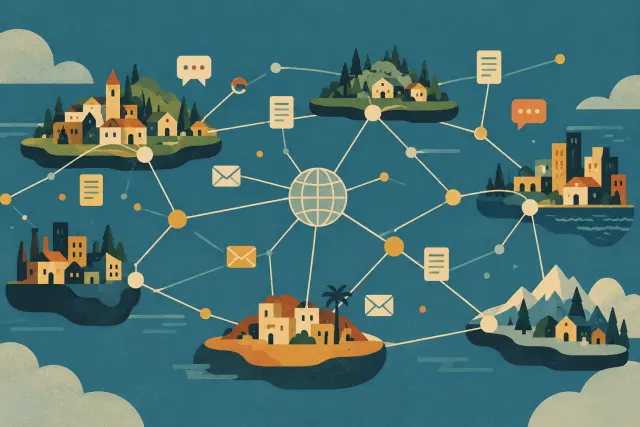
In 1974, Vinton Cerf and Robert Kahn published an internetworking proposal that helped shape TCP/IP. The central idea was to let different systems exchange information through shared protocols while allowing each network to retain its own characteristics. The Internet thus took shape as a “network of networks,” rather than as a single centralized system.
Shared protocols, expanding networks
The adoption of TCP/IP on ARPANET on 1 January 1983 was a planned transition: connected systems had to change protocols to keep communicating. It was not, however, the instantaneous birth of a universal network. As those protocols spread, academic, public, and research networks joined, each with different policies and conditions of access.
Expansion depended on organization as well as engineering. RFCs circulated technical proposals in an open format, while email and discussion lists helped researchers in different places collaborate. Usenet and UUCP networks also distributed messages and newsgroups where direct Internet access was unavailable. These were not steps in a uniform sequence: different architectures and ways of connecting coexisted for years.
In the United States, NSFNET helped link universities and research centres from the mid-1980s onward. It was an institutional part of a broader infrastructure, not an Internet service for the general public. In 1995, the National Science Foundation-funded backbone service ended and traffic moved to commercial networks. The growth of access providers and the removal of restrictions on commercial traffic consolidated a transformation that already involved more networks and participants.
The Web offered an accessible way to navigate information
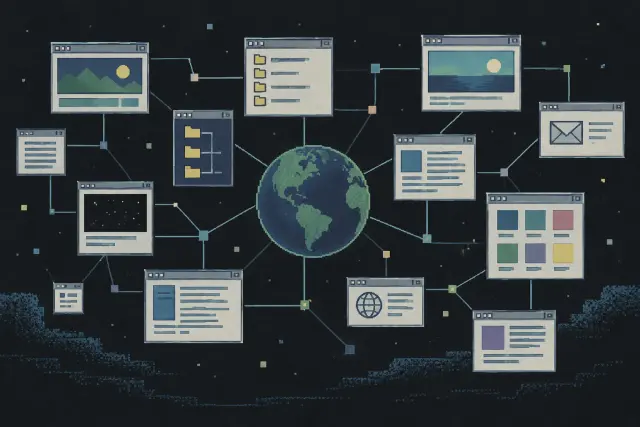
The Internet and the World Wide Web are not synonyms. The Internet is the infrastructure of interconnected networks; the Web is one information system running on it. Tim Berners-Lee’s proposal at CERN, developed between 1989 and 1990, linked documents through hypertext and offered a straightforward way to navigate information stored at different points on the network.
The Web did not immediately displace email, Usenet, FTP, or dial-up services. It developed alongside them and broadened the possibilities for publishing and browsing. In the 1990s, graphical browsers made browsing more accessible to people without specialist technical training. Personal pages, directories, search engines, forums, and webmail made online publishing and communication more visible.
Commercial expansion brought new companies and services, as well as disputes over intellectual property and business models. The dot-com bubble, which grew and collapsed between 1995 and 2000, showed that increased online activity did not guarantee the viability of every company. The popularity of the Web and the commercial strength of its businesses were related, but not identical, questions.
Many pages of the period were static and harder to update than later applications. Yet guestbooks, personal pages, and forums already offered interaction. The phrase “Web 2.0” described a trend towards user-created content, collaboration, and participation; it did not designate a new technical version of the Internet. The distinction separates ways of producing and using websites from the infrastructure that makes them possible.
From communication services to everyday participation
In the late 1990s and the following decade, forms of online activity multiplied. Email, instant messaging, blogs, wikis, social networks, and file sharing served different purposes. Some services relied on existing networks; others became prominent by making publishing or collaboration easier. Launched in 2001, Wikipedia made collective knowledge production visible. Social networks and video sites in the mid-2000s broadened everyday publishing and the circulation of content.
The change did not have the same pace or meaning for everyone. Computer availability, connection costs and speeds, and the languages represented online shaped who could connect and what they could do. National and academic networks joined at different times; mobile services became especially important in some Asian countries before spreading more widely elsewhere. A global history should therefore avoid presenting one local experience as universal.
How this digital life is reconstructed also matters. A screenshot can show what a page looked like at a particular moment; an RFC records a proposal or specification; an archived message may reveal conversational practices. Each trace answers different questions, and none alone represents an entire service or the experience of all its communities. Likewise, the date when someone later recalled a service is not necessarily the period when it was active.
A layered transformation, not a rupture
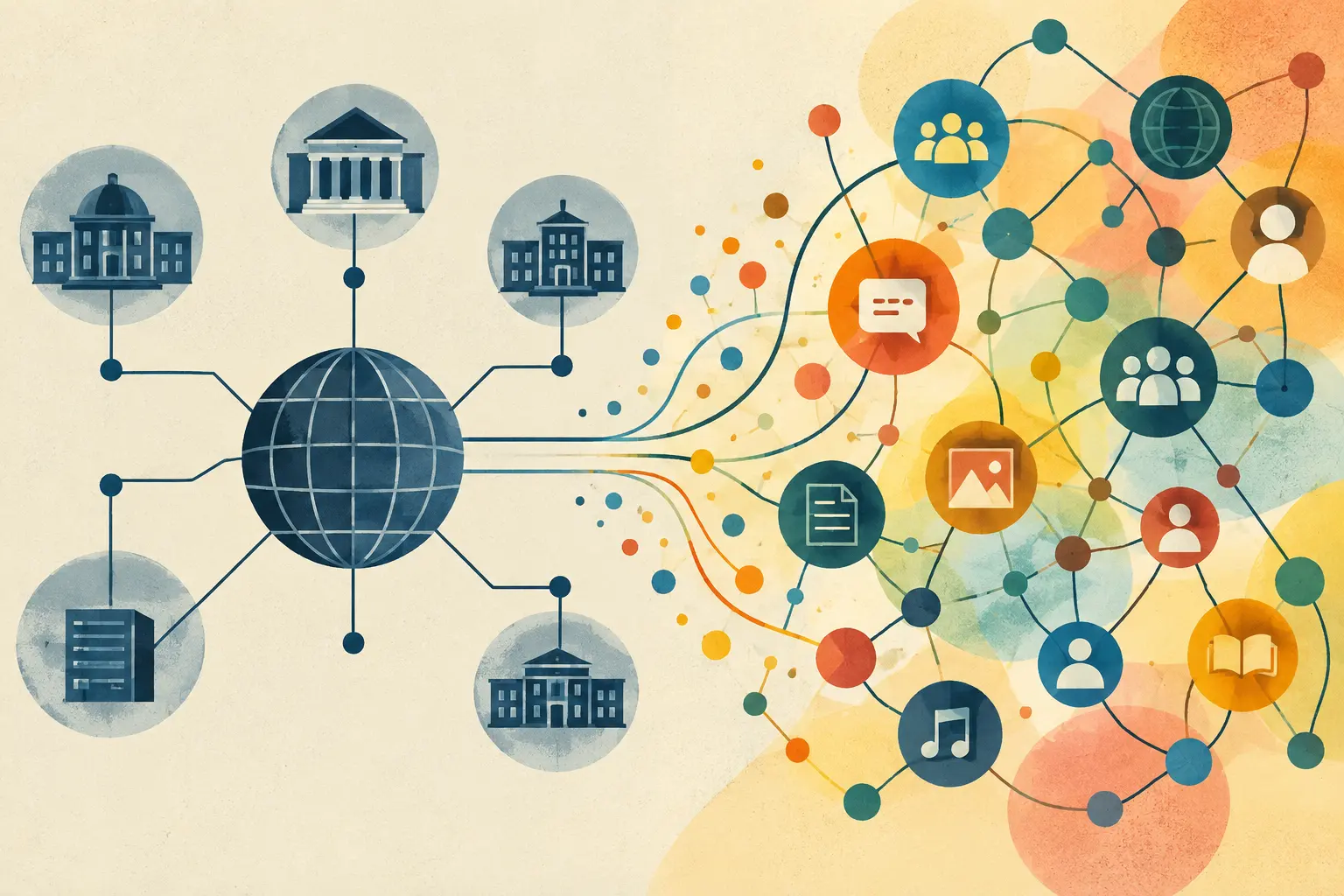
By 2009, the social Web had changed the relationship between publishing, conversation, and sharing, but it had not eliminated earlier uses. Email, forums, personal pages, and specialist communities remained part of the Internet. The evolution is best understood as an accumulation of layers: shared protocols, connected networks, services with varied functions, and communities adopting them in uneven ways.
Looking beyond a list of milestones makes it possible to distinguish infrastructure from the practices that grew on top of it. Technical documents explain how different networks could communicate; archived pages and preserved messages show what people did with that possibility. Together, these traces help explain how an infrastructure born in research settings became a social and commercial space, without confusing the history of the Internet with that of the Web or any particular service.
- Decade
- 1990s
- Region
- Global
- Level
- Introduction
- Entities
- World Wide Web, Internet, ARPANET, Usenet
Sources and references
- La opción tecnológica de las cajas de ahorro españolas antes de Internet, circa 1950-1995doi.org · 2026-11-07
- Historia de Internettranslate.google.com · 2026-11-07
- Historia de Internet: ¿cómo nació y cuál ha sido su evolución? -www.telefonica.com · 2026-11-07
- Una breve historia de Internetwww.internetsociety.org · 2026-11-07
- La historia del origen de Internet I partewww.nougir.com · 2026-11-07