A social history that predates platforms
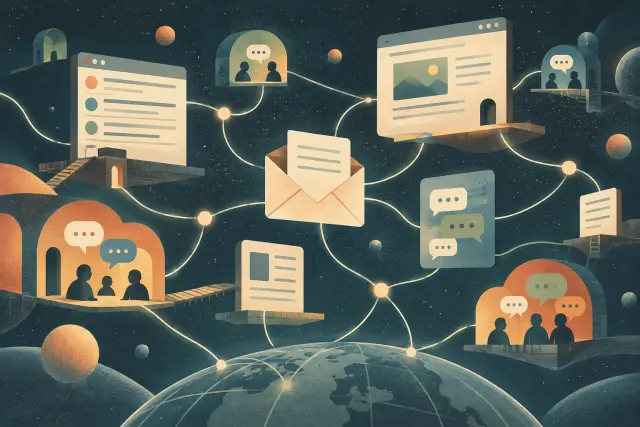
Internet history is often told through technical milestones: packet networks, protocols, domains and browsers. It can also be told through the activities those systems made possible. Before social networks became mass services, email, newsgroups, mailing lists and bulletin board systems already let people share information, talk and collaborate across distance.
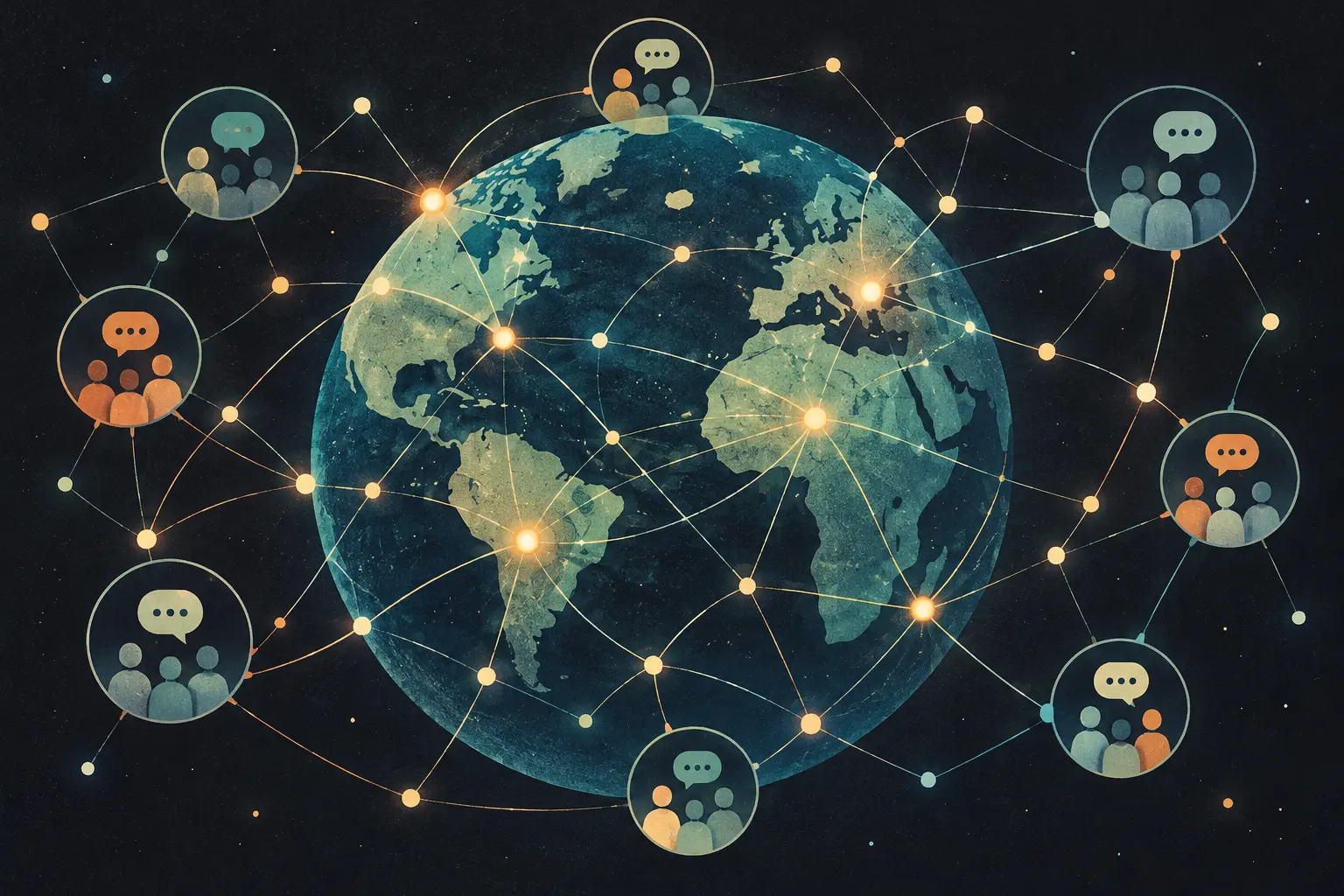
There was no single early social space, nor a simple transition from an exclusively academic internet to one connected by platforms. Different networks and services had their own technologies, audiences and ways of providing access. Some communicated through gateways; others operated separately. What they shared was the use of computer networks to sustain relationships and conversations beyond physical proximity.
Email and asynchronous conversation
Email quickly became a central application on ARPANET. In 1972, Ray Tomlinson developed tools for sending messages between connected computers and adopted the at sign to separate a user’s name from the destination system. Email met practical needs for coordination among researchers, but its significance reached further: it offered a form of person-to-person communication that did not require participants to be online at the same time.
That asynchrony changed the rhythm of conversation. Messages could be read and answered when each participant had network access; replies could travel across different systems and communities. Email also became crucial to technical collaboration: mailing lists let people discuss proposals, share documents and reach agreements without gathering everyone in one place.
Usenet, mailing lists and bulletin boards
Usenet began to take shape in 1979 as a distributed discussion network. Using UUCP, computers exchanged messages and organized them into topic-based groups. It was not a forum hosted on one central server: posts propagated from node to node according to the connections available. This architecture supported conversations on a wide range of subjects, though the experience depended on which systems and communities a participant could reach.
Mailing lists offered another format for group conversation, usually organized around a subject, activity or project. Bulletin board systems, meanwhile, brought posts, files and discussion together in services often accessed through a telephone call. Many BBSs were local or independent communities and were not, in themselves, part of the internet. Some networks and services later linked up through gateways, but their histories should not be conflated.
Created in 1988, IRC added a different mode: real-time exchanges in channels. Early connected communities therefore relied on more than one technology or conversational rhythm. Email and lists supported delayed participation; Usenet sustained distributed discussion groups; IRC enabled simultaneous gatherings, and bulletin boards could combine conversation with files and local services.
The Web joined an existing ecosystem
Tim Berners-Lee developed the World Wide Web at CERN between 1989 and 1990. By linking documents through hypertext and providing a common way to access them, the Web made it easier to publish and navigate information across the network. Its public availability in the early 1990s widened that possibility, but it did not inaugurate communication between users: messages, mailing lists, newsgroups and other forms of exchange were already in place.
The Web did change how people found and presented content. Tools such as Gopher and directories helped users locate resources; personal pages offered a place to publish interests and projects, while forums created spaces for replies and debate. Many early pages were relatively static, but that does not mean the internet as a whole was passive. The Web coexisted with conversational systems that gave participants ways to respond, organize and maintain ties.
That is why a strict division between an early read-only Web and a later social, interactive one oversimplifies the history. What changed over time was the scale, the ease of publishing and the integration of functions into broader services. Participation did not appear from nowhere; it took new forms built on earlier practices and communities.
From research networks to commercial services
The growth of commercial use changed who could provide access and which services were available to the public. In 1995, funding for the NSFNET backbone ended and the last restrictions on carrying commercial traffic over it were lifted, as traffic shifted to commercial networks. This was part of a broader transition, not a single moment when the internet stopped being academic.
During the 1990s, commercial providers, webmail, portals and virtual communities grew. Some services brought email, content, directories and conversation together in one interface. This could make access easier, but it also gave each company or service a greater role in organizing identity, publishing and contact among users. Online social experience depended on networks and protocols as well as the rules and tools of each community.
What it means to reconstruct these communities
Internet history cannot be understood by listing dates, company names or innovations alone. An archived page can show what a service looked like at a particular moment, but it may not reveal how its members participated, what norms they followed or how they connected with other spaces. Reconstructing those practices means relating surviving traces to technical documentation, published accounts and historical studies.
It also matters to distinguish the history of a network from the history of its uses. A protocol can make communication between systems possible, but people create groups, establish norms and sustain conversations. Conversely, a community can exist on services that do not share the same infrastructure. This diversity makes it impossible to present the early internet as one homogeneous community.
Before mass social platforms, the internet was already a changing collection of networks and communities. People shared information, debated, organized projects and maintained relationships across distance using different tools. The Web expanded and reorganized those possibilities, but online sociability did not begin with it or with the social networks that came later.
- Decade
- 1990s
- Region
- Global
- Level
- Introduction
- Entities
- World Wide Web, Internet, ARPANET
Sources and references
- Historia de Internettranslate.google.com · 2026-10-27
- Historia de Internet: ¿cómo nació y cuál ha sido su evolución? -www.telefonica.com · 2026-10-27
- 10 Hitos de la historia de Internet | EUDE Business Schoolwww.eude.co · 2026-10-27
- Una breve historia de Internetwww.internetsociety.org · 2026-10-27
- La historia del origen de Internet I partewww.nougir.com · 2026-10-27