A year of different proposals
Treating the social web of 2007 as an inevitable prelude to today’s platforms obscures what was at stake at the time: several tools were competing to define what online participation meant. Some made personal publishing easier; others gathered scattered activity or opened services to outside developers. Their later trajectories were not predetermined by their first versions.
Tumblr offered a less structured way to publish than a conventional blog. Its tumblelog format reduced the effort involved in sharing text, links and other material. FriendFeed, launched that year, brought a person’s activity across different sites together in a single feed. OpenSocial, meanwhile, provided interfaces that let developers build social applications compatible with multiple services. These were not variations on one feature. They addressed different questions about who publishes, where activity is gathered and who gets to build within a platform.
Twitter stood out for its short messages and open circulation. At the South by Southwest festival in March 2007, it attracted attention from people connected to the technology industry, though its usefulness was not obvious to everyone. The 140-character limit encouraged quick updates akin to messaging while allowing posts to circulate and be read publicly. That combination helped turn a service some dismissed as trivial into a way to follow events as they unfolded.
Opening a platform was also a business decision
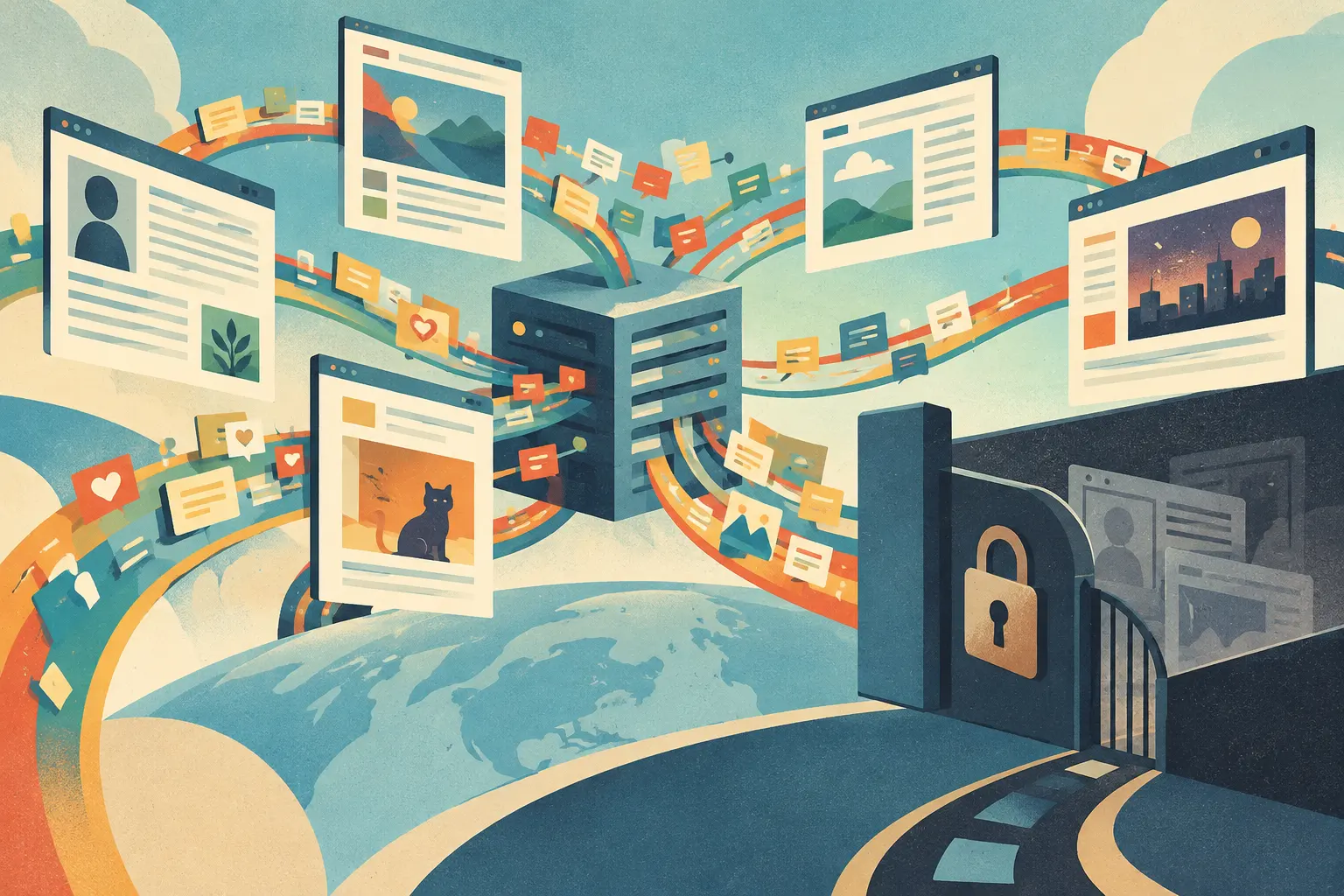
In 2007, Facebook was still competing with larger networks. Opening its platform to outside companies so they could develop applications within the site expanded what users could do without requiring Facebook to build every feature itself. The decision also linked the platform’s growth to developers’ interests and advertising: Mark Zuckerberg presented Facebook as a place where developers could build advertising businesses.
This kind of openness was not neutral. When applications are built inside a service, the platform sets the terms for access to its users and their data, as well as the possibilities for distribution and monetization. Developers could reach Facebook’s audience; in return, their applications could help keep users on the site. The connection between social activity and advertising did not emerge only after the social web matured: it was part of some design decisions from the outset.
The tension was especially visible in Beacon, a Facebook feature launched in November 2007 that could communicate users’ activities on external sites. Criticism focused on its default activation and the need to intervene in each notification to stop it. In December, Facebook added a general opt-out. The episode showed how social participation could become promotional material without users clearly understanding when their activity was being shared.
What hindsight changes
The cases of 2007 help distinguish technical innovation, adoption and consequences. Being first did not guarantee that a service would become a regular destination; attracting developers did not settle how revenue would be divided or how much control users would have. Tumblr later reached a scale that led Yahoo to acquire it in 2013; Twitter consolidated a form of public posting; Facebook’s open platform linked outside applications to a centralized service. These were different outcomes, not evidence that every launch was pointing toward the same kind of web from the start.
It is also worth distinguishing a service’s launch from the experience it offered users. Some debuted as trials, first attracted technology communities or took time to become widespread habits. A private beta is not the same as general availability, and an announced feature does not show that most users adopted it.
The more enduring cultural question is not which tool won, but what kinds of exchange these services normalized. Publishing and following other people became easier; so did integrating those activities into systems of measurement, promotion and monetization. The social web of 2007 was less a single turning point than a field of experiments: some services expanded personal expression, while others quickly showed that convenience, openness and privacy could come into conflict.
- Decade
- 2000s
- Region
- North America
- Level
- Enthusiast
- Entities
- No linked entities
Sources and references 5
- 10 lanzamientos de internet de 2007 y en qué se convirtieron ...es.qz.com · 2026-11-13
- Comercialización de Internettranslate.google.com · 2026-11-13
- Historia de Internet: ¿cómo nació y cuál ha sido su evolución? -www.telefonica.com · 2026-11-13
- Agencia de publicidades.wikipedia.org · 2026-11-13
- Fenómeno de internetes.wikipedia.org · 2026-11-13