A broadcast was more than its programme
A printed schedule seems to offer an orderly map of television: titles, times and channels. Yet the actual experience also included advertisements, trailers, continuity segments and live changes. Raymond Williams used the term “flow” for this planned sequence, whose boundaries do not always match the way viewers experienced a broadcast. Studying historical television therefore requires more than preserving isolated episodes; it also means reconstructing how programmes were arranged and connected.
The difficulty begins with the medium’s history. In its early years, television was centred on live transmission, and systematic recording was not a priority. Videotape made it possible to record and reuse images, but also to erase and record over tapes. According to Elina Adduci Spina’s study of Argentina, preservation long served broadcasters’ operational needs—rebroadcasting or reusing material—rather than a heritage policy. The result is an uneven, fragmentary record.
What each trace can tell us
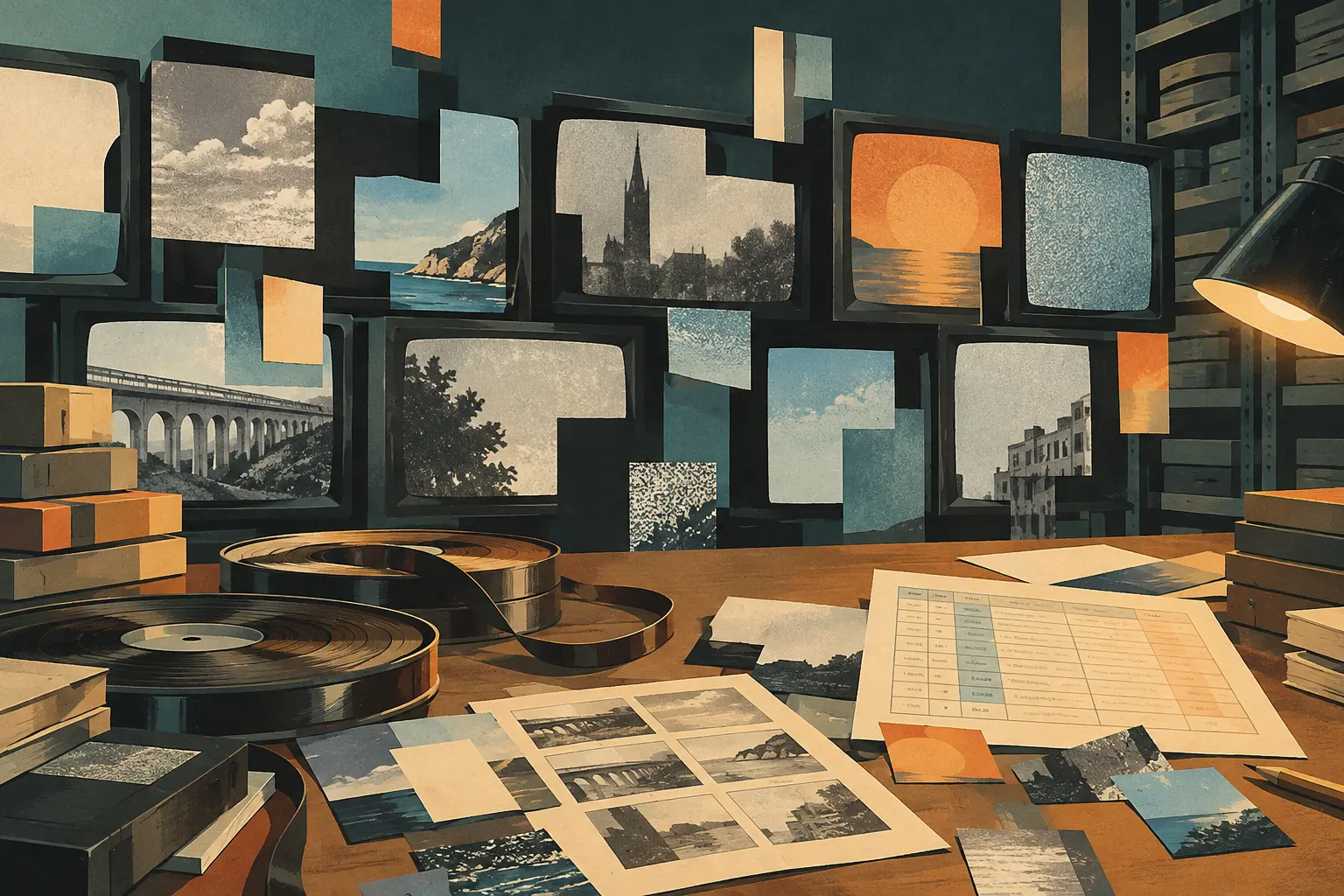
Surviving recordings are only one kind of evidence. Tapes may preserve episodes or segments, but they may also contain advertisements detached from programmes, auxiliary footage or thematic excerpts from news broadcasts. Technical records associated with a recording—production and transmission dates, roll or studio numbers, operator names—can help establish context. Adduci Spina, for example, examines Argentine television promotions from 1979 whose technical documentation helps situate them within a particular production practice.
Schedules printed in newspapers and magazines place a programme within the day’s sequence and show its announced time; by themselves, they do not prove that a broadcast went out exactly as planned. The press may contribute reviews, interviews, announcements and production news. Photographs, scripts and institutional records can connect incomplete broadcasts with their production context. For the Argentine series Los gringos (1984), the author relates surviving tapes to production photographs, press clippings and scripts. None of these sources replaces a complete broadcast, but comparing them expands what can be known.
Home recordings matter too. Viewers’ recordings may preserve programmes no longer held in broadcasters’ archives, although their selection reflects what each person chose to record. Private tapes are not a neutral sample of all programming: they preserve particular interests, moments and opportunities. Their value increases when they can be identified and compared with schedules, production records and other copies.
Recording, reuse and loss
Videotape transformed production by making it possible to record for later transmission, but the ability to erase and reuse the medium encouraged discard. A tape was a working resource, not necessarily an object intended to last. The study also notes that many early broadcasts in Argentina were live. No audiovisual record of the country’s first official television transmission, on 17 October 1951, is known to exist in the archive described by the author.
Home recording opened another path to preservation, but it did not remove the problem of selection. A home recording may capture a programme alongside advertisements and transitions—the very elements sometimes missing from institutional archives. Even so, every tape represents a choice and may contain cuts, channel changes or incomplete information. Viewers’ archives complement professional collections; they do not replace them.
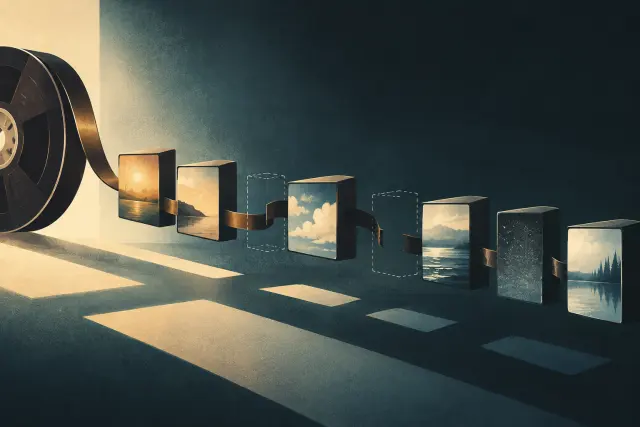
Physical preservation does not guarantee access either. Adduci Spina describes Los gringos: seven of its twenty-one supports could be digitised, while fourteen tapes were affected by deterioration known as glue flange, which prevented playback. The example distinguishes three tasks that are often conflated: storing a medium, keeping it playable and making its contents available to the public.
Reconstructing without concealing absence
A television archive can rarely reproduce the original flow in its entirety. Its work involves identifying materials, documenting their provenance and relating fragments to records that restore some of their context. This makes it possible to study not only what appeared on screen, but also how broadcasts were organised, which materials were retained for industrial reasons and which voices or content were left out.
The Argentine case shows both the potential and the tensions of this work. Public and private archives, broadcast tapes, schedules and related documentation offer complementary paths for research. At the same time, every collection reflects decisions about preservation, reuse and access. Reconstructing television means working with these traces without confusing an announced schedule with a verified broadcast, or a fragment with a complete programme. A rigorous account also preserves the incomplete form in which the past has reached us.
- Decade
- 2000s
- Region
- Global
- Level
- Enthusiast
- Entities
- Televisión, Elina Adduci Spina, Argentina, Mappa
Sources and references 5
- Desarrollo y conservación del patrimonio cultural-natural en el contexto neoliberal y nuevas tecnologíasdoi.org · 2026-11-12
- Conservación y Restauración del Patrimonio Cultural en soporte Papel - Museo Jesuítico Nacional de Jesús Maríadoi.org · 2026-11-12
- Memoria, inteligencia artificial y ciudadanía digital: el archivo como agente narrativo en la era de la desinformacióndoi.org · 2026-11-12
- Paradojas y desafíos del patrimonio audiovisual televisivo. ...www.scielo.org.ar · 2026-11-12
- Recuerdos en movimiento: Archivo Audiovisual de CMEFMwww.casamuseoeduardofrei.cl · 2026-11-12