Disappearance does not erase every trace
An internet service is more than its home page. It includes internal pages, links, functions, forms of participation, and infrastructure that may cease to operate. When the service disappears, a preserved capture can show how it appeared at a particular moment, but not necessarily how it responded, what content it offered to each person, or how it changed through use.
Reconstructing older services means reading traces as complementary pieces. A page capture may document visible design and text; institutional documentation may explain an archive’s purpose or scope; collection records may place a page within a thematic selection or a sequence of captures. None of these traces alone reproduces the full experience.
What web captures preserve
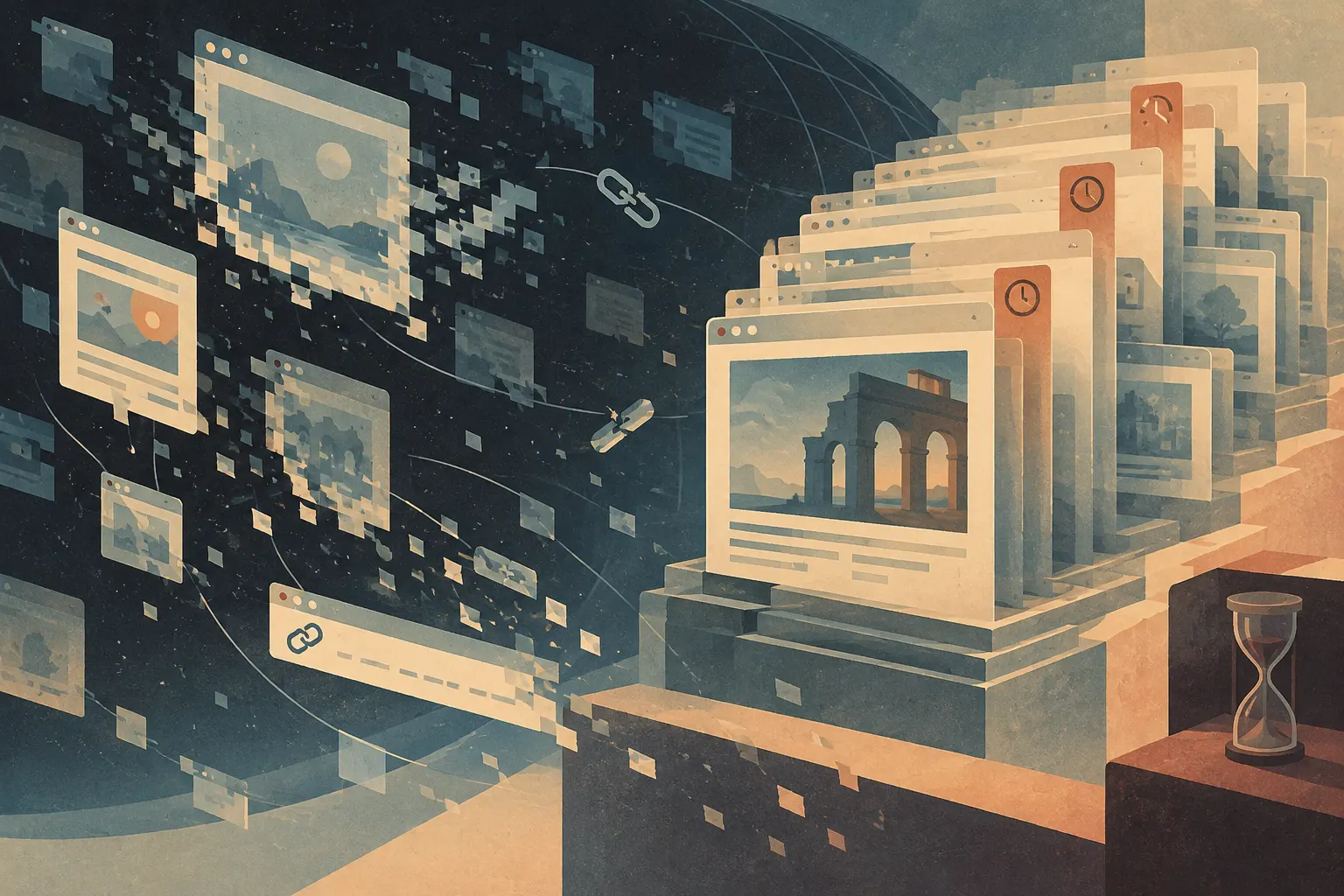
The Wayback Machine makes archived versions of pages available for consultation. In practical terms, a capture is a dated record of what could be retrieved from a web address at a particular moment. It can help researchers examine changes in wording, structure, links, or visual presentation, and compare a remembered page with a preserved version.
The date of a capture, however, documents when that version was captured—not necessarily when the service launched or when each page element was added. Content may have changed before or after, and the same address can lead to different versions depending on when it is consulted. Keeping those dates distinct prevents a user’s recollection from becoming a chronology of the service.
Links are part of a page’s context. When they lead to resources that were not preserved, a visible discontinuity remains. A capture is still valuable because it records that structure, even when it cannot recover every destination.
Web archives and institutional memory
Documentation about the Spanish Web Archive describes an initiative coordinated by the National Library of Spain to capture, preserve, and provide access to websites of cultural and documentary interest. It also places this work within a broader network of institutions and web-preservation initiatives. Its importance to internet history lies not in turning every service into a functional replica, but in preserving records that can be studied in context.
Selection and archival organization matter. A thematic collection or focused capture can bring together at-risk materials that might otherwise be difficult to find. But the existence of a collection does not mean that all its contents are publicly accessible. The access conditions described for the Spanish archive show that preservation and consultation are separate questions.
Archives make it possible to compare pages, identify changes, and recover period vocabulary. They also help researchers study which institutions, communities, or practices are represented. Decisions about what to capture become part of the archive’s history and, in turn, of the accounts that can later be written.
A saved page is not the service
A visible website may be only one layer of a service. Actions that depended on accounts, databases, personalized content, or interaction with other users may not appear in a capture. An archive allows us to study what it recorded; it does not prove that every original function remains available or that a present-day visitor can repeat the experience.
This distinction also affects interpretation. A presentation page may show how a service wanted to describe itself, but it is not enough to establish how its members used it. Personal recollections can add context about everyday practices, but they should be distinguished from dates and features supported by contemporary records. Reconstruction becomes more precise when different kinds of documents are compared and each claim is tied to the trace that supports it.
From recollection to a verifiable history
Research can begin by identifying a service’s known names and web addresses, searching for captures from different moments, and noting the dates shown. The visible structure can then be compared with archival, institutional, or published documentation from the service’s lifetime. If a source describes a feature, that description is evidence of what the source says—not proof that every user experienced it in the same way.
The result need not pretend to be a complete reconstruction. It can be a reasoned map of what survives: which pages are documented, which changes can be observed, which relationships between pages remain, and which kinds of interaction can only be described cautiously. An archive does not bring a disappeared service back to life; it makes it possible to study its digital presence without mistaking a trace for the whole object.
The Internet Archive, national web archives, and preservation networks offer different frameworks for this work. Together, they show that internet memory does not reside in one place or in a definitive capture, but in dispersed records that must be dated, contextualized, and read carefully.
- Decade
- 2000s
- Region
- Global
- Level
- Introduction
- Entities
- Archivo de la Web Española, Internet, Mappa, Internet Archive
Sources and references
- cómo la preservación web está redefiniendo los archivos y ...museotech.org · 2026-11-11
- Entrando en el flujo: Museo entre archivo y obra de arte totaltranslate.google.com · 2026-11-11
- INTERNET Archivesevemuseografia.com · 2026-11-11
- Patrimonio cultural digital: guía completa y prácticaartgonuts.com · 2026-11-11
- Centro Cultural Universitario Tlatelolcoes.wikipedia.org · 2026-11-11