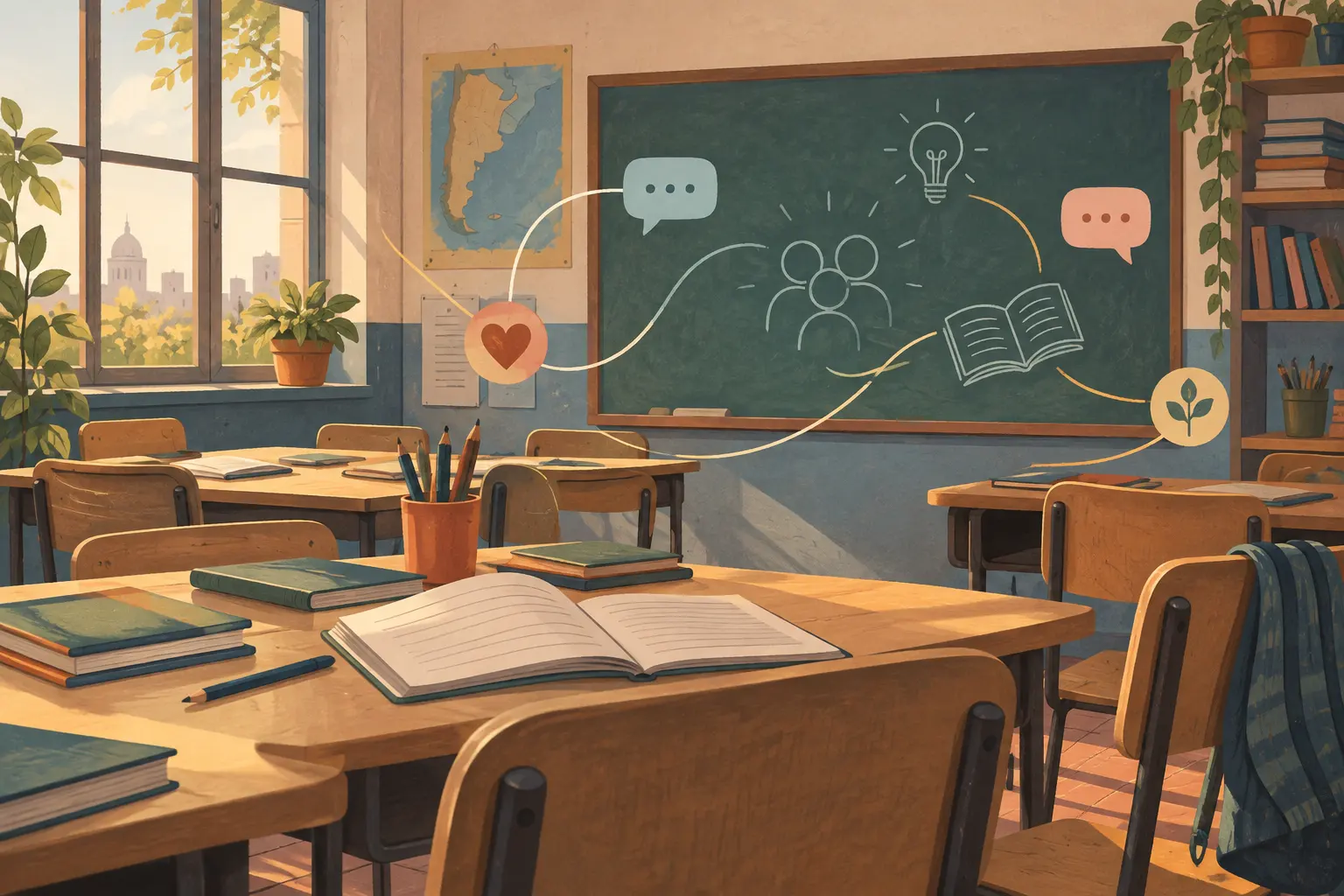
School is built through relationships, too
A classroom is a place for more than subjects, timetables and rules. It is also where worries are shared, relationships take shape and authority is negotiated. In “Cosas de escuela: Aproximaciones a la vida cotidiana escolar” (“School Matters: Approaches to Everyday School Life”), published in 2011, Irene Macera examines this dimension through the testimonies of secondary-school teachers in Argentina. Her aim is not to define what all schools are like, but to understand what happens when the relationship between teacher, student and knowledge is shaped by personal and emotional concerns.
The article grew out of doctoral research begun in 2007. Macera worked with teachers from public and private schools, both religious and secular, whose professional histories differed. For this article she draws on individual interviews and a group discussion held in 2008, where the testimonies were shared and debated. The author treats that exchange as part of the analysis: hearing one account alongside others can bring out tensions and questions that an isolated statement might not reveal.
Teaching across several institutions
The accounts point to a concrete feature of secondary-school work: some teachers divide their hours among two, three or more institutions. One participant questions how strong a connection with each school community can be when the working day consists of moving from one school to another. The image of school as a place to pass through exists alongside the possibility that a classroom can acquire its own meaning for the people who meet there.
Teachers also express reservations about meetings, plans and projects that they see as tools of control or as efforts whose results are never made visible. One participant describes a large institution that offers little support, where a lack of supervision can mean freedom to teach but also an absence of guidance. These remarks do not provide a uniform portrait of Argentine schools; they show how these teachers interpret particular institutional conditions.
Macera relates the accounts to Marc Augé’s distinction between place and non-place. In her reading, the concept raises questions about how belonging is created—or weakened—when shared time and institutional relationships are scarce. This is not a claim that a school is literally a non-place. A space can acquire meaning through the relationships formed there; moreover, the same institution may be experienced differently by the people who inhabit it.
Care as part of teaching—and a source of tension
The interviews show that conversations about friendships, conflict, love and personal worries take place alongside subject lessons. Some teachers say that listening and showing warmth helps them build trust with students and encourage participation. One recounts speaking with a student after an angry outburst, only for the student to share aspects of her life.
The article does not present this closeness as a simple solution. In the group discussion, several participants ask how much teaching depends on the relationship established with a class. One teacher worries that emotional demands may carry more weight than subject knowledge and teaching methods. Another says she does not need to be friends with her students, while acknowledging that tensions—and how they are handled—are part of the work.
Macera preserves this ambivalence. Listening and trust can help sustain a shared classroom experience, while feeling obliged to respond to emotional demands can be exhausting. She does not oppose care to knowledge or conclude that one should replace the other. Instead, she proposes considering relationships, teaching, methodology, the transmission of knowledge and institutional conditions together.
Questions about generational change
During the 2008 discussion, some teachers wonder whether care always had a similar place in school or whether its importance has changed. One recalls that teachers in earlier generations seemed less open to question; another suggests that affection was present then too, perhaps in different forms. The conversation also includes the perception that some students look to school for listening or support they do not always find elsewhere.
These are the participants’ interpretations, not established historical conclusions about all Argentine families, generations or schools. Their importance in the article lies in showing how teachers make sense of their experience and debate the terms of their role. Macera notes that personal concerns can blur the boundary between the teacher’s professional function and private life, raising questions about what it means for school to be a public space today.
The contribution of this qualitative study is to place relationships at the heart of a reflection on school life without separating them from the work of teaching. The classroom remains a place where knowledge is transmitted, but what happens there also depends on relationships, working conditions and ways of exercising authority. The testimonies illuminate that interplay through specific experiences, without turning them into a universal explanation.
- Decade
- 2000s
- Region
- Latin America
- Level
- Enthusiast
- Entities
- Argentina, Irene Macera
Sources and references 5
- Nuevos enfoques en la Historia de las Universidades: la vida cotidiana de los universitarios en la Península Ibérica durante la Edad Modernaopenalex.org · 2026-11-13
- Violencia Escolar y Convivencia Escolar: Descubriendo estrategias en la vida cotidiana escolaropenalex.org · 2026-11-13
- La Vida Cotidiana Escolar en la Formación Valoral: Un Casoopenalex.org · 2026-11-13
- El uso del patrimonio documental para Educación Primaria y ...papiro.unizar.es · 2026-11-13
- Cosas de escuela: Aproximaciones a la vida cotidiana ...www.scielo.org.ar · 2026-11-13