From peineta to peinetón
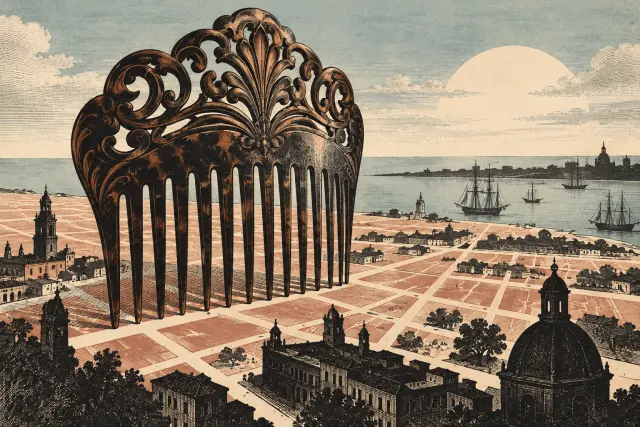
In the late 1820s, an ornamental comb related to the Spanish peineta took on a distinct shape and scale in Buenos Aires. The peinetón had a broad, slightly convex, pierced body that extended beyond the hair and changed the wearer’s silhouette. The fashion also reached Montevideo and, to a lesser extent, other parts of the region. Rather than a simple enlargement of an imported accessory, it was a local adaptation shaped by European references, urban workshops and the preferences of the women who wore it.
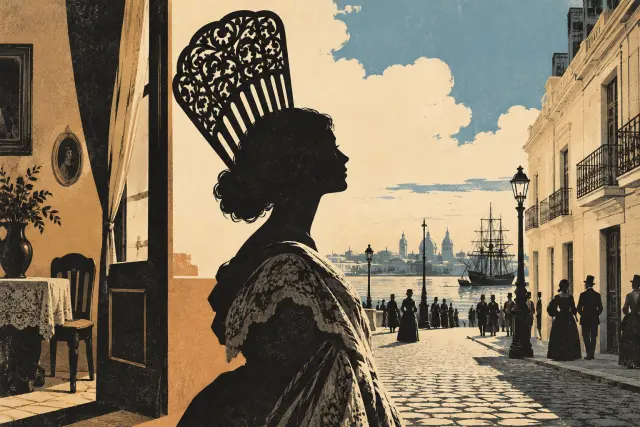
Sources place its heyday in the 1820s and 1830s, especially between 1830 and 1837. Portraits by Charles Henri Pellegrini and lithographs by César Hipólito Bacle show it alongside narrow-waisted dresses and voluminous sleeves associated with Romantic fashion. These images reveal changing styles and visual conventions, but they are not a census of what people wore: they depict particular individuals and scenes, often connected with public life and wealthier groups.
Workshops, materials and labour
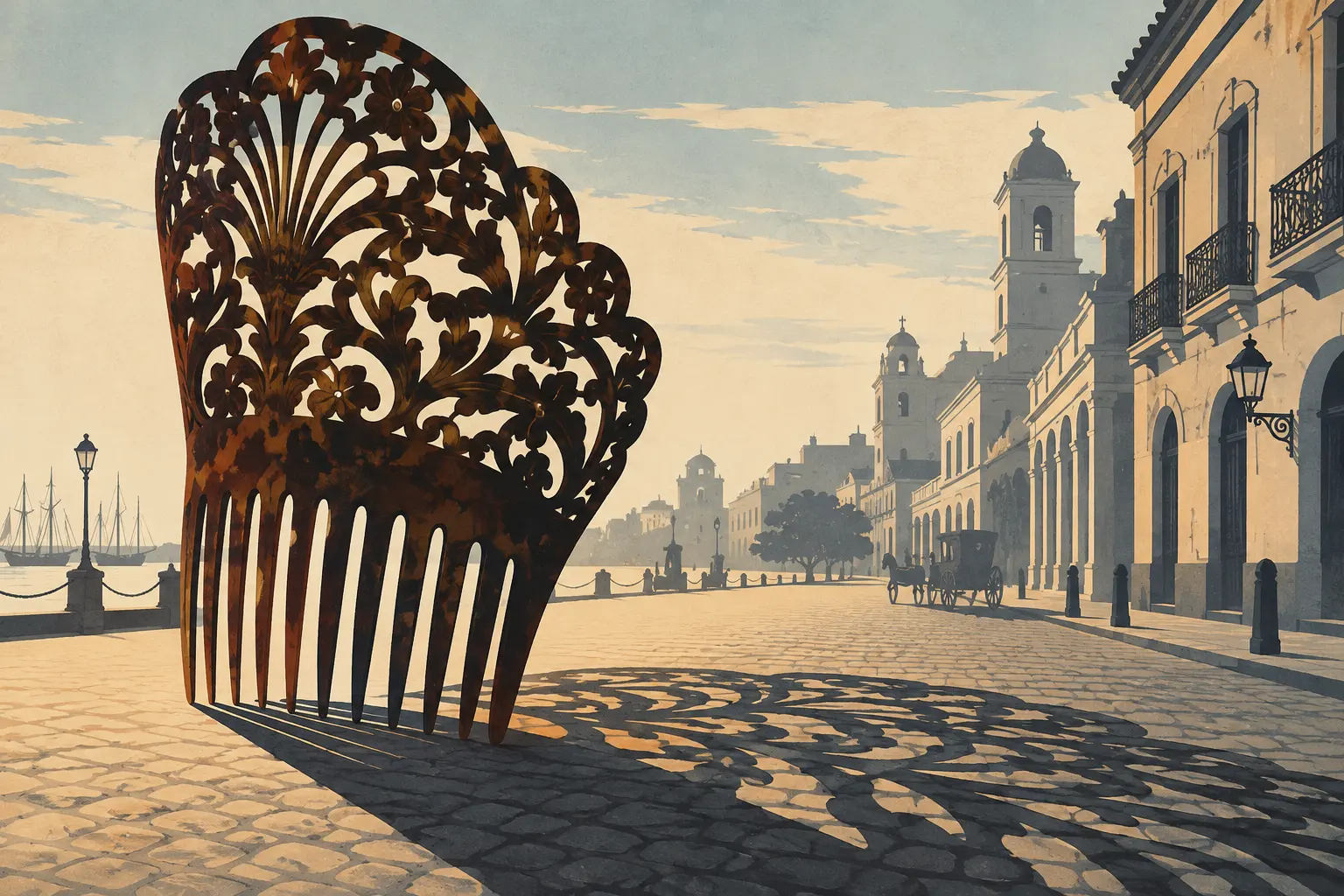
The peinetón combined a comb that held it in the hair with a visible, decorated and pierced section. It was made mainly from tortoiseshell; horn, a less expensive material, was also used, while ivory, mother-of-pearl and silver appeared less often. Making one required skill: cutting, softening, joining, shaping and polishing the material, as well as producing decorative motifs that could be botanical, animal, geometric or political.
Production was concentrated in the shops and workshops of Buenos Aires. Manuel Mateo Masculino, who arrived from Spain in 1823, opened a comb and peineta business and became one of the accessory’s most prominent makers and promoters. His prominence does not establish that he invented it. Researchers including Regina A. Root and Susan Hallstead have suggested that the peinetón may have emerged from competition among makers and demand from women, rather than from the initiative of a single person.
Its manufacture also prompts the question of who did the work. Studies of the period’s workshops describe an unequal division of labour in which enslaved or free Black craftspeople, including women and children, took part in different stages. Employment notices and commercial records, considered alongside surviving objects, help bring this labour into view. The ornament should not obscure the people whose work made each piece possible.
A fashion that occupied the street
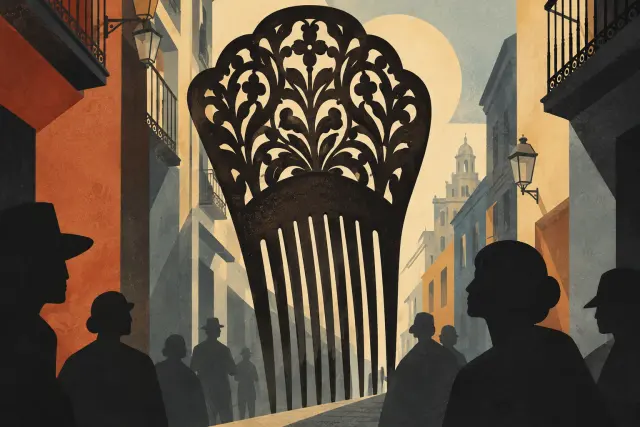
The peinetón’s size caught the attention of artists, travellers, writers and journalists. Bacle’s lithographs even include comic scenes in which the large combs impede passage along narrow streets. Newspapers debated the fashion, while travellers such as Alcide d’Orbigny and Arsène Isabelle described its visual impact. In a passage about his travels in the region, Charles Darwin recorded the pride some rural men took in the combs worn by women in Buenos Aires. These accounts reflect their authors’ perspectives and expectations; they are not neutral observations.
Historians have interpreted the peinetón as more than an ornament. Its volume made women’s bodies occupy more visual space in the street and turned appearance into a public matter. That visibility could offer a means of self-assertion, while also provoking criticism of women’s presence beyond the domestic sphere. The tension matters: the accessory drew attention to its wearer, but could also restrict her movement and make her a target of satire or disapproval.
Access was not equal either. The cost of tortoiseshell and the complexity of its manufacture associated the peinetón with luxury and status. Some images and accounts nevertheless suggest that women from different social groups aspired to wear it or had access to different models, although it remained beyond the means of many. A peinetón in a portrait therefore cannot prove that the fashion was universal. Portraits of wealthy sitters take on a different meaning when compared with caricatures, advertisements, commercial inventories and evidence about prices and production.
Politics and material memory
During Juan Manuel de Rosas’s government, some peinetones incorporated Federalist effigies and slogans. Not every example had an explicit political function, but decorated pieces show how a fashionable object could communicate affiliation and belonging. In such cases, the ornament carried messages that were legible in the context of the period.
The peinetón fell out of everyday fashion towards the end of the 1830s. It survived in paintings, prints, documents and collections, where it can now be studied alongside advertisements and period records. Examples are held by Argentine institutions including the National Museum of Fine Arts, the National Historical Museum and the Cornelio de Saavedra Historical Museum of Buenos Aires. Reading the objects alongside their representations helps distinguish the material accessory from the images that helped make it famous.
The peinetón matters to the history of dress because it brings together several dimensions of urban life: the adaptation of models, workshop labour, unequal access, political codes and women’s visibility in public space. It was a striking and significant Río de la Plata fashion, but not a description of what all women in the region wore.
- Decade
- Before 1950
- Region
- Latin America
- Level
- Enthusiast
- Entities
- Museum, Peinetón, Buenos Aires, Museo Histórico de Buenos Aires Cornelio de Saavedra, Museo Histórico Nacional
Sources and references 5
- Los tejidos en las colecciones de los museos españoles, una larga historia de valoración y conservaciónopenalex.org · 2026-11-14
- La representación del poder y el poder de la representación: la política cultural en los museos de Antropología y la creación del Museo del Trajeopenalex.org · 2026-11-14
- Museos de moda del mundo: archivos vivosinstitutodemoda.com · 2026-11-14
- Casa sobre el Arroyoes.wikipedia.org · 2026-11-14
- Peinetónes.wikipedia.org · 2026-11-14