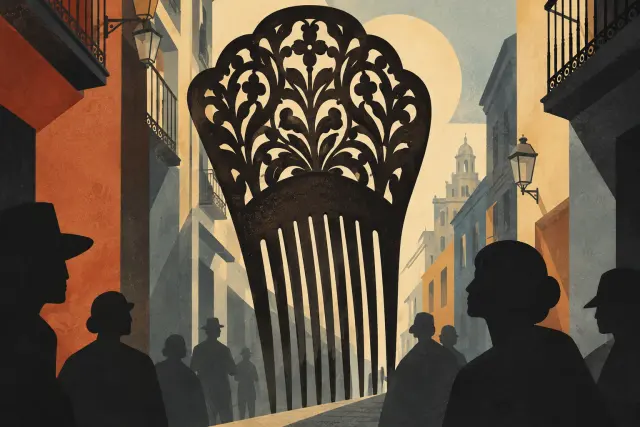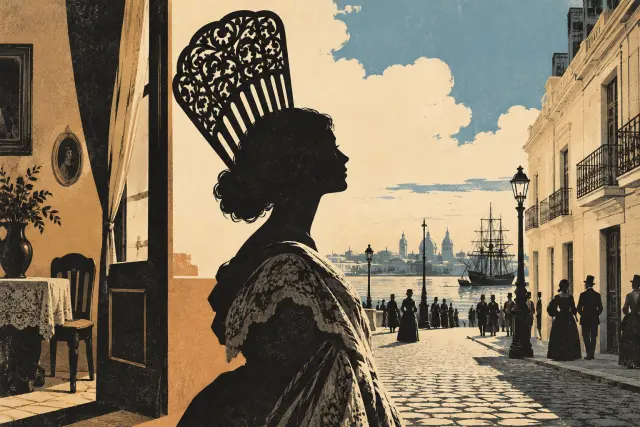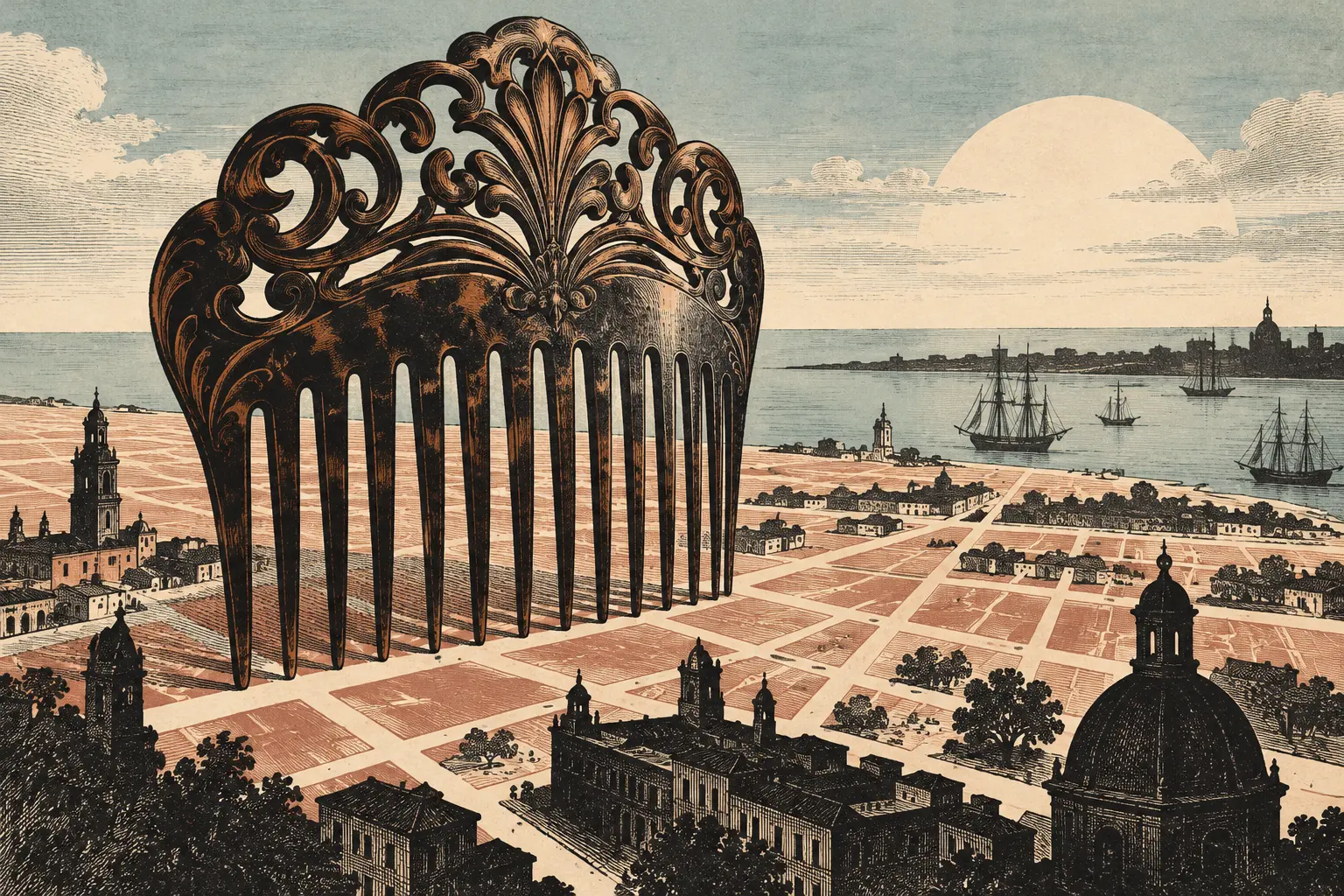
The peinetón was a large ornamental comb that became one of the most recognizable silhouettes in Buenos Aires and Montevideo from the late 1820s to the mid- or late 1830s. More than a striking accessory, it was made and sold in the city, depicted in portraits and lithographs, and discussed in the press. Its history offers a way to examine how fashion entered debates about labor, social distinction, women’s presence in the streets and political identity.
From the Spanish peineta to a Río de la Plata fashion
The Spanish peineta was circulating in the Río de la Plata around 1815. From 1824, interest grew in larger, more elaborate models until the accessory developed its own form, known as the peinetón. Its rise coincided with Romantic-era fashion: high hairstyles, narrow waists and voluminous sleeves. It also drew on French hairstyles and ornaments. Rather than a straightforward copy, it combined outside references adapted to local circumstances.
There is not enough evidence to attribute its invention to a single person. The maker Manuel Mateo Masculino was a prominent promoter who popularized some of the most sought-after designs. However, scholars such as Regina A. Root and Susan Hallstead have challenged the idea of a sole creator: the peinetón also emerged from competition among makers, the circulation of designs and the choices of the women who wore it.
The object had a comb that secured it to the hair and a visible, often pierced and decorated panel. It was made chiefly from imported tortoiseshell; horn was also used, and ivory, mother-of-pearl and silver appear less often. In workshops, sheets were softened with heat, cut and joined, then shaped, engraved or embossed, and polished. Production demanded skill and involved several distinct tasks.
That process had a social dimension that can disappear behind the image of a luxury ornament. Historical research points to the participation of enslaved Black artisans and freedpeople, including women and children. Presenting the peinetón only as a designer’s creation or a symbol of elegance leaves out the people who carried out much of the material work.
Portraits, lithographs and everyday life
Portraits by Charles Henri Pellegrini and other artists show women wearing peinetones of different sizes and styles, with dresses characteristic of Romantic-era fashion. César Hipólito Bacle’s lithographs, collected in Trages y costumbres de la provincia de Buenos Ayres, record clothing types and urban scenes. In some images the accessory appears in social and public settings; in others, figures do not wear one, suggesting that its use depended on the occasion.
Travel accounts, advertisements and newspapers add details that portraits cannot provide. The press discussed the peinetón’s size with admiration, humor or criticism; some caricatures depicted it as an obstruction on narrow sidewalks. Notices for lost combs also appeared, sometimes describing the shawls worn with them. These traces help us approach how the accessory was used without mistaking an idealized image for every woman’s experience.
Imported tortoiseshell and the labor involved in making the peinetón made it expensive. Scholarship does not offer a single account of who wore it: some studies emphasize its association with elites, while others point to depictions of women from different social groups and to aspirations to buy one that could not always be fulfilled. It is more accurate to speak of unequal access and varying degrees of visibility than of a universal fashion.
An object that contested public space
The peinetón was difficult to overlook. Its size could make it awkward to pass on narrow sidewalks and turn everyday movement into a subject of public comment. Some historical interpretations understand this presence as a way of asserting women’s visibility in the street, in a society where public life was shaped by gendered limits. Other readings emphasize the accessory’s ambivalence: it drew attention to women, but could also restrict their movement and invite criticism of their conduct.
Visibility did not, by itself, mean equality. The object’s cost could mark differences in wealth, while satirical images used its bulk to mock women occupying the streets. The peinetón thus became a point of contact between fashion and disputes over who could move through the city and be seen there.
During Juan Manuel de Rosas’s rule, clothing could communicate political positions. Some peinetones bore federalist portraits or slogans, but those motifs should not be attributed to every piece or wearer. The sources show both politicized models and a range of designs. Fashion intersected with politics, though not every clothing choice necessarily expressed partisan allegiance.
The fashion spread to Montevideo, and its presence in Asunción has also been noted. Its Río de la Plata character did not depend on an absence of European influence, but on its transformation: Spanish and French references met urban production and local forms of representation. In this sense, the peinetón offers a specific example of how a postcolonial society developed signs of belonging of its own.
From the street to museum collections
Peinetones are now held by Argentine institutions such as the Museo Histórico Nacional, the Museo de la Historia del Traje, the Museo Fernández Blanco and the Museo Cornelio de Saavedra. Read alongside portraits, lithographs, advertisements and accounts, the accessory becomes more than an extravagant silhouette. It raises questions about the materials used, how workshops were organized, who made the objects and what social conditions shaped access to them.
The peinetón’s history is not just that of a passing fashion or an individual creation. It is also a history of skilled labor, unequal consumption and public representation. Comparing surviving objects with period images and written accounts helps recover those dimensions without turning the visible choices of some women into everyone’s experience.
- Decade
- Before 1950
- Region
- Latin America
- Level
- Enthusiast
- Entities
- Museum, Peinetón, Buenos Aires, Argentina, Trages y costumbres de la provincia de Buenos Ayres, Museo de la Historia del Traje, Museo Histórico Nacional
Sources and references 5
- Museos de moda del mundo: por qué son archivos vivosinstitutodemoda.com · 2026-11-13
- Verónica Kuhliger: Guardiana del patrimonio cultural ...juanra.substack.com · 2026-11-13
- Explorando el papel de los archivos de moda: Preservar y ...translate.google.com · 2026-11-13
- Los mejores —y más elegantes— museos de moda del ...es.qz.com · 2026-11-13
- Peinetónes.wikipedia.org · 2026-11-13