The peinetón, a large ornamental comb that spread in Buenos Aires and Montevideo from the late 1820s, was more than a conspicuous accessory. Its size and decoration made it a recognizable fashion, but it was also tied to consumption, artisan labor, political identity and disputes over women’s presence in public space. Portraits, lithographs, advertisements and travel accounts help reconstruct both its use and the different meanings attached to it.
A River Plate fashion, not simply an enlarged peineta
The Spanish peineta had reached Buenos Aires by around 1815. From 1824, interest grew in larger, more elaborate models; the peinetón reached its peak between 1830 and 1837. It inherited the basic form of the peineta, but in the River Plate region it became a distinctive headpiece, adapted to local hairstyles and the Romantic-era fashion of the time.
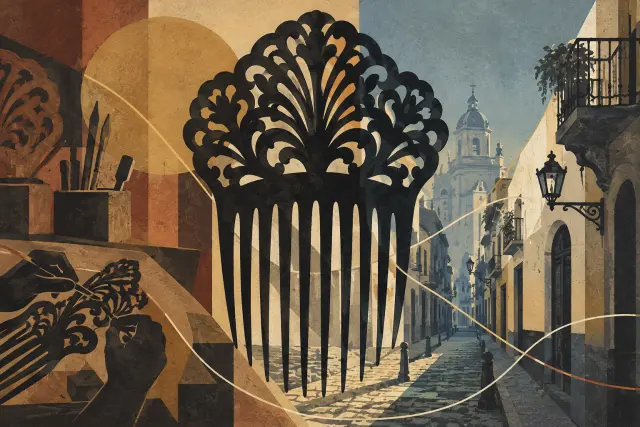
Its slightly convex body was secured in the hair by teeth. It was made chiefly from tortoiseshell, though horn—a cheaper material—was also used, along with smaller amounts of ivory, mother-of-pearl and silver. Decoration combined plant and animal motifs with neoclassical designs. Models varied in shape and size: some were extraordinary in scale, but the objects did not all look alike or follow one design.
Nor can its invention be securely attributed to one person. Manuel Mateo Masculino was one of its most prominent makers and popularized many models. Historical research, however, describes the peinetón as the outcome of competition among workshops, a growing market and the choices of the women who adopted it. Rather than the achievement of a single inventor, it was a fashion produced and reshaped collectively.
Workshops, trade and unequal labor
Manufacture and sales were concentrated in the commercial district around Plaza de la Victoria, now Plaza de Mayo. Materials arrived as pieces or sheets that artisans cut, softened with heat, joined, pierced and polished. The sequence of tasks required manual skill; some studies also point to production volume, the division of labor and the use of machinery as evidence of manufacture on a significant scale. Those features alone do not establish that production was fully mechanized.
The object’s history also includes the people who made it. Contemporary advertisements and other documents cited in research describe enslaved or formerly enslaved Black workers—including women and children—performing manufacturing tasks. Free Spaniards and people of mixed ancestry could work as owners or foremen. The accessory associated in many portraits with affluent women therefore depended on artisan labor organized under racial and social inequalities.
Trade extended beyond the workshops: peinetones were sold in specialist shops and in stores dealing in other goods. Shipping records cited in the English-language press in Buenos Aires also indicate that some were exported. The object’s circulation connected local production, urban consumption and wider markets, though that does not establish the existence of a fully mechanized industry.
Portraits and street scenes
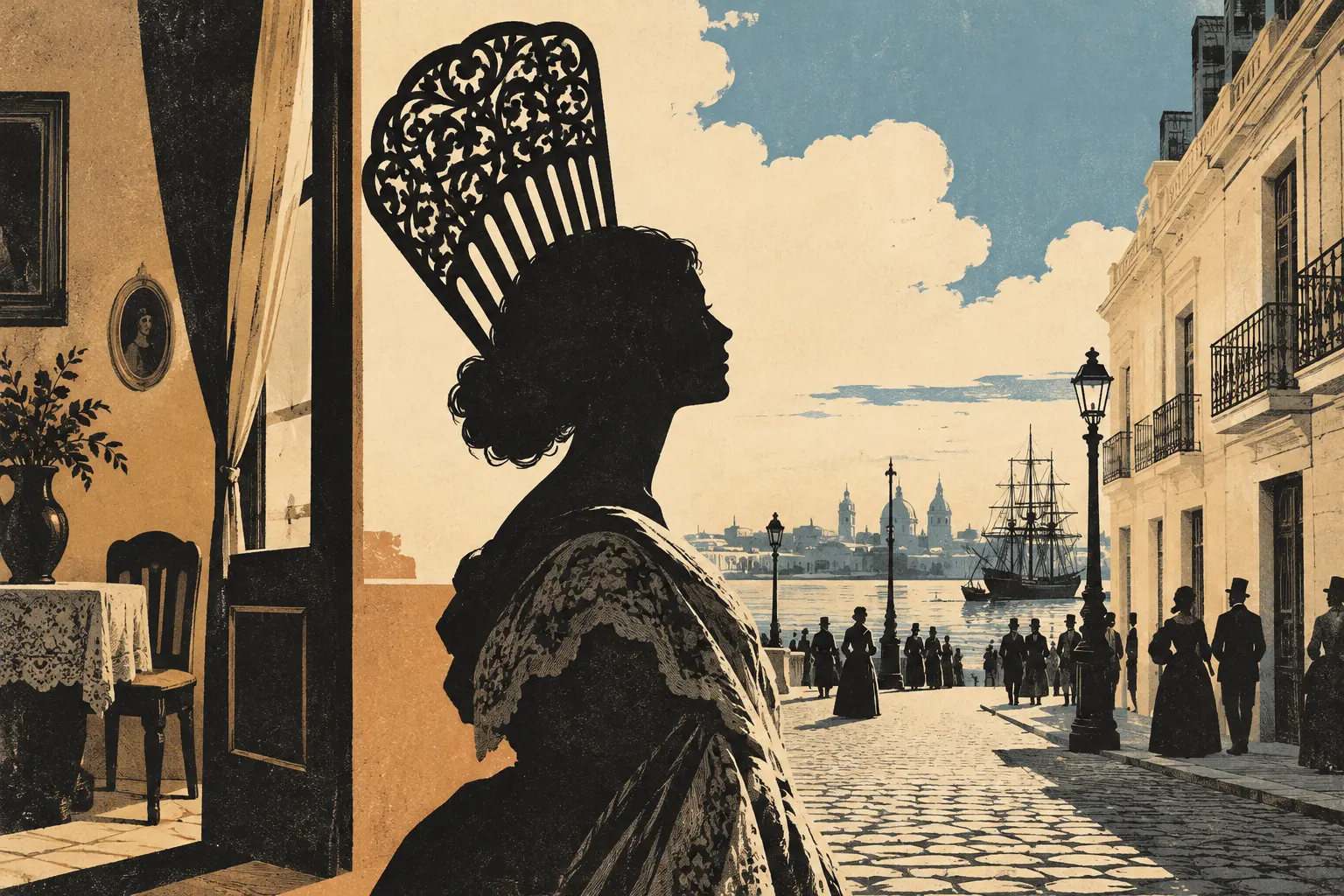
Portraits by Charles Henri Pellegrini and other artists show peinetones worn with narrow-waisted dresses and voluminous sleeves, in keeping with Western Romantic-era fashion. They are valuable evidence of the accessory’s forms, sizes and modes of wear. But they depict particular people, often from affluent circles; they are not a comprehensive record of what the entire population wore.
César Hipólito Bacle’s costumbrista lithographs offer another perspective. His series Trages y costumbres de la provincia de Buenos Ayres depicts clothing and urban scenes; some images place the peinetón in public life, including satirical scenes of encounters on narrow streets. Newspapers, lost-property notices and travel accounts provide further clues about its use and circulation. Compared with surviving objects and inventories, these materials help distinguish idealized imagery, contemporary dress conventions and documented practices.
Foreign visitors’ accounts record the impression the accessory made. Alcide d’Orbigny described the large comb as a feature that distinguished women of Buenos Aires, while Arsène Isabelle noted its size and the effect of its presence in public. These are situated observations, not neutral descriptions of all women; they nonetheless show that the peinetón had become a recognizable emblem to visitors to the region.
Who could wear it, and what did it mean?
Imported tortoiseshell and skilled workmanship made the peinetón expensive. Some research suggests that women from different social groups wore one or hoped to own one; other evidence emphasizes that it remained beyond the means of many. Images of women wearing peinetones cannot settle that question on their own. It is more accurate to understand it as a highly visible fashion that inspired broad aspirations but was shaped by unequal access.
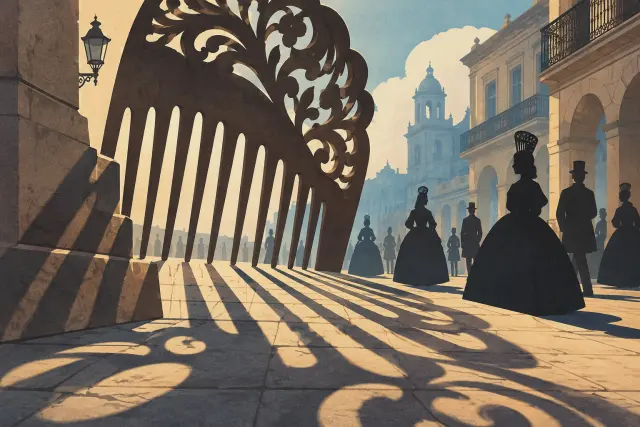
Its size made the wearer’s presence difficult to ignore. On narrow streets it could take up space and impede passage; historical records include a police ordinance concerning pedestrian movement. Newspapers published both praise and criticism, while some caricatures presented the accessory as a nuisance to men in the street. These images speak not only about the object but also about tensions over who could occupy urban space, and on what terms.
Several fashion historians interpret the peinetón as a way of asserting women’s presence in public, at a time when women were strongly associated with domestic life. The reading is compelling, but it should not be taken to mean that every wearer shared a political or emancipatory intention. The same accessory could serve as adornment, a sign of status and a source of controversy; its meaning depended on who wore it, who looked at it and in what circumstances.
Fashion and political identity
During Juan Manuel de Rosas’s government, clothing participated in codes of political identification. Some peinetones incorporated portraits of Rosas, Federalist references or slogans. These pieces show that a fashion object could carry recognizable political signs, but they do not justify claiming that every peinetón expressed partisan allegiance. The connection between accessory and identity is documented for particular models, not as a uniform feature of them all.
Fashion can also be understood in the context of a postcolonial society developing its own ways of distinguishing itself from Spain while remaining in dialogue with European influences. The peinetón did not emerge outside those traditions: it combined Spanish precedents and Western fashion with forms and uses developed locally. Its history shows that cultural identity is not necessarily built by excluding outside influences; it can also take shape through their adaptation and appropriation.
An object preserving many histories
Peinetones and images of the accessory are now held in Argentine museum collections, including the Museo Histórico Nacional, the Museo Histórico de Buenos Aires Cornelio de Saavedra and the Museo Fernández Blanco. Research into their materials, dimensions and ornament is complemented by portraits, lithographs, newspapers and written records. None of these sources alone gives a complete picture; together, they make it possible to examine production, use and representation without treating portraits of a minority as a portrait of society as a whole.
The peinetón’s fashion life was relatively short, but it left a remarkable documentary trace. Artisan labor and consumption, social and racial hierarchies, representations of women and politics all meet in its history. The story shows how an everyday object could attract attention, unsettle conventions of the street and become the subject of public debate.
- Decade
- Before 1950
- Region
- Latin America
- Level
- Enthusiast
- Entities
- Museum, Peinetón, Buenos Aires, Museo Histórico de Buenos Aires Cornelio de Saavedra, Trages y costumbres de la provincia de Buenos Ayres
Sources and references
- Museos de moda del mundo: por qué son archivos vivosinstitutodemoda.com · 2026-11-09
- Verónica Kuhliger: Guardiana del patrimonio cultural ...juanra.substack.com · 2026-11-09
- Los mejores —y más elegantes— museos de moda del ...es.qz.com · 2026-11-09
- Casa sobre el Arroyoes.wikipedia.org · 2026-11-09
- Peinetónes.wikipedia.org · 2026-11-09