From peineta to peinetón
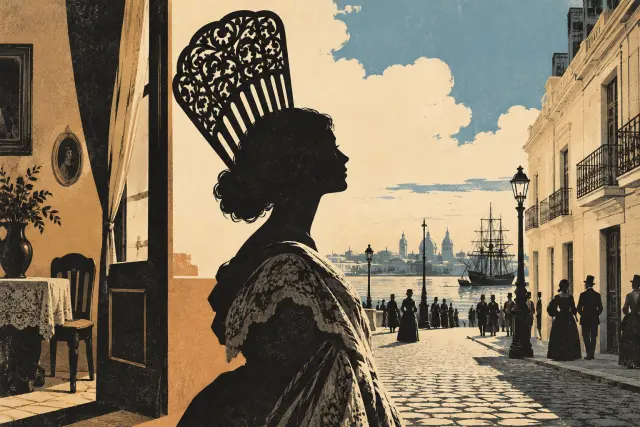
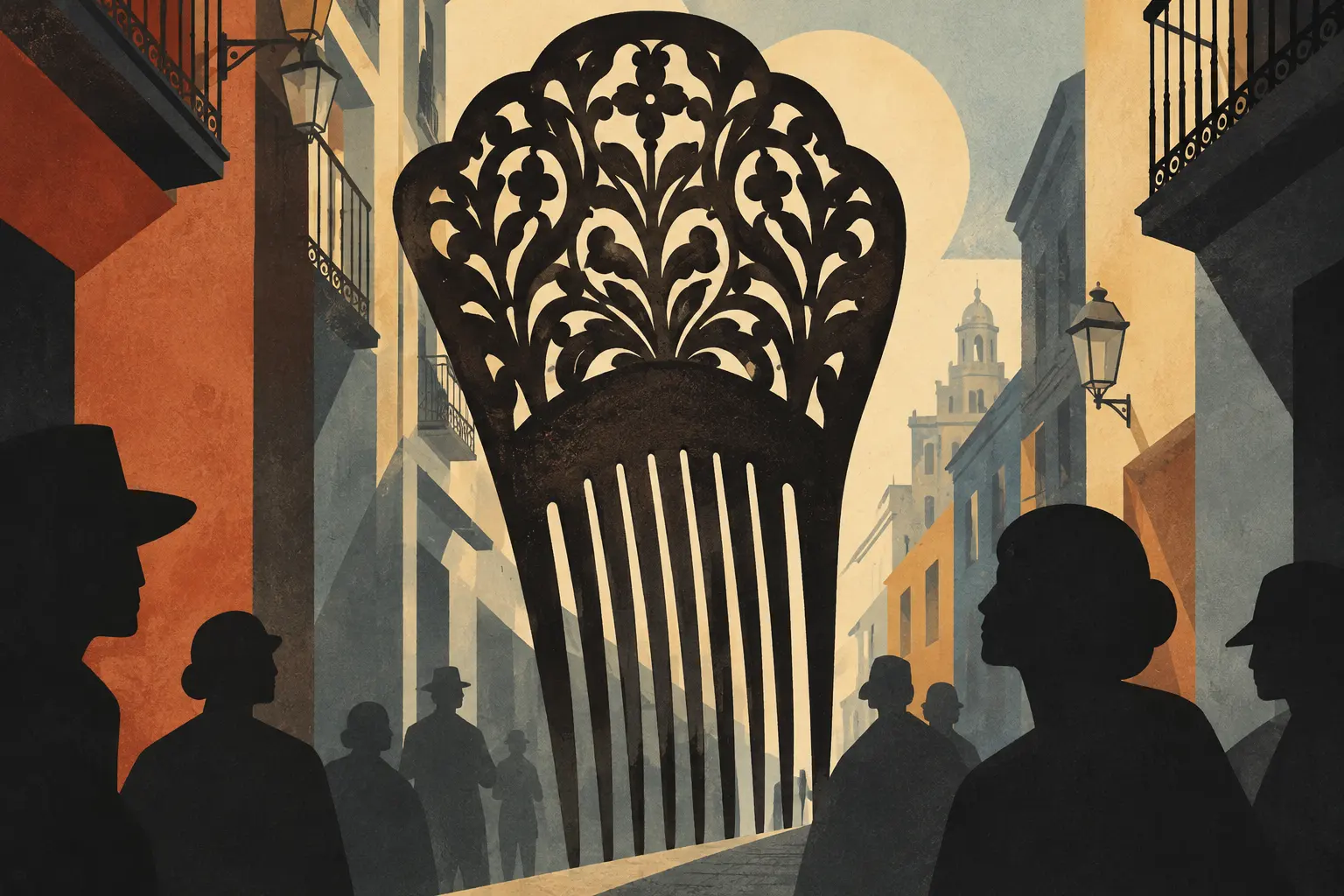
From the late 1820s into the 1830s, an oversized ornamental comb became a recognizable feature of women’s fashion in Buenos Aires and Montevideo. The peinetón grew from the Spanish peineta tradition, but its scale and decoration made it a distinct object. It was more than a hair ornament: extending beyond the wearer’s silhouette, it changed how she occupied the streets and drew comment, satire and curiosity.
The fashion coincided with the Romantic silhouette of narrow waists and voluminous sleeves. Portraits by artists such as Charles Henri Pellegrini show peinetones with these dresses; César Hipólito Bacle’s lithographs, by contrast, record scenes both with and without the accessory. That variety matters. It invites us to consider particular occasions—social life and public outings, as some readings of the images suggest—rather than assume the comb was part of every everyday outfit. Portraits and prints give us specific models and scenes, not a comprehensive account of what every woman wore.
A workshop-made object and a market
Tortoiseshell was the most common material, although horn and other materials were also used. Making a peinetón involved skilled tasks: cutting and softening pieces, joining them, shaping the comb, polishing it and piercing or decorating its surface. Production was concentrated in Buenos Aires workshops and shops, where makers promoted new designs in the press. Manuel Mateo Masculino was a prominent figure, but the invention cannot confidently be assigned to one person. Fashion historian Regina A. Root discusses the interpretation that the peinetón was, rather, a creation of the market and commercial competition, spread by makers and consumers.
The object’s history also depends on who made it. A study by Serafina Perri, drawing on period advertisements and accounts of workshops, describes the involvement of Black enslaved or freed craftspeople alongside workers from other groups. Recognizing their labor changes the story: the peinetón was not only a design choice or a symbol worn by women; it was also the product of artisanal work organized within social and racial hierarchies.
Imported tortoiseshell and specialized labor could make the comb expensive. Accounts of its social reach differ: some studies describe it as a luxury associated with elites, while others note that the fashion inspired aspirations and may have circulated beyond them, even as it remained out of reach for many. Portraits of affluent women cannot, on their own, establish who could afford one or how often it was worn.
Appropriation, politics and public space
The peinetón combined European references with local change. Its relationship to the Spanish peineta and to hairstyles circulating in Europe does not amount to unaltered imitation. Researcher Susan Hallstead has interpreted it as a selective appropriation: a way of transforming elements of European origin within a postcolonial society seeking to express a distinct identity. This describes a historical possibility, not a meaning shared by every wearer.
Newspapers, caricatures and literature preserve both fascination with and disapproval of the comb. Its size prompted comments about navigating narrow sidewalks and inspired satirical images that made it an urban obstruction. During Juan Manuel de Rosas’s rule, some examples incorporated Federalist references or political messages. This supports discussion of specific partisan uses, not the claim that every peinetón carried slogans or that its wearers shared a political affiliation.
The relationship between its scale and women’s presence in the streets is also debated. Regina A. Root has read the peinetón as a means of visibility and intervention in public space, where masculine expectations held sway. Susan Hallstead also emphasizes its ambiguity: the accessory made women’s bodies visible and claimed space, but could restrict movement and provoke criticism that reinforced domestic obligations. The object offers no simple answer about the autonomy of those who wore it. It does, however, reveal how appearance, movement and the right to occupy the city became matters of social negotiation.
What the archive preserves
Peinetones now held in Argentine museums can be studied alongside portraits, prints, advertisements and other documents. Read together, these sources illuminate not only the accessory’s form but also its manufacture, representation and reception. Each kind of document has a different reach: an image records a scene; an advertisement, a commercial strategy; a caricature, a form of commentary. None, by itself, represents every experience of dressing.
That caution does not diminish the peinetón’s interest. It helps us see it as more than a decorative extravagance: an object where craft, consumption, gender, politics and Río de la Plata identity intersected. Its history becomes more precise when the monumental comb is considered alongside the people who made it, the images that represented it and the debates it prompted in the streets.
- Decade
- Before 1950
- Region
- Latin America
- Level
- Enthusiast
- Entities
- Peinetón, Buenos Aires, Peinetón rioplatense
Sources and references
- La moda como herramienta performativa en el museo contemporáneoopenalex.org · 2026-11-11
- Los tejidos en las colecciones de los museos españoles, una larga historia de valoración y conservaciónopenalex.org · 2026-11-11
- Museos de moda del mundo: por qué son archivos vivosinstitutodemoda.com · 2026-11-11
- Verónica Kuhliger: Guardiana del patrimonio cultural ...juanra.substack.com · 2026-11-11
- Peinetónes.wikipedia.org · 2026-11-11