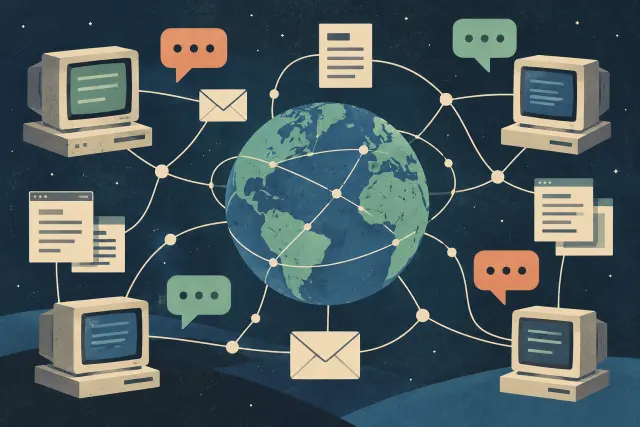
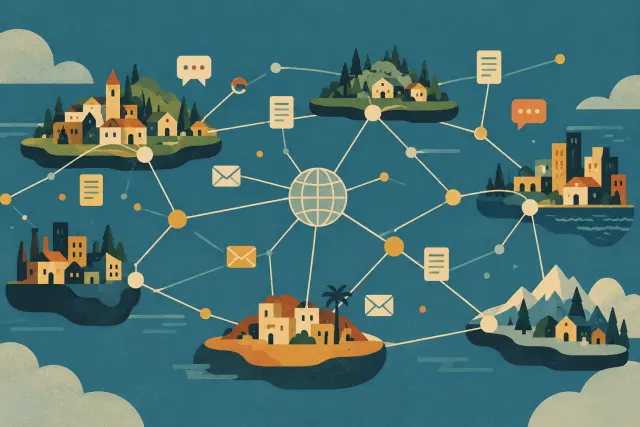
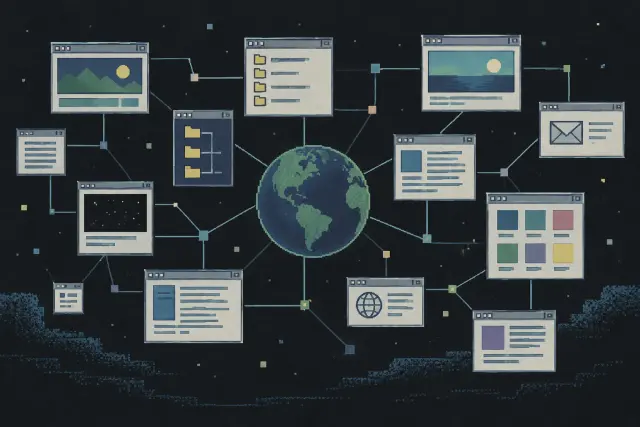
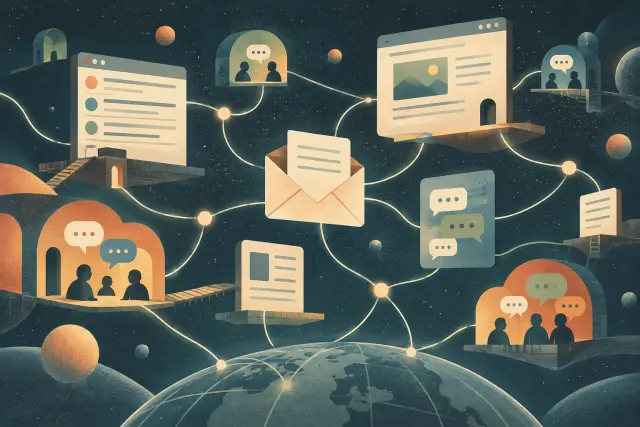
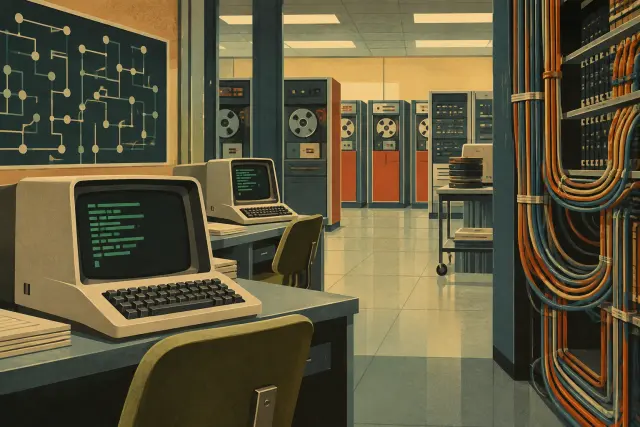
A system for remotely consulting files through linked texts. According to CCCB, its prototype was built in 1991 after HTML was developed at CERN in 1990.

Selected excerpts from our archive offer more context on this subject. Each reading links to the original article and its sources.
World Wide Web: When Browsing Meant Following Links
Treating the World Wide Web as a complete synonym for the Internet erases an important distinction. The available sources describe the Internet as the result of scientific and technological advances, computing languages, media theories, and digital-service companies. Within that setting, the Web was a specific layer: a way to consult remote files through texts that led to other texts.
That nuance matters when considering the “old Internet.” Before browsing became the dominant gesture, the network already carried email, file transfer, and remote access. Internet Society stresses that email was the most important network application for more than a decade. The Web did not instantly replace those uses; it offered another way to organize and travel through distributed information.
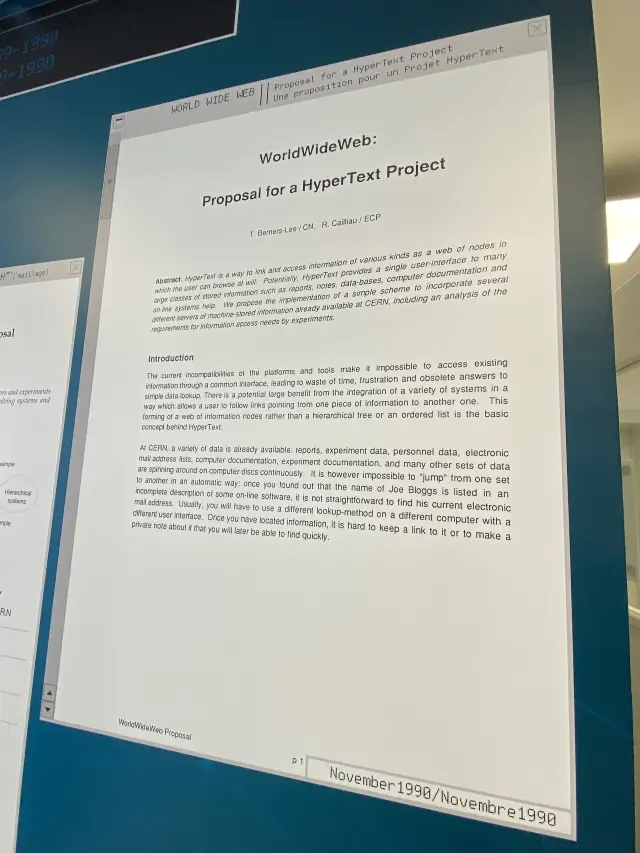
CCCB places a group of CERN physicists led by Tim Berners-Lee in 1990, developing HTML. The same source says that the World Wide Web prototype was built in 1991. That level of precision should be preserved: on the evidence assembled here, it is appropriate to state the language’s development in 1990 and the prototype’s construction in 1991, but not to add undocumented version histories, technical particulars, or numerical claims.
The proposal had a quality that can seem elementary today but was highly expressive at the time: one text could point to another file. A link was not merely visual decoration. It made reading into a possible journey. Rather than receiving a fixed sequence of pages, a visitor could follow associations prepared by the publisher.
The World Wide Web of 1990: When the Internet Began to Be Read Through Links
Speaking about the old Internet as though it had always meant a screen full of pages erases an essential distinction: the Internet already brought together services and networks, while the World Wide Web proposed a particular way of moving through information. The CCCB’s historical overview places the development of HTML and the prototype that would be built in 1991 as the World Wide Web in 1990, by a CERN group of physicists led by Tim Berners-Lee. Its wording matters because it does not treat the Web as an automatic synonym for the Internet: it says that existing network infrastructure was used to make remote queries of files through texts linked to other files.
That distinction changes a retro perspective. It is not accurate to imagine that there was no digital communication before the Web. Internet Society recalls that email was probably the period’s most consequential innovation: it changed collaboration between people and, for more than a decade, became the most important network application. File transfer and remote login through Telnet were important applications too. The Web therefore arrived in an environment with established practices, protocols and users; it did not arrive in a technological void.
The phrase “texts linked to other files” contains the crucial novelty. A file no longer had to remain isolated in a known list, path or machine: it could lead a reader to another file. Linking did not remove the need for someone to organise, publish or maintain information, but it made movement between documents a visible part of the experience.
It is reasonable to interpret this as encouraging less linear reading, although the supplied sources do not allow us to measure how many people adopted it or describe their everyday habits in detail. What can be verified is narrower and firmer: CERN developed HTML and a Web prototype; it used existing network infrastructure and enabled remote consultation through links. From that followed a lasting cultural distinction: the Internet could be perceived not only as separate services, but as a navigable space of connected documents.
KEY FACTS
- Type
- Service
- Year
- 1991
References
- Internet: una historia en construcción | CCCB Lab - CCCBlab.cccb.org
- Historia de internetfib.upc.edu