A change in duration and material
For much of the first half of the twentieth century, recorded music circulated mainly on 78 rpm records, usually made of shellac. They were fragile and offered little playing time per side, so longer works required several discs. The microgroove changed that relationship between medium and duration: Columbia Records officially introduced its LP in 1948, with grooves narrower and shallower than those on 78 rpm records. Turning at 33⅓ rpm, a 12-inch LP could hold around 22 minutes per side, though the exact duration depended on the recording and the cutting process.
The change brought together three elements: a different material, a finer groove and a slower rotation speed. Vinyl, made from polyvinyl chloride, was more flexible and less brittle than shellac. The result made it possible to release more music on a single record and to arrange tracks into sequences that could be heard for longer before the listener turned the disc over. The listener still had to intervene—the record still had two sides—but the scale of home listening had changed.
The LP and the single took different paths
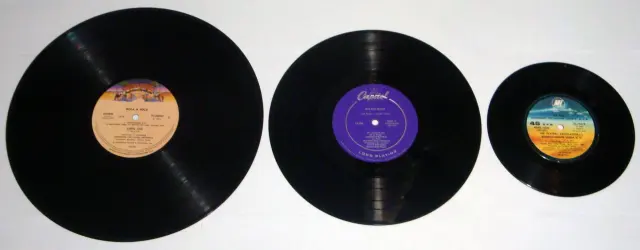
The LP’s arrival did not end the competition to define the postwar record. In 1949, RCA Victor introduced the 7-inch, 45 rpm single. It was a short format suited to distributing individual songs, while the 12-inch LP offered longer playing time. The contest, known as the “battle of the speeds,” involved commercial strategies as well as playback equipment: early records and players from the two systems were not always interchangeable without adapters.
Over time, the formats became associated with different uses. The single made it easy to circulate one song per side; the LP could gather more tracks and arrange them for extended listening. The distinction affected not just duration but also release formats and listening habits. “Album” had previously referred to a collection of 78 rpm records stored in a case. With the LP, the term became associated with a single disc, even though the word outlasted the physical change in format.
The turntable was part of the experience
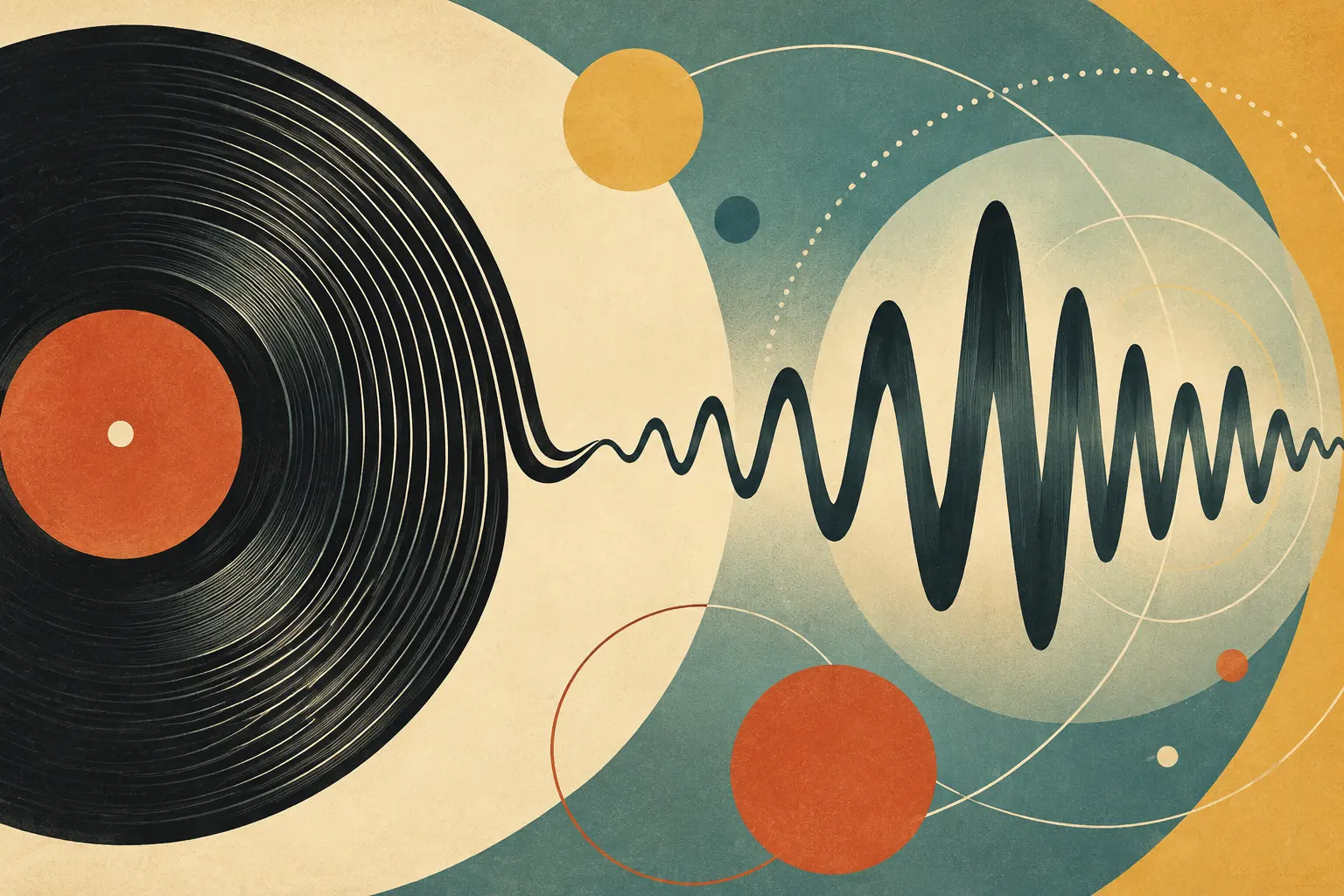
A record needed a machine to become sound. The stylus followed variations in the groove and transmitted its vibrations to a pickup cartridge; the resulting electrical signal had to be amplified for playback through speakers. Home equipment could offer several speeds and adapters, and some models could automatically play a stack of records. Listening involved selecting the record, placing it and setting the speed; on many turntables, each side also had to be handled separately.
The microgroove extended playing time, but it did not make vinyl free of wear. Records could be scratched or warped, dust and grime affected the sound, and the stylus itself could deteriorate. Tracking also became more difficult near the centre, where the linear speed of the groove beneath the stylus decreased. Vinyl offered a relatively long, ordered listening experience, but required careful handling and attention to the equipment.
From stereo to a changing market
Stereo records began to be marketed in the late 1950s and became popular during the following decade. A groove could carry two channels through lateral and vertical stylus movements, and stereo records could be played in mono on suitable equipment. Stereo widened the possibilities for placing sounds in space, although listeners needed a stereo cartridge and playback system to hear the effect.
For decades, the record was the main home format for recorded music. The spread of the cassette introduced another way to listen to and carry music; later, the CD gradually displaced vinyl from the mass market. In the United States, compact-disc sales overtook vinyl sales in 1991. Vinyl production continued on a smaller scale, serving, among other audiences, collectors, audiophiles and disc jockeys. For DJs, direct contact with the record made physical mixing and manipulation techniques possible.
The LP and the single do not represent stages in which one format completely replaced the other, but two ways of distributing music. The LP made duration and track order part of a release’s design; the single preserved a shorter, more manageable form. Their history shows that a format is more than an object: it also determines how much music an edition can contain, what equipment is needed and how listening unfolds.
- Decade
- 1950s
- Region
- North America
- Level
- Introduction
- Entities
- Sounds, Vinilo
Sources and references
- Vestigios para una historia musical de la sociedad chilena en la historia reciente: El Fondo Documental Sello Alerceopenalex.org · 2026-11-04
- Análisis de la Estética Gráfica aplicada a la música popular del Ecuadoropenalex.org · 2026-11-04
- Disco de vinilo - Wikipedia, la enciclopedia libre - Disco de viniloes.wikipedia.org · 2026-11-04
- Hard trancees.wikipedia.org · 2026-11-04
- Disco fonográficoes.wikipedia.org · 2026-11-04