A rivalry that ended in coexistence
The history of records is often reduced to a handover: shellac gave way to vinyl, and 78 rpm was replaced by slower speeds. But the post-war contest between the 33⅓-rpm LP and the 45-rpm single reveals something more significant. The formats did not merely store music differently; they offered different ways to organise, sell and listen to it.
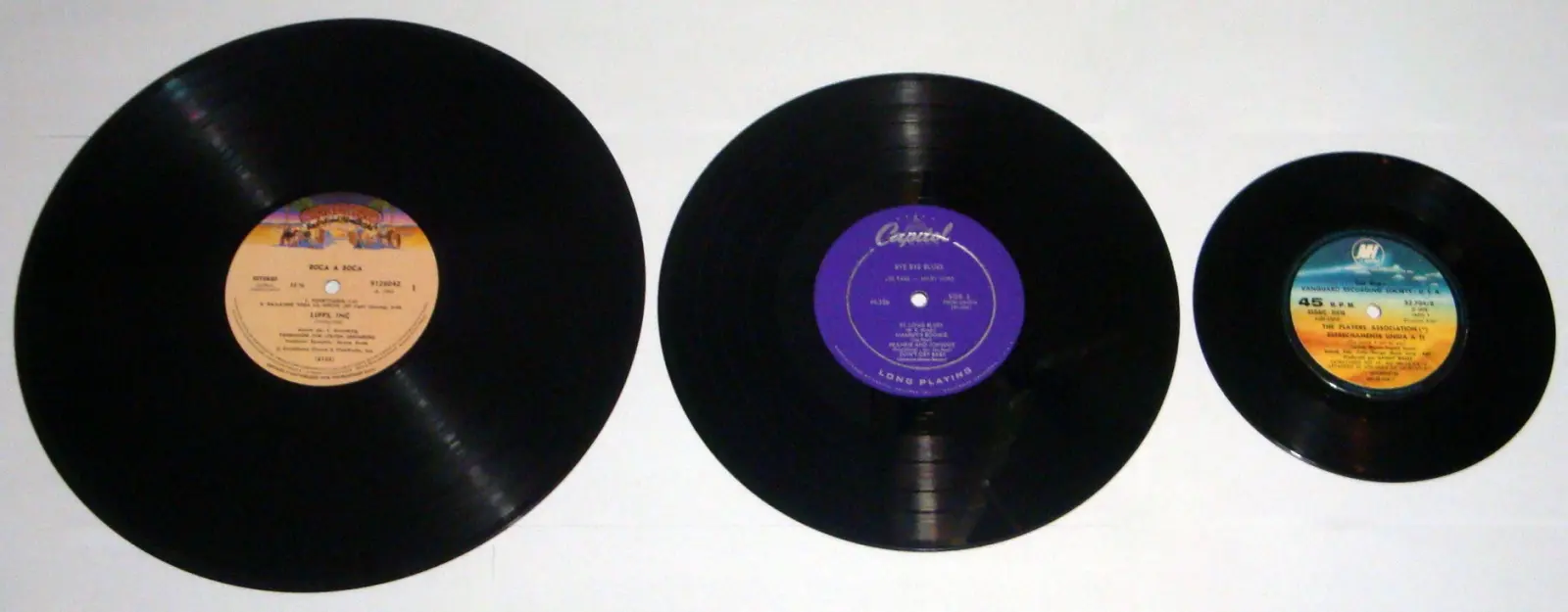
Columbia introduced its microgroove system in June 1948 with a 12-inch LP played at 33⅓ rpm. RCA Victor responded in 1949 with a 7-inch, 45-rpm record aimed at the singles market. The contest became known as the “battle of the speeds”. It did not, however, end with one format defeating the other: the LP suited extended programmes, while the 45 served individual songs.
From short pieces to longer programmes
The 78-rpm record had established a brief unit of listening. A 10-inch disc held about three minutes per side, so longer works had to be divided across several sides or records. The first “albums” were collections of 78s kept in a binder, not single long-playing records.
Microgrooves and a slower speed made it possible to fit more music on one side. Capacity depended on the recording and groove spacing, but an LP could offer roughly twenty minutes or more per side. This reduced the need to interrupt listening to change records and made it possible to present extended repertoires in a planned sequence.
That did not make every album a narrative work conceived as a whole. It did give artists and record labels more options: a collection could include longer pieces or bring together more songs without becoming a series of short records. Playing time became part of how music was presented.
The 45-rpm record served a different purpose. Its size and capacity suited the sale of individual songs, and it worked well with automatic players and record changers. It was not simply a smaller LP, but a format centred on one song or a pair of tracks. For listeners seeking a particular piece, that unit could be more practical than buying a longer programme.
The technology depended on the turntable, too
PVC was less fragile than shellac and made finer grooves possible, two important qualities for microgroove records. But material alone does not explain the transition. Experiments with long-playing records and 33⅓-rpm discs predated Columbia’s commercial launch; some were intended for specialised uses. The spread of the new formats also depended on households having access to compatible players.
A record needs a machine that can follow its groove at the right speed. Speed, centre hole, stylus and turntable mechanism all shape playback. The LP and 45 had different physical characteristics, and accommodating both called for mechanisms, adapters or multi-speed players. Compatibility was a matter of design and cost, not an automatic result of one format’s greater capacity.
That dependence helps explain why the change was not immediate. New records coexisted with 78s, and households did not replace their equipment all at once. The history of the format is also a history of the machines that made it playable.
The sleeve and everyday use
The LP also changed the visual scale of recorded music. A 12-inch cover offered more room for images and text than a single sleeve. Liner notes and the order of the sides could accompany the musical programme, so the record’s physical presentation helped shape how listeners encountered and followed the music.
This does not mean that people always listened to an LP continuously or that singles disappeared. The formats endured because they served different practices: the LP gathered more material and supported a longer listening session; the 45 made it possible to select, buy and play particular songs. Later, DJs took advantage of the direct handling of records and manual control of their rotation, while LPs and singles remained part of listening and collecting.
Greater capacity came with trade-offs
Microgroove increased playing time, but playback still depended on the condition of the record and the equipment. Dust, scratches and wear can affect the sound, and a lower speed does not eliminate those problems. On an LP, groove geometry can also make tracking more demanding towards the centre.
The coexistence of the LP and the 45 shows that record history is not a simple succession of technologies. A format can make one kind of programme more practical while leaving another relevant. The LP made long programmes easier to handle at home; the 45 kept the individual song as a unit of circulation. Together, the formats helped define not only how long recorded music could last, but also how it was selected, ordered and played.
- Decade
- 1950s
- Region
- North America
- Level
- Introduction
- Entities
- Vinilo
Sources and references
- Vestigios para una historia musical de la sociedad chilena en la historia reciente: El Fondo Documental Sello Alerceopenalex.org · 2026-10-30
- El nacimiento del disco de vinilo es ...www.instagram.com · 2026-10-30
- Disco de vinilo - Wikipedia, la enciclopedia librees.wikipedia.org · 2026-10-30
- Surcos a través del tiempo: El formato cambiante del discowww.google.com · 2026-10-30
- Disco fonográficoes.wikipedia.org · 2026-10-30