The process behind the finished image
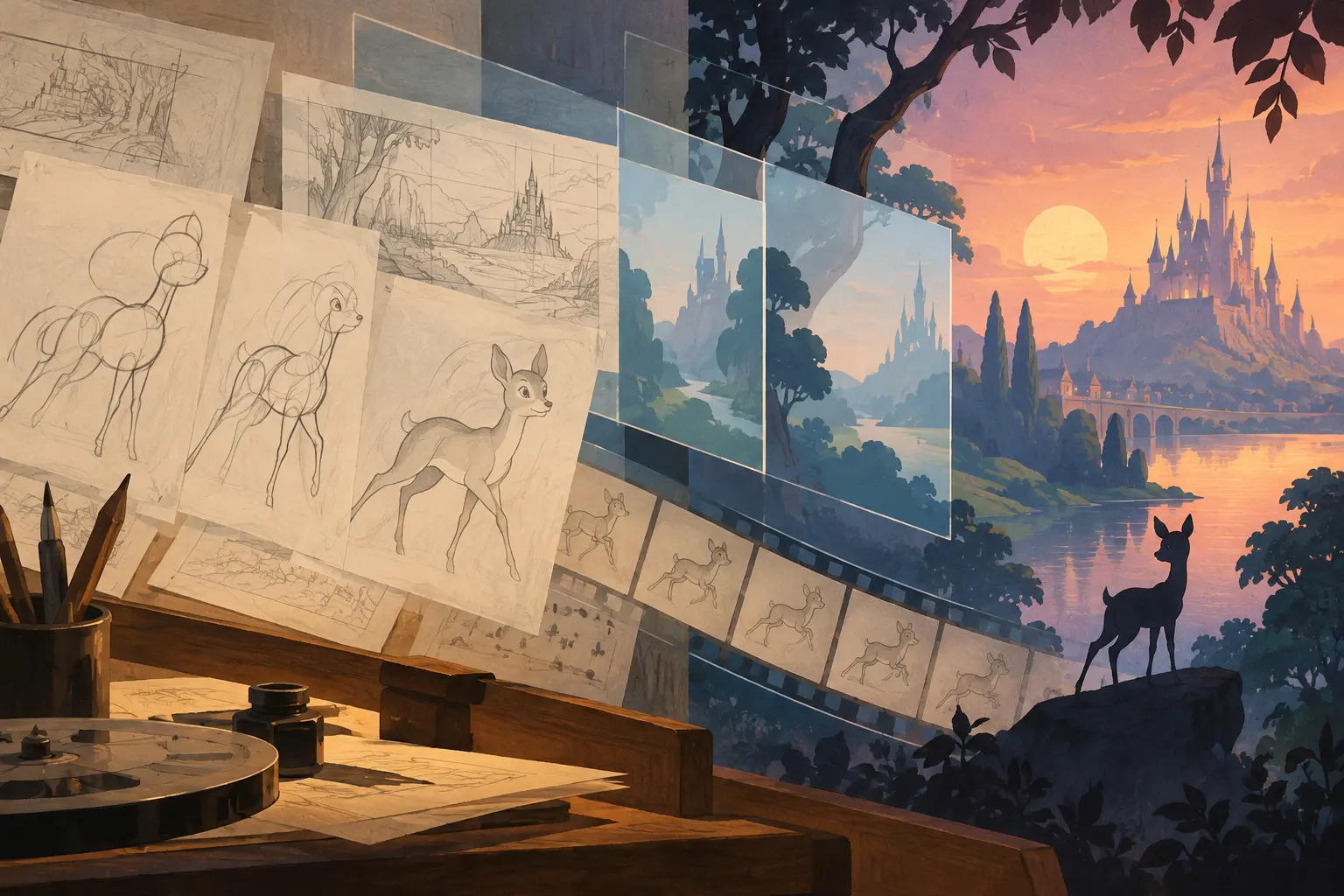
An animated film gathers countless decisions into images that seem to unfold naturally. Production materials offer a view of that process: an animation drawing explores a solution to movement; a story sketch tests how a scene might develop; concept art investigates styles and atmospheres; a background painting establishes space; and a layout drawing organizes staging. These are not flawed or incomplete versions of the film, but documents made for different tasks.
The exhibition The Art of Walt Disney Animation Studios: Movement by Nature, presented at Paris’s Musée Art Ludique from October 2016 to March 2017 in collaboration with the Walt Disney Animation Research Library, brought together 350 objects. Critic Thibaut Clément identifies animation drawings, story sketches, concept art, background paintings, and layout drawings among them. The range matters: treating “production art” as a single, uniform category can obscure what each work was made to do.
From sketches to visual storytelling
Story sketches make it possible to follow a scene through successive images and see how its rhythm takes shape. Clément highlights a sketch for the car chase in One Hundred and One Dalmatians as an example of the iterative, collaborative development of a story. The sequence records more than drawing skill: it shows how actions are ordered, changes anticipated, and alternatives tested before the scene reaches its final form.
In his review, Clément notes that many works in the exhibition appeared as isolated images rather than within the sequences to which they belonged. This presentation can focus attention on the line, but it also makes the document’s role harder to understand. A drawing means something different depending on whether it is a movement test, a framing proposal, or one stage of narrative development. Comparing it with neighboring drawings or the finished shot helps reveal what was retained, transformed, or discarded.
Concept art calls for a different kind of attention. Its proposals may differ substantially from the finished film because they explore possibilities before production unifies the look of characters and settings. Clément points to, among other examples, Mary Blair’s work for Alice in Wonderland, Eyvind Earle’s approach to Sleeping Beauty, and Walt Peregoy’s designs for One Hundred and One Dalmatians. The contrast between these explorations and the finished film brings stylistic choices into view in a way a synopsis cannot. But concept art should not be mistaken for images meant to appear unchanged on screen: its value lies in showing possibilities and decisions in development.
Designing space and point of view
Background paintings and layout drawings do more than decorate. They help organize space and perspective: they shape the elements that establish an atmosphere, the placement of characters, and the vantage point from which action is seen. A finished image may bring together different layers of work; recognizing the documents that contributed to it makes composition visible as a planned decision, not merely an accompaniment to character drawing.
Technical history also belongs in this reading, though naming a technique alone cannot explain its effects. Clément associates the xerographic process with One Hundred and One Dalmatians and notes its visible influence on the outlines. The multiplane camera, mentioned among the exhibition’s production tools, invites questions about how different image planes are combined. Clément argues, however, that the exhibition gave little context for xerography’s effects and offered sparse information about technical processes. To understand a technique visually, it needs to be connected to specific choices and to materials that make those choices available for examination.
Comparison as a way of seeing
Careful viewing begins by identifying the kind of document, the stage of work it represents, and its relationship to a scene. From there, one can examine scale, line, color, composition, and differences between versions. When a sequence or finished image is available for comparison, putting them side by side can reveal both revisions and continuities.
Kevin L. Ferguson’s scholarly study offers a complementary perspective, though it works with a different kind of material. Ferguson analyzes Walt Disney Animation Studios features through composite projections: he gathers samples of film frames and transforms them into images that can be compared. These are not production sketches, nor do they replace examination of the originals. They are an analytical method for finding patterns of framing, lighting, and color across a group of films. The approach also shows how comparison can make visible qualities that are easy to miss when each frame is encountered only within the flow of a story.
The exhibition and Ferguson’s study address different objects—working documents and completed films—but both emphasize the importance of context. An isolated storyboard may look like an illustration; placed within its sequence, it reveals a narrative decision. A background painting can be appreciated on its own; alongside the corresponding shot, it invites questions about its role in the staging.
Understanding each material’s function restores its status as a working tool. It also makes visible the collaboration behind a film’s apparently unified look: development documents reveal individual styles and alternatives, while the finished film brings them together in a shared visual experience. A synopsis tells us what happens; production materials help us understand how what we see was imagined, tested, and constructed.
- Decade
- 1990s
- Region
- North America
- Level
- Enthusiast
- Entities
- Walt Disney, Revisiones, Walt Disney Animation Studios
Sources and references
- Dark Horse: An Overview of Walt Disney Animation Studios’ Horses (1937-2016)doi.org · 2026-11-04
- Digital Surrealism: Visualizing Walt Disney Animation Studiosdoi.org · 2026-11-04
- The Art of Walt Disney Animation Studios: Movement by Naturedoi.org · 2026-11-04
- Walt Disney Animation Studios: Fundación, historia y películas notablescinepremiere.com.mx · 2026-11-04
- Mulanes.wikipedia.org · 2026-11-04